Candles do emit volatile organic compounds (VOCs), and studies detected over 60 different VOCs in scented candle emissions. The good news: exposure modeling and peer-reviewed emission chamber testing generally conclude that, for most people burning candles in a ventilated home, long-term health risk is low. Short-term peaks and sensitive individuals are a different story. Here is what science says, and what you can do right now.
Start here:
- Open a window or run a ventilation fan before lighting any candle
- Trim the wick to 1/4 inch before every burn
- Limit continuous burn time to two to three hours per session
- Choose candles made with phthalate-free fragrances and refined wax
Table of Contents
What are VOCs and why do they matter indoors?
Volatile organic compounds are carbon-based chemicals that vaporize at or near room temperature. That transition from liquid or solid to gas is what makes them inhalable. The term covers an enormous chemical family: terpenes, aldehydes, aromatic hydrocarbons, ketones, and more. Scientists sometimes distinguish very volatile organic compounds (VVOCs, which evaporate fastest) from standard VOCs and semi-volatile organic compounds (SVOCs, which linger on surfaces), but for candle users the practical concern is the same: these compounds enter the air you breathe.
Concentration is the key variable. A trace amount of benzene in a well-ventilated room is a very different exposure than the same compound building up in a sealed bathroom over several hours. The EPA’s indoor air guidance frames risk in terms of concentration and duration, not mere presence. Low concentrations over brief periods generally carry low risk for healthy adults; repeated high-concentration exposures or prolonged contact with certain compounds are where documented harm begins.
“The dose makes the poison” is the oldest principle in toxicology, and it applies directly to candle VOCs. The question is never whether a compound is present — it almost always is — but whether the concentration and duration of exposure cross a threshold that matters for health.
How do candles actually produce VOC emissions?
There are two distinct pathways, and both matter.
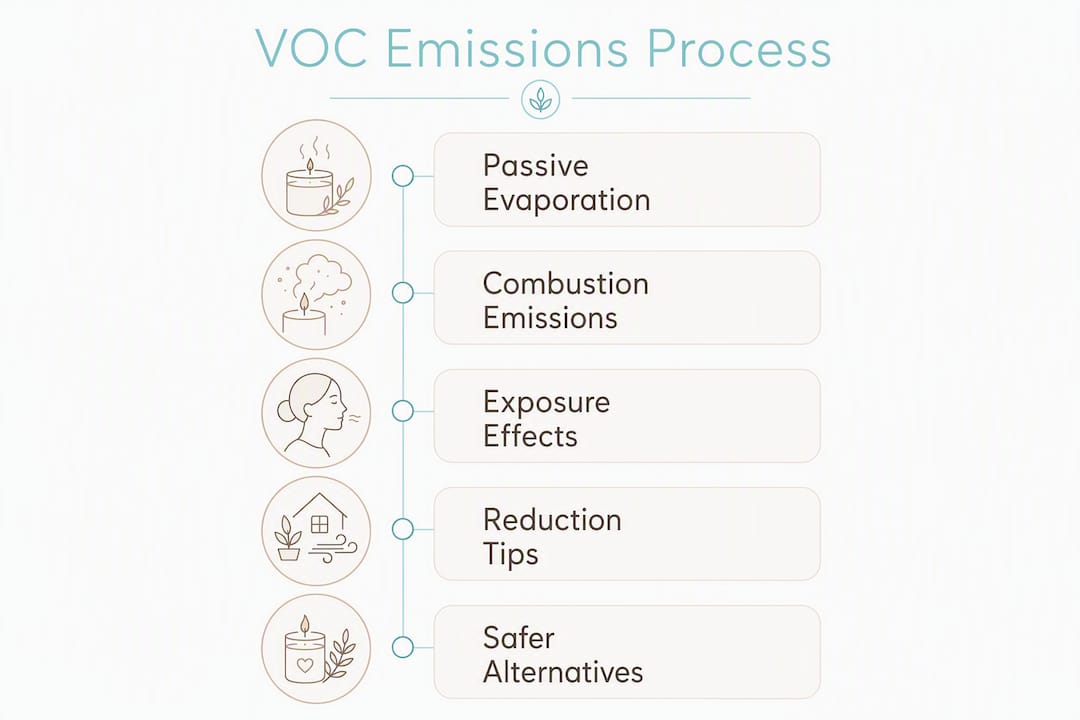
Passive evaporation (unlit candle): Fragrance molecules in the wax have vapor pressure. Even sitting on a shelf, a scented candle releases measurable VOCs into the surrounding air. Warm rooms accelerate this. A candle stored in a hot car or on a sunny windowsill off-gasses more than one kept in a cool cabinet.
Combustion (lit candle): Burning adds a second, more complex layer. The flame oxidizes wax and fragrance molecules, producing combustion byproducts including carbon dioxide, water, soot, and a range of VOCs. Incomplete combustion, where the fuel does not fully oxidize, generates significantly more of the problematic compounds. Unstable burning conditions can increase particulate matter concentrations by approximately 20 times compared to a steady flame.
Here is the sequence from pour to post-burn:
-
Unlit storage: Fragrance evaporates passively from the wax surface; rate increases with ambient temperature.
-
Lighting: The flame establishes; early-burn emissions are often higher as the wax pool forms.
-
Steady burn: A full, stable melt pool with a trimmed wick produces the lowest VOC and particulate output for a given candle.
-
Flickering or drafty burn: Incomplete combustion spikes; soot and combustion-derived VOCs increase.
-
Extinguishing: A sharp spike in ultrafine particles occurs immediately after the flame goes out, especially when blown out rather than snuffed.
Pro Tip: Trim the wick to 1/4 inch before every single burn, and keep the candle away from air vents and open windows that cause flickering. A steady flame is the single most effective thing you can do to reduce incomplete combustion and its associated VOC byproducts. Use a candle snuffer rather than blowing the flame out to minimize the post-extinguish particle spike.
Which VOCs come from candles and what do they do to your body?
Studies have detected over 60 different VOCs in scented candle emissions. The ones that appear most consistently in peer-reviewed literature are worth knowing by name.
| VOC |
Primary source |
Health notes |
| Benzene |
Combustion (paraffin) |
Classified as a known human carcinogen by NCI; chronic exposure linked to leukemia |
| Toluene |
Combustion (paraffin) |
Acute neurological effects at high concentrations; irritant to eyes and respiratory tract |
| Formaldehyde |
Combustion byproduct |
Respiratory irritant; classified as a probable human carcinogen; short-term peaks can trigger asthma symptoms |
| Acetaldehyde |
Combustion byproduct |
Irritant; classified as a possible human carcinogen; detected in most candle burn tests |
| Limonene |
Fragrance (citrus, floral) |
Low acute toxicity; reacts with ozone to form secondary pollutants including formaldehyde |
| Linalool |
Fragrance (floral, lavender) |
Generally low toxicity; can cause skin sensitization at high concentrations |
| Benzaldehyde |
Fragrance (almond, cherry) |
Irritant at elevated concentrations; frequently detected in chamber tests of floral and fruit fragrances |
One number worth knowing: In specific lab tests under controlled conditions, formaldehyde concentrations reached as high as approximately 2,098 ppb for certain scented candles. That figure comes from a chamber study designed to identify hazard potential, not a living-room scenario. Real-world concentrations in ventilated spaces are substantially lower, but the finding illustrates why fragrance load and burn conditions matter.
Benzene and toluene are the compounds that draw the most concern in paraffin candles because they originate from the petroleum-derived wax itself during combustion, not just the fragrance. Limonene is interesting for a different reason: it is relatively harmless on its own, but it reacts with indoor ozone to generate secondary formaldehyde, which means a “fresh citrus” candle in a room with an ozone-producing air purifier can create more formaldehyde than either source would alone.

Do all candles emit VOCs, or does wax type make a difference?
Every candle emits some VOCs. The type and quantity vary by wax, fragrance, and wick, but there is no zero-emission candle.
-
Paraffin wax: Petroleum-derived; produces benzene and toluene during combustion. Higher soot output than plant-based waxes when burned with a long wick or in drafty conditions.
-
Soy wax: Burns cooler and slower than paraffin. Lower combustion-derived VOC output in most studies, though fragrance load still drives total VOC emissions. Plant-based waxes do not eliminate VOCs from the fragrance itself.
-
Beeswax: Often cited as the cleanest-burning natural wax. Produces a harder, higher-melting-point candle with relatively low VOC output. Still emits fragrance-derived VOCs if scented.
-
Blended waxes: Common in commercial candles; emission profile depends on the blend ratio and fragrance concentration.
The “natural” label is where most consumers get misled. A soy candle loaded with synthetic fragrance oil at a high concentration can emit more total VOCs than a lightly scented paraffin candle. Fragrance families like floral and fruit produced higher total VOC values in chamber tests compared to oriental or spice fragrances, regardless of wax type. Health impact is more closely tied to combustion behavior and ingredient purity than to “natural” vs. “synthetic” labels.
Practical warning signs of a high-emission candle: heavy black soot on the jar or nearby walls, a sharp chemical smell during burning (distinct from the intended fragrance), or a wick that mushrooms into a large carbon ball. Any of these suggest toxic ingredients or poor burn conditions worth addressing.
What does the research actually say about health risk?
The short answer from the literature: normal household use in a ventilated space is unlikely to cause long-term harm for most healthy adults. The nuances matter, though.
| Study / source |
Method |
Key finding |
Takeaway |
| Petry et al. (British Candles Association) |
ConsExpo 1-box and 2-box exposure modeling |
Modeled exposures generally fell below indoor/outdoor guideline thresholds for long-term harm |
Normal ventilated use unlikely to cause chronic damage for general population |
| NCA chamber study |
8 m³ stainless-steel chamber, 7-hour burn |
Fragrance type and burn conditions drove VOC variability; floral/fruit fragrances highest |
Fragrance choice and burn stability matter more than wax type alone |
| ScienceDirect lab study |
Emission chamber, GC–MS analysis |
Formaldehyde peaks up to ~2,098 ppb under specific conditions |
Peak values are hazard signals, not typical exposure estimates |
The Petry et al. modeling study used both a simple one-room model and a more detailed two-room model to estimate what a consumer actually inhales during and after burning a candle. The conclusion: concentrations typically remain below levels associated with chronic health damage when ventilation is present. Short-term peaks, however, can trigger symptoms in people with asthma, allergies, or chemical sensitivities, and the same modeling flagged this subgroup explicitly.
For households with children, pregnant people, or anyone with respiratory conditions, the guidance from exposure modeling is consistent: shorter burn times, better ventilation, and lower fragrance loads reduce the peaks that matter most for sensitive individuals.
The American Lung Association and similar public-health bodies list candles among many common indoor VOC sources alongside cleaning products, paints, and adhesives. Candles are not uniquely dangerous, but they are also not neutral. Context and ventilation are the deciding factors.
This article provides general information, not medical advice. If you or someone in your household experiences persistent respiratory symptoms, consult a qualified clinician and check current indoor air guidance from the EPA.
How to reduce your exposure when burning scented candles
These steps, taken together, meaningfully lower both VOC and particulate exposure without requiring you to give up candles entirely.
-
Ventilate before, during, and after: Open a window or run an exhaust fan. Ventilation is the single highest-impact control, consistently identified in exposure modeling as the primary driver of real-world concentration.
-
Trim the wick to 1/4 inch before every burn: Long wicks cause flickering, soot, and incomplete combustion. This one habit cuts particulate output substantially.
-
Limit continuous burn time to two to three hours: Concentrations build over time. Shorter sessions with ventilation breaks keep peaks low.
-
Use a proper candle holder: Stability prevents drafts from reaching the flame and reduces flickering.
-
Keep candles away from air vents, fans, and open windows: Drafts destabilize the flame and drive incomplete combustion.
-
Choose lower fragrance-load candles: Higher fragrance concentration means more passive and active VOC emission. Look for candles that list fragrance percentage or use phthalate-free, refined fragrance oils.
-
Store candles in a cool space: Warm storage increases passive off-gassing from the wax even when the candle is unlit.
-
Extinguish with a snuffer, not your breath: Blowing out a candle causes a sharp spike in ultrafine particles. A snuffer cuts the flame cleanly and minimizes that post-extinguish burst.
-
Ventilate immediately after extinguishing: The particle spike after extinguishing is short-lived but concentrated. A minute of fresh air clears it quickly.
-
If irritation occurs: Stop burning, open windows, and leave the room for several minutes. If symptoms like coughing, headache, or eye irritation persist, consult a clinician.
Pro Tip: For small spaces, a single candle in a room under 150 square feet with no air movement can accumulate VOCs faster than the same candle in an open living area. In tight spaces, crack a window or run a bathroom fan, and consider a shorter burn session.
What are the safer alternatives to burning scented candles?
Alternatives exist, and each has real trade-offs.
-
Flameless wax warmers: Use a low-wattage bulb or heating plate to melt scented wax without combustion. No soot, no combustion-derived VOCs. The fragrance still evaporates and contributes VOCs, but without the particulate load of a flame. Good for frequent, long-duration use.
-
Reed diffusers: Passive evaporation of fragrance oil through reeds. No heat, no combustion. VOC output is lower than burning but continuous. A reed diffuser in a well-ventilated room is one of the lowest-emission ways to fragrance a space.
-
Electric ultrasonic diffusers: Disperse water and essential oils as a fine mist. No combustion VOCs, but essential oils themselves contain terpenes and other VOCs. The total emission is generally lower than a burning candle, though fragrance load and oil quality still matter.
-
HEPA + activated carbon air purifiers: Not a fragrance source, but a meaningful complement to any of the above. A purifier with an activated carbon stage captures both particulates and some VOCs. HEPA alone does not remove gases.
-
Houseplants and ventilation: Plants contribute minimally to VOC removal at household scale, but natural ventilation remains the most effective and free control available.
One caveat worth stating plainly: fragranced plug-in air fresheners and some essential oil diffusers emit VOCs at rates comparable to or higher than a well-managed candle. “Flameless” does not automatically mean lower emissions. Evaluate fragrance load and ventilation the same way regardless of the format. For special occasions or short sessions in ventilated spaces, a well-made candle used with proper burn care is a reasonable choice, not a health emergency.
How do scientists actually measure candle emissions?
Understanding the methods helps you read study headlines critically.
The standard approach is an emission chamber test. A candle burns inside a sealed, climate-controlled chamber of known volume, and air samples are collected at defined intervals. Researchers then analyze those samples using gas chromatography–mass spectrometry (GC–MS), which separates and identifies individual compounds with high precision. Carbonyls like formaldehyde and acetaldehyde require a different technique, typically HPLC (high-performance liquid chromatography), because they react with a derivatizing agent before analysis.
Protocol choices drive results more than most headlines acknowledge. One comprehensive study used an 8 m³ stainless-steel chamber and extended burn tests to 7 hours to reach steady-state sampling, deliberately deviating from the smaller 1 m³ chamber specified in EN 16738. Chamber size, number of candles burned simultaneously, air exchange rate, and whether sampling starts at ignition or after steady state is reached all change the numbers significantly.
Lab peak concentrations are useful for identifying which compounds a candle can produce and at what theoretical maximum. They are not direct predictions of what you inhale in your living room. Translating chamber data into consumer risk requires exposure modeling that accounts for room volume, ventilation rate, burn duration, and use frequency. Read the methods section before citing a headline figure.
The gap between a sealed 1 m³ chamber with no air exchange and a 400-square-foot living room with a cracked window is substantial. Studies that use exposure modeling alongside chamber data, like the Petry et al. work, give a more realistic picture of actual consumer risk than raw emission rates alone.
Key Takeaways
Candles emit VOCs through both passive evaporation and combustion, but ventilation and burn care are the primary levers for keeping exposure at safe levels in most U.S. households.
| Point |
Details |
| VOCs are present in all candles |
Every candle emits VOCs; scented candles have been found to release many different compounds. |
| Normal use is generally low risk |
Exposure modeling finds concentrations typically stay below chronic-harm thresholds in ventilated homes for healthy adults. |
| Sensitive groups need extra care |
Short-term peaks can trigger symptoms in people with asthma, allergies, or chemical sensitivities; shorter burns and better ventilation help most. |
| Ventilation and wick trimming are the top controls |
Trimming to 1/4 inch and opening a window reduce both particulate and VOC exposure more than any product switch alone. |
| Wickandglow’s approach |
Hand-poured soy candles with phthalate-free fragrances, designed to burn cleanly when used as directed with proper wick care. |
The part most candle guides skip
There is a version of this conversation that goes: “paraffin bad, soy good, beeswax best, problem solved.” That framing is too simple to be useful. The research is consistent on one point that rarely makes the headline: fragrance load and burn conditions outweigh wax type as predictors of VOC output. A heavily fragranced soy candle in a sealed room, burned for four hours with a long wick, will produce more concerning emissions than a lightly scented paraffin candle burned for 90 minutes in a ventilated kitchen.
The other thing worth saying: the fear around candles is sometimes disproportionate to the evidence. Cooking on a gas stove, running a gas furnace, or using certain cleaning sprays typically contributes more to indoor VOC load than a single candle burned with reasonable care. That does not mean candles are harmless or that ingredient quality is irrelevant. It means the conversation should be about total indoor air management, not a single product category.
What actually moves the needle: ventilation, burn duration, wick maintenance, and choosing products made with refined, lower-fragrance-load ingredients. Those four things, done consistently, address the majority of the risk the research identifies. The rest is noise.
Wickandglow’s cleaner-burning candles, made for conscious homes
If you have read this far, you already know that ingredient quality and burn care work together. Wickandglow’s hand-poured soy candles are formulated with phthalate-free fragrances and designed to burn cleanly when used as directed, which means trimming the wick, limiting burn time, and keeping the room ventilated. No absolute safety claims here, because no candle earns those. What Wickandglow does offer is a cleaner starting point: plant-based wax, refined fragrance oils free of phthalates, and wick care guidance built into every product.
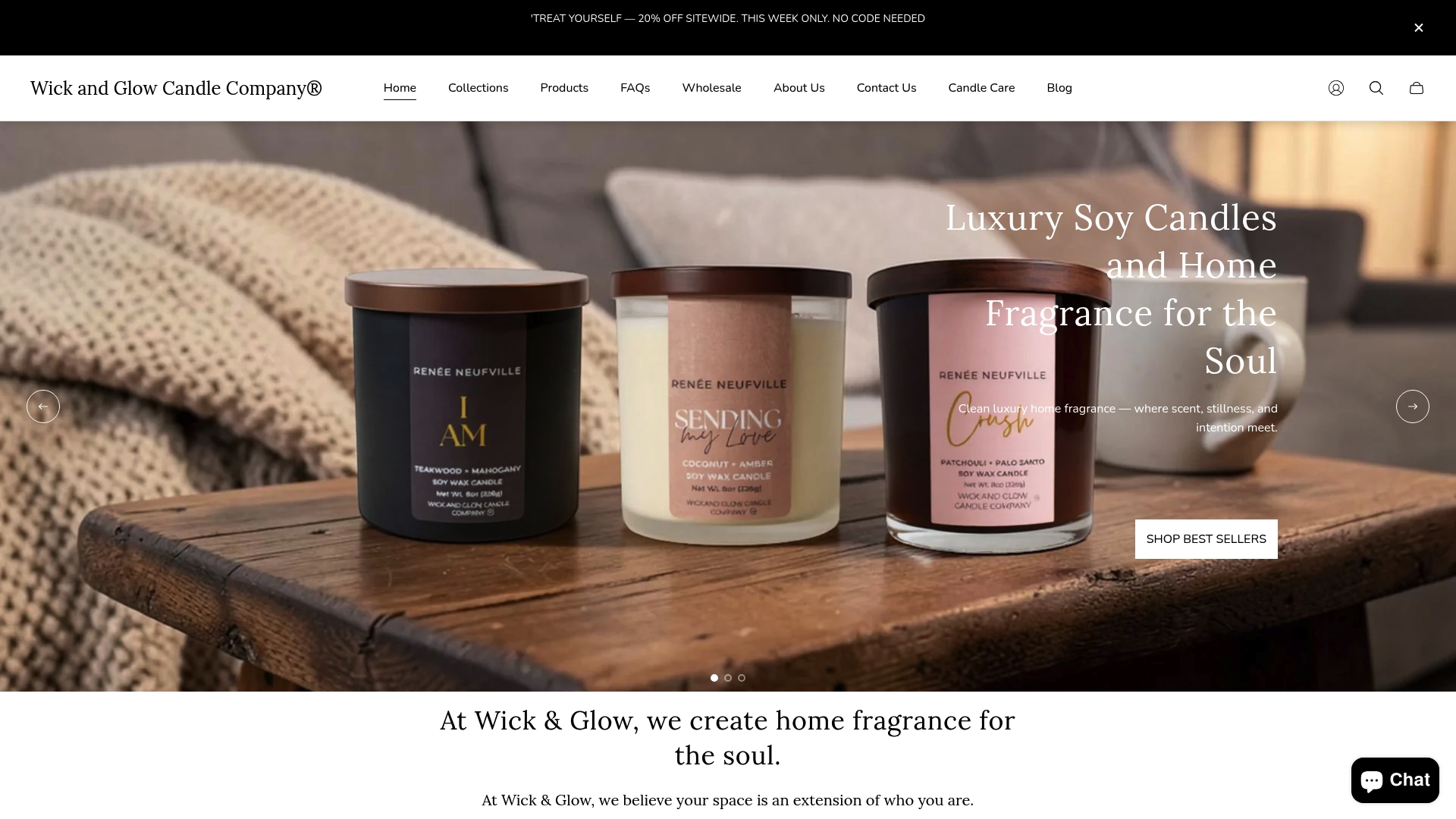
Each candle is also paired with an R&B-inspired playlist, so the ritual of lighting one becomes something you actually look forward to. If you want a flameless option, the reed diffuser delivers continuous fragrance without any combustion at all. For a candle that pairs clean ingredients with genuine craft, the Exhale Luxury Candle is a strong place to start.
Useful sources for further reading
These are the primary sources behind the claims in this article. Each is worth bookmarking if you want to go deeper on the science or regulatory context.
-
Characterization of hazardous and odorous volatiles emitted from scented candles before lighting and when lit (ScienceDirect): The source for formaldehyde peak data and passive off-gassing findings; includes pre-light and post-extinguish measurements.
-
Study on combustion conditions and emissions (Nature, 2025): Documents the approximately 20-fold increase in particulate matter from unstable vs. steady flames; supports the wick-trimming guidance.
-
Scented candles may be cozy — but are they polluting your home’s air? (National Geographic): Accessible summary of the emission research for general readers; covers the 60+ VOC finding and ventilation as the primary control.
-
Are scented candles bad for you? What the science says (CNN Health): Mainstream synthesis of current evidence; includes American Lung Association framing on VOC sources and ventilation.
-
Benzene and cancer risk (National Cancer Institute): Primary source for benzene’s carcinogen classification and the chronic exposure evidence behind it.
-
Frontiers in Public Health — Toxicological evaluation of VOCs from scented candles: Peer-reviewed in vivo toxicology study examining candle emission effects under realistic exposure conditions; useful for understanding biological mechanisms.
-
Cleveland Clinic — Are candles bad for you?: Clinical health perspective on candle emissions; useful for understanding when to consult a healthcare provider about indoor air concerns.
Recommended


