If your reed diffuser smells like nothing even though the bottle is still full, flip the reeds and check where you’ve placed the bottle. Nine times out of ten, the reeds are clogged, the reed count is wrong for the room, or the bottle is sitting near a vent or window that’s carrying the scent away before you ever notice it.
TL;DR:
- Using too few or improperly positioned reeds can significantly weaken scent dispersal, especially in large or drafty rooms.
- Oil formulation with high viscosity or dried, clogged reeds often blocks wicking channels, preventing the oil from reaching the surface.
- Common causes of non-scenting include old or hardened reeds, placement near vents or windows, or a faulty or counterfeit diffuser product.
- Replacing reeds every four to eight weeks and matching reed count to room size improves scent strength and diffuser lifespan.
- Proper troubleshooting involves inspecting the oil, reed condition, placement, and formulation before considering product replacement.
Table of Contents
Reed Diffuser Not Scenting? Try This 6-Step Checklist First
Before you assume the whole product has failed, run through these fast checks. Most of them take under five minutes and solve the problem without buying anything new.
-
Flip the reeds. Pull each stick out, turn it over, and put the wet end up. This exposes fresh, saturated fibers to the air and can restore scent within a day or two.
-
Recount your reeds. A large open living room might need 8 to 10 reeds; a small bathroom or closet only needs 3 to 5. Add or remove sticks to match the space.
-
Move the bottle. Get it away from HVAC vents, ceiling fans, direct sunlight, and drafty windowsills. Airflow disperses scent before it has a chance to build.
-
Wipe the bottle neck and reed tops. Dust and old oil residue can cake around the opening and block the wicking channels.
-
Sniff the oil straight from the bottle. If you can’t smell anything even up close, the issue isn’t the reeds. It’s the formulation or your nose.
-
Swap in new reeds if nothing changes. Old rattan sticks that have hardened or darkened rarely recover no matter how many times you flip or dust them.
If you’ve done all six and still smell nothing, move on to a real diagnosis instead of guessing.
How Do You Diagnose a Reed Diffuser That Won’t Scent?
A quick checklist fixes most cases. The ones it doesn’t fix usually fall into one of four categories: dead reeds, bad placement, a formulation mismatch, or a nose that’s stopped noticing. Here’s how to tell which one you’re dealing with.
-
Check the oil directly. Unscrew the cap and smell the liquid itself. If it’s faint even from an inch away, the oil has genuinely lost strength or was weak to begin with, not the reeds.
-
Get a second opinion. Ask someone who hasn’t been in the room to walk in and tell you what they smell. Olfactory fatigue is a documented phenomenon where your brain tunes out a constant background scent even though it’s still there for everyone else.
-
Inspect the reed tips. Dry, dark, or crusty tips mean the wicking channels inside the reed have closed up. Wet, pale tips mean the reed is still pulling oil just fine.
-
Relocate and retest. Move the whole setup to a different room for 24 hours. If scent suddenly shows up, your original spot was the culprit all along.
-
Think about the timeline. A diffuser that faded gradually over weeks points to normal reed aging or evaporation. One that stopped scenting overnight points to a spill, a clog, or someone moving it near a vent.
Pro Tip: Do the “second opinion” test before you do anything else. It takes thirty seconds and immediately tells you whether you’re chasing a real problem or just used to your own home.
What Actually Causes a Reed Diffuser to Stop Working?
Reeds work through capillary action, tiny internal channels that pull oil upward the same way a paper towel soaks up a spill. Rattan reeds, the classic woody sticks most diffusers ship with, are porous and effective when new, but they can swell in humid air or clog permanently once dust, oil residue, and dried polymers build up inside those channels. Fiber reeds resist that swelling far better, which is why they hold up longer in bathrooms and kitchens.
Oil formulation matters just as much as the reeds themselves. Viscosity determines wickability: oil that’s too thick won’t travel up the reed at all, while oil that’s too thin wicks up fast and evaporates before it ever fills a room. Both produce weak, short-lived scent, just from opposite directions.
Then there’s the room itself:
- Airflow from vents, fans, or open windows speeds up evaporation, which can make a diffuser seem stronger near the source but empty the bottle faster.
- High humidity mutes how fragrance molecules disperse through the air, while heat accelerates the whole process.
- Room size dilutes concentration. The same bottle that fills a powder room can feel invisible in an open-plan living room.
Matching diffuser size, reed count, and oil formulation to your actual room is what SOSA calls “diffusion fit,” and getting that fit wrong is one of the most common reasons a perfectly good diffuser gets blamed for “not working.”
How Many Reeds and How Often Should You Replace Them?
Treat reed count as a volume knob, not a fixed number. More reeds means stronger, faster scent throw; fewer reeds stretches out how long a bottle lasts. Start light and add sticks only if the room calls for it.
-
Small spaces (bathrooms, closets, entryways): 3 to 5 reeds.
-
Medium rooms (bedrooms, home offices): 5 to 7 reeds.
-
Large or open rooms (living rooms, open-plan kitchens): 8 to 10 reeds, or a second diffuser in another corner.
-
Humid rooms: choose fiber reeds over rattan, since porous fiber resists the swelling that closes off wicking channels.
-
Flip cadence: every 1 to 2 weeks under normal conditions, more often in humid climates.
-
Replacement interval: swap reeds entirely every 4 to 8 weeks, or sooner if they’ve darkened and stopped absorbing.
When you refill or switch scents, wipe the bottle neck clean and use fresh reeds rather than reusing old ones. Old reeds carry the previous scent’s residue and will muddy a new fragrance instead of carrying it cleanly. Our reed diffuser care guide walks through the full cleaning routine if you want a repeatable schedule.
Pro Tip: Let new reeds soak undisturbed for about an hour before their first flip. That initial soak saturates the internal channels fully, so the first flip actually exposes a wet, working end instead of a half-dry one.
Why Isn’t the Oil Soaking Up the Reeds?
If you pull a reed out and the bottom two inches are still bone dry after a full day, the oil isn’t wicking properly, and that almost always traces back to one of three things.
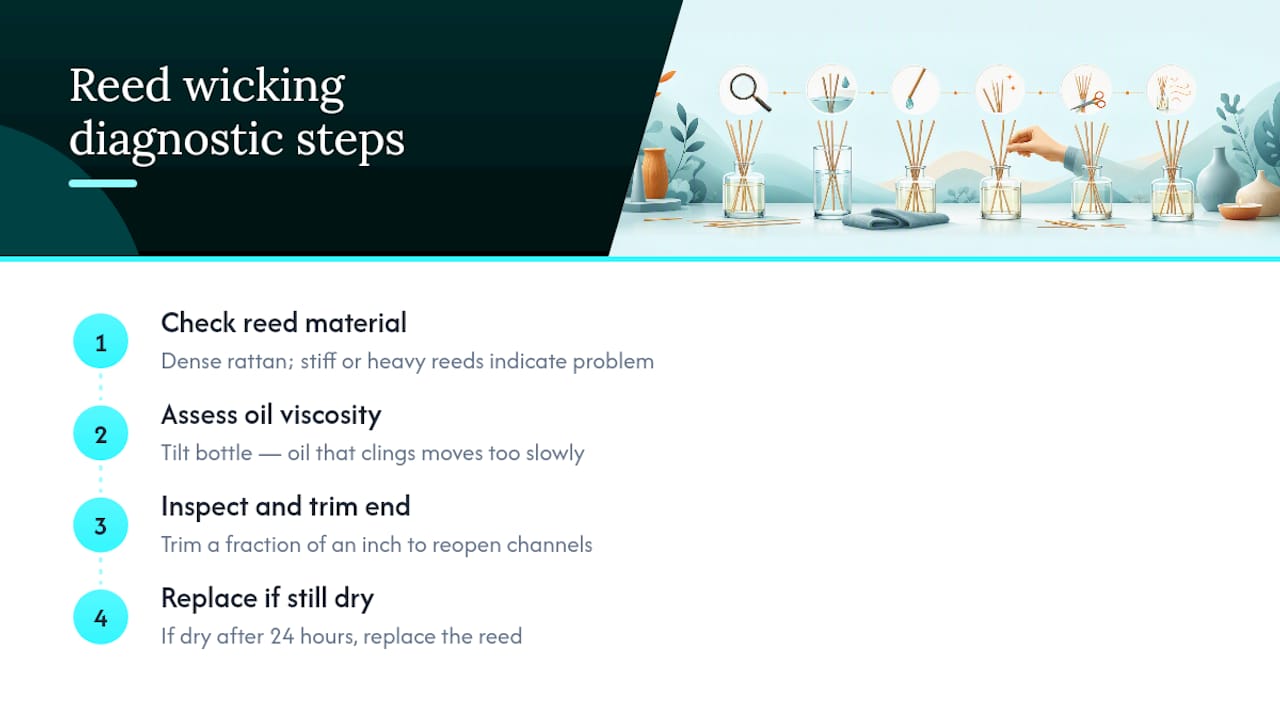
First, check the reed material itself. Cheap, dense rattan sometimes ships with tighter grain than it should have, which restricts how much liquid the capillary channels can pull. If the reeds feel unusually stiff or heavy for their size, that’s your answer.
Second, look at the oil. Thick, syrupy oils sit at the bottom of the reed instead of climbing it. This shows up most with heavily scented or oil-diluted formulas where the carrier wasn’t balanced correctly for reed use. You can test this by tilting the bottle and watching how the oil moves. Oil that clings to the glass and moves slowly is too viscous for consistent wicking.
Third, check for a seal or blockage at the reed’s cut end. Reeds are cut to expose the porous channels, and a rough or resin-clogged cut can seal off absorption before it starts. Trimming a fraction of an inch off the bottom with clean scissors sometimes opens a fresh, unobstructed surface and restarts the wicking process immediately.
If you’ve ruled out all three and the reed still won’t take on oil after 24 hours, the reed itself is likely defective rather than the formulation, and it should be replaced rather than fought with.
Could a Manufacturing Defect Be the Real Problem?
Not every underperforming diffuser is a placement or maintenance issue. Sometimes the product itself left the factory flawed, or it’s not what it claims to be.
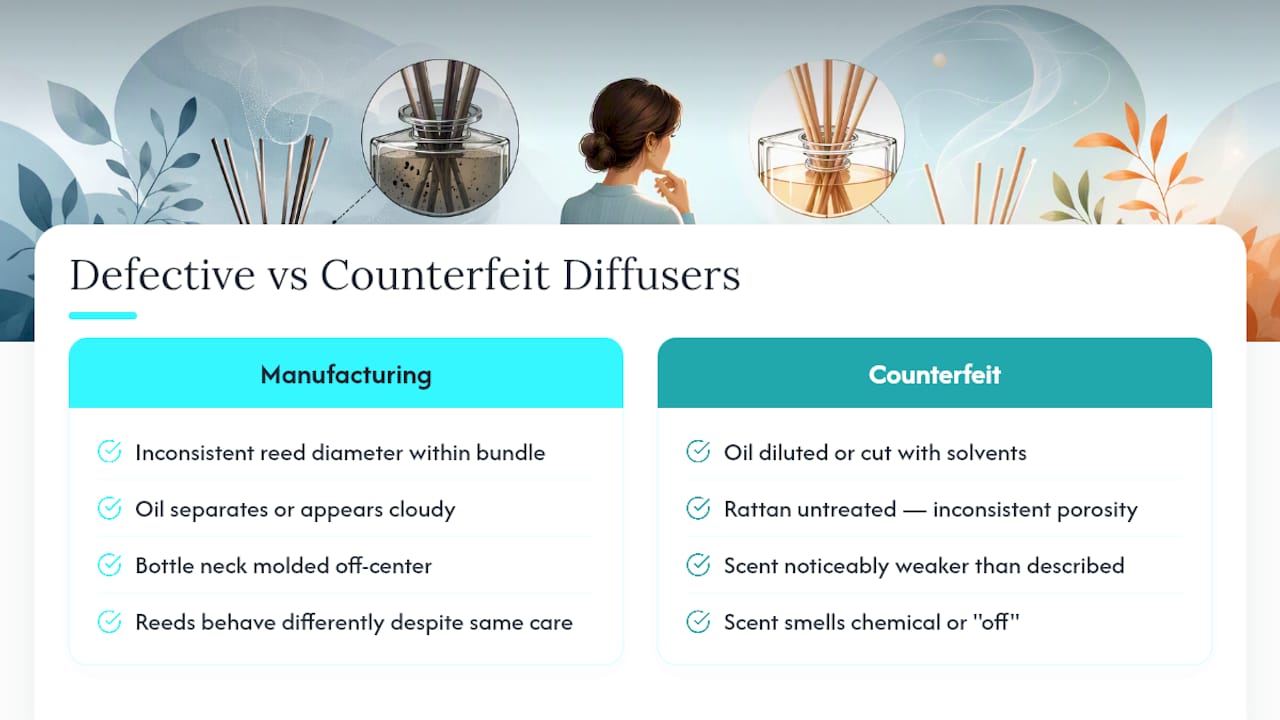
Genuine manufacturing defects usually show up as inconsistent reed diameter within the same bundle, oil that separates or looks cloudy when it shouldn’t, or a bottle neck that’s molded slightly off center, which throws off how evenly reeds sit and absorb. If several reeds from the same set behave completely differently from each other despite identical treatment, that inconsistency points to poor quality control rather than something you did wrong.
Counterfeit or gray-market diffusers are a separate issue, particularly for diffusers bought through third-party marketplace sellers rather than a brand’s own site. These often use diluted oil, cut with cheap solvents to stretch volume, or dressed-up rattan that was never treated for consistent porosity. The tell is usually a scent that’s noticeably weaker than described, or one that smells “off” or chemical rather than true to the labeled fragrance notes.
If a diffuser fails these checks right out of the box, before any humidity, sunlight, or airflow could have degraded it, the fix isn’t more flipping or more reeds. It’s returning or replacing the product through a legitimate retailer or the brand directly, since no amount of troubleshooting fixes an oil that was under-strength from the start.
Does Bottle Shape Change How Well a Diffuser Works?
Container design affects diffusion more than most people assume. A narrow-necked bottle concentrates its reeds close together, which increases oil contact per reed but also means the reeds compete for the same limited surface area at the opening. That crowding can slow evaporation slightly since less air moves across each individual stick.
A wide-necked bottle spreads reeds farther apart, exposing more of each stick’s surface to open air. That generally means faster, more even evaporation, and it’s part of why apothecary-style wide-mouth diffusers tend to throw scent more aggressively than slim glass tubes with the same reed count and oil.
Neither shape is inherently better. Narrow necks suit small rooms where you want a controlled, longer-lasting throw. Wide necks suit larger rooms where you need scent to fill space faster, but they’ll also burn through oil more quickly. If you’ve matched your reed count and oil formulation correctly and you’re still underwhelmed, the bottle’s neck width is worth checking, since a narrow, low-airflow design can bottleneck an otherwise perfectly good setup.
Wick & Glow’s Perspective: What Most People Get Wrong
Most complaints we hear trace back to two habits: too many reeds crammed into a small bottle, and reeds left untouched for months without a flip. Neither is a formulation failure, it’s setup.
We pair our oils with reed types chosen for how they wick, not just how they look, because a beautiful reed that clogs in three weeks isn’t doing anyone favors. Fiber-leaning reeds paired with a properly balanced carrier oil resist the swelling and uneven evaporation that plague cheaper rattan-and-thin-oil combinations.
Picking the right diffuser size and reed count for your room matters more than which scent you choose. A gorgeous fragrance in the wrong bottle for your space will always underperform.
— B
Ready to Replace a Diffuser That Just Won’t Cooperate?
If you’ve flipped, dusted, relocated, and recounted reeds and you’re still smelling nothing, it’s probably time to stop troubleshooting a diffuser that was never formulated to last. Wickandglow builds its reed diffusers around oil viscosity and reed pairing specifically chosen to avoid the clogging and uneven throw that kill most drugstore versions within weeks.

Our glass reed diffuser with a hanging stand is sized right for bedrooms and smaller rooms where oversized bottles usually overwhelm the space, and the reed-to-oil ratio is tuned so you’re not fighting evaporation speed from day one. If you’re shopping for a gift or want to try a full sensory set, the Scenting My Love Trio pairs a diffuser with complementary pieces so you get consistent scent across a room without guessing at reed count. Browse the Men Love Candles Too collection if you’re picking a gift, or head to Wickandglow to find a formulation that fits your space and skip the troubleshooting altogether.
Sources


