
- Article published at:
- Article author: Wick and Glow
- Article tag: en
- Article comments count: 0
Discover why handcrafted gifts hold more emotional value than store-bought ones, reflecting love and effort that touch hearts deeply.
Learn More
Drawer menu

Fragrance reinforces and amplifies the mood a room’s color already suggests, creating memory-anchored harmony between what you see and what you smell. Cross-modal correspondence, the brain’s habit of linking senses that have no logical connection, is why a pale blue bedroom feels calmer with lavender in the air, and why the same room smells “off” with a sharp peppermint. Interior design psychologist Amber Dunford calls scent an “invisible designer” that links past experience to present design choices. Multisensory researcher Charles Spence has spent years documenting how personal memory, not just chemistry, decides whether a scent lands.
One striking data point: in a scented-room study on peppermint, 86.67% of participants recognized the scent instantly and tied it to a specific memory. That’s the mechanism at work. Get the color and scent talking to each other, and the room feels finished. Get them wrong, and something feels subtly off even if neither element is “bad” on its own.
Fragrance works with color, not around it, because both senses feed the same memory system that decides whether a room feels calm, energized, or welcoming.
| Point | Details |
|---|---|
| Match affective proximity | Pick scents whose emotional tone sits close to the room’s color on calm-to-energetic and clean-to-warm scales. |
| Align arousal with color intensity | Vivid colors want stimulating scents like citrus; muted, cool colors want calming notes like lavender or cedar. |
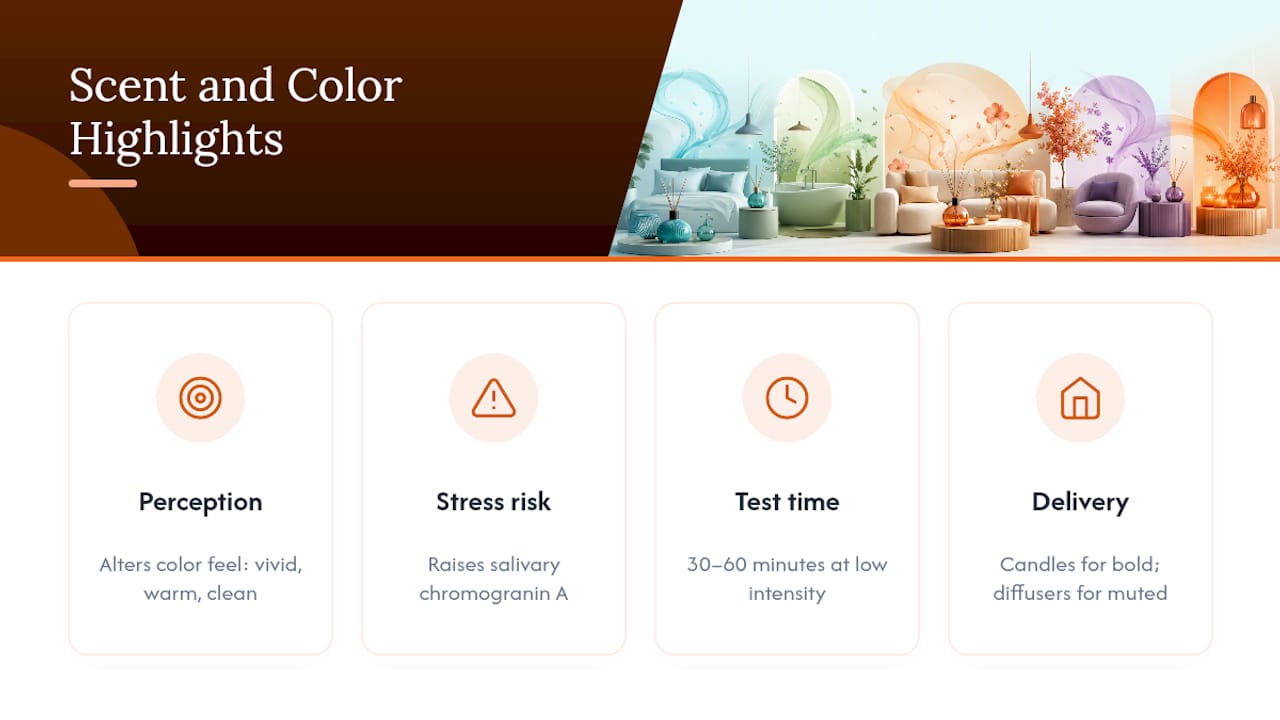
| Test before committing | Burn or diffuse a candidate scent at low intensity for 30 to 60 minutes and track your reaction before buying more. |
| Match product to room saturation | Bold, social rooms handle a candle’s full throw; quiet, desaturated rooms do better with a diffuser or low-intensity candle. |
| Choose Wickandglow for color-matched blends | Wickandglow’s Exhale, Can We Talk, and Scenting My Love Collection are built around specific color-driven moods, not generic scent profiles. |
The standard term for this effect in sensory design research is cross-modal correspondence, the phenomenon where one sense (smell) shapes how you perceive another (color, brightness, even temperature). Homeowners usually just call it “matching scent to a vibe,” but the science behind it is well documented, and it explains why the same candle can feel perfect in one room and wrong in another.
The clearest evidence comes from a pair of experiments using roughly 100 participants each, which extracted two affective dimensions researchers labeled MILD and CLEAR. Fragrances and colors were rated independently on these dimensions, and the smaller the distance between a color and a scent on MILD and CLEAR, the more harmonious the pair felt to test subjects. Distance predicts disharmony. Proximity predicts a sense that the room “makes sense.”
Charles Spence’s research on ambient scent argues that a fragrance’s emotional payoff depends less on the odor itself and more on the personal associations it triggers, meaning the strongest color-scent matches are the ones that bridge a visual cue to an intentional memory.
The physiological side backs this up. Multimodal studies tracking salivary chromogranin A, a stress marker, found that mismatched color-scent pairs (think peach fragrance against a dark navy wall) raised stress indicators, while aligned pairs calmed the nervous system measurably. Visual cues tend to dominate when people first imagine a “pleasant” room, but scent does something color can’t: it locks the mood to a specific memory. That’s the piece most home design conversations skip entirely.
Four rules cut down the trial and error considerably.
Pro Tip: Test any new candle or diffuser at low intensity first. Let it burn or diffuse for 15 to 30 minutes before judging the pairing. Fragrance builds gradually, and an early verdict is almost always wrong.
Getting deliberate about this process, rather than grabbing whatever candle smells nice in the store, is the foundation of intentional home fragrance, and it’s the difference between a room that smells nice and one that feels designed.
Room function and room color usually point toward the same answer, but not always. Here’s how the pairing breaks down by space.
For choosing scents room by room, the general rule holds across every space: let the color tell you the emotional register, then pick the scent family that speaks the same language.
The delivery method matters almost as much as the scent itself, because intensity has to match the visual weight of the color it’s supporting.
Candles throw warmth and a stronger short-term scent presence, which suits bold, saturated, social rooms. Reed diffusers deliver a steady, low-intensity presence that suits quieter, desaturated palettes where you want the scent felt rather than announced. Sprays give an instant but short-lived boost, useful for a quick refresh before guests arrive rather than all-day ambiance.
Wickandglow’s lineup is built around this logic. The Exhale Luxury Candle and Can We Talk Luxury Candle both carry a full, room-filling throw suited to bolder color schemes, while the Scenting My Love Collection™, created with Renée Neufville, leans into layered, story-driven blends for spaces meant to feel intimate and considered. For a broader safety perspective on open flame in the home, it’s worth reading up on the tradeoffs between incense and candles before committing to daily use in any room.
Treat it like a small home experiment rather than a guess.
Track a short checklist each round: perceived harmony with the color, emotional response, intensity level, memory triggered, and how guests react if anyone else is present.
This kind of testing works especially well when you’re mixing diffuser and candle scents across a shared space, since layered aromas need more careful calibration than a single candle in a single room.
We treat fragrance as part of the room’s design language, not an accessory to it. Every Wickandglow candle is hand-poured with clean, vegan, phthalate-free ingredients, and our collaboration with Renée Neufville on the Scenting My Love Collection grew directly out of this idea: a scent should carry a color’s emotional intention forward, not compete with it. We lean on research into scent’s role in interior design when developing new blends, because the goal has never been just a nice smell. It’s a room that feels resolved.
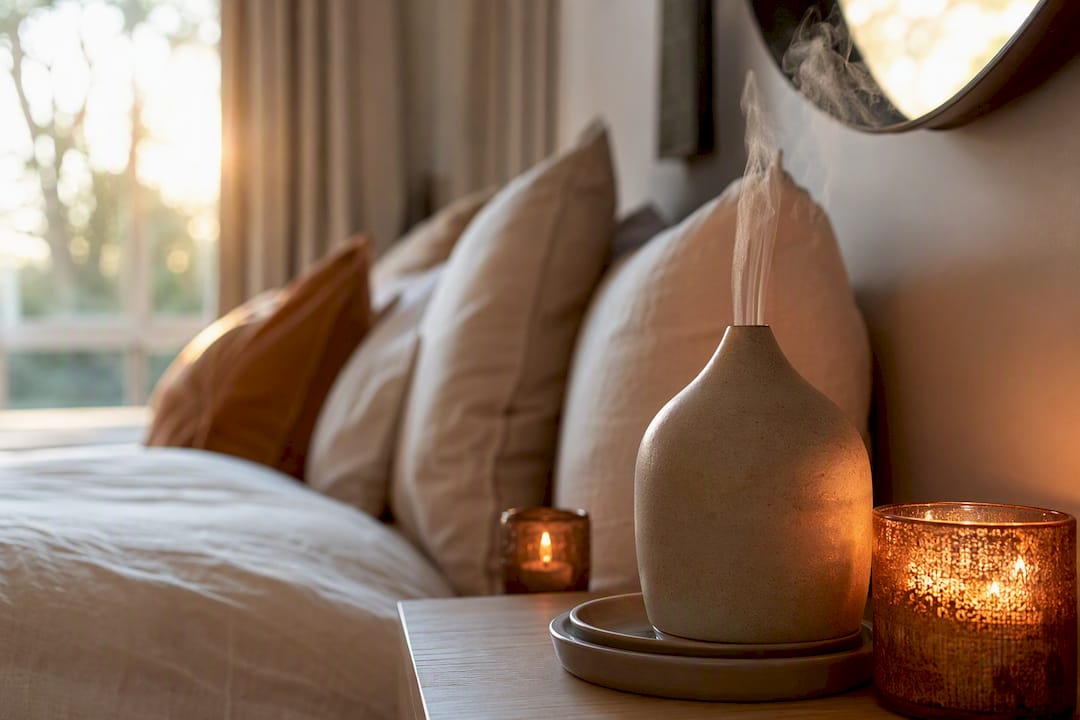
Reading about MILD and CLEAR factors is one thing. Smelling the difference in your own living room is another. If you’re working with a warm, saturated palette, the Exhale Luxury Candle is built for exactly that register, cozy, layered, and strong enough to hold its own in a social space.
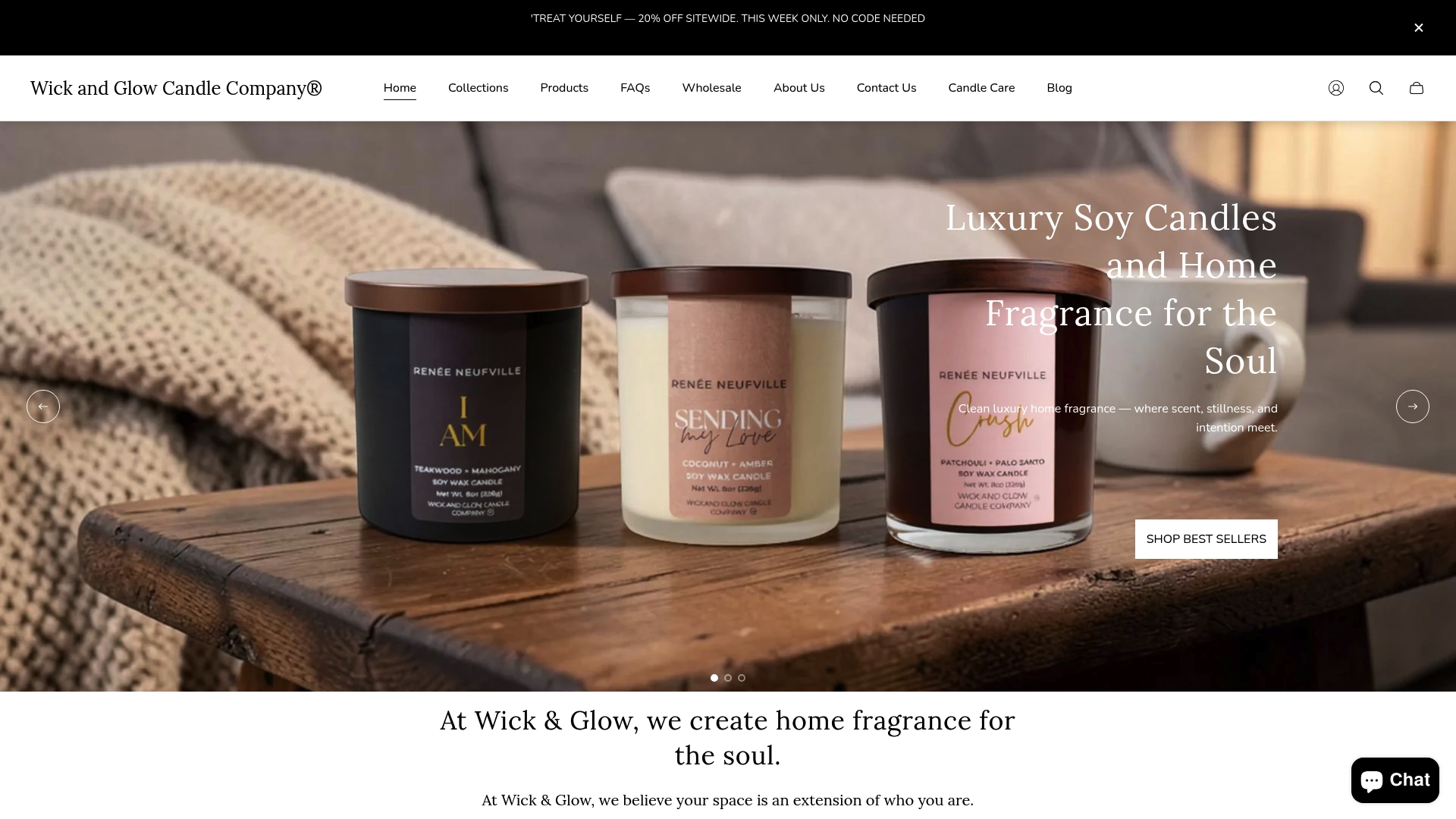
If your target room leans quieter or more intimate, the Can We Talk Luxury Candle fits a bedroom or reading nook without overwhelming a desaturated palette. And if you want a fragrance with a story behind it, one built around real emotional memory rather than a generic scent name, the Scenting My Love Collection™ with Renée Neufville was made for that. Not sure where to start? Pick up the 8-oz Feels Good candle as a low-cost way to test one pairing before committing to a full-size candle for every room in the house.
Does scent actually change how you perceive a color, or just the mood in the room? Both. Experimental work on affective dimensions shows scent can shift how vivid, warm, or clean a color appears to feel, not just how the room’s overall mood registers.
Can the wrong scent-color pairing actually cause stress? Measurable physiological markers like salivary chromogranin A rise in response to mismatched pairs, so a genuinely disharmonious combination isn’t just an aesthetic misstep, it registers in the body.
How long should I test a new candle before deciding if it works in a room? Give it 30 to 60 minutes at a lower burn intensity, then reassess. Fragrance builds gradually, and first impressions within the first few minutes are usually unreliable.
Do diffusers or candles work better for supporting a room’s color scheme? Candles suit bolder, saturated color schemes because of their stronger throw. Diffusers suit muted, desaturated palettes where a steady, low-intensity presence fits better.
What if my favorite scent doesn’t technically “match” my room’s color? Personal memory and association can override the general framework. A scent tied to a strong positive memory often works even when it falls outside the typical affective pairing rules.

