
- Article published at:
- Article author: Wick and Glow
- Article tag: en
- Article comments count: 0
Discover why handcrafted gifts hold more emotional value than store-bought ones, reflecting love and effort that touch hearts deeply.
Learn More
Drawer menu

A single whiff of pine or vanilla can drop you back into a childhood living room faster than any photograph. That happens because smell is the only sense with a direct highway to the brain’s memory and emotion centers, skipping the filtering stop every other sense has to make. Olfactory signals bypass the thalamus and travel straight into the olfactory bulb, which fires almost instantly into the amygdala and hippocampus, according to Harvard Medicine Magazine. At Wickandglow, that wiring is the whole reason a candle can feel less like decor and more like a memory box. Research on granule cells in the PLOS Biology study of over 600 volunteers even suggests why so many of these memories trace back to childhood.
Fragrance triggers vivid, emotional memories because olfactory signals bypass the thalamus and route directly into the amygdala and hippocampus, with early-life exposure encoded especially strongly.
| Point | Details |
|---|---|
| Direct neural route | Smell skips the thalamic filter that sight and sound go through, hitting emotion and memory centers faster. |
| Two-stage retrieval | Odor memory requires recognition first, then associative retrieval, which follows a U-shaped familiarity curve. |
| Childhood imprinting | Long-lived granule cells formed early in life appear to store many of our most vivid scent memories. |
| Emotional resistance | Scent memories resist being overwritten, which makes them both comforting and hard to unlearn when negative. |
| Practical use | Positive autobiographical scents, used sparingly and with intent, can support mood and stress management. |
The chain starts at the nose. Odor molecules bind to olfactory receptors lining the nasal cavity, and those receptors send electrical signals into the olfactory bulb, sitting just above the nasal passages and technically part of the brain itself.
From there, the path gets interesting. Every other sense (sight, sound, touch) routes through the thalamus first, a kind of relay station that filters and organizes incoming information before passing it along. Smell mostly skips that step. Signals from the olfactory bulb project almost directly into the amygdala, which handles emotion, and the hippocampus, which handles memory formation, according to both Harvard Medicine Magazine and a Cleveland Clinic summary on smell and memory. Fewer stops means faster, rawer access to the parts of your brain that decide how something feels.
That shortcut has a measurable effect. Studies comparing scent-triggered recall to visually triggered recall find greater amygdala activation and higher self-reported emotional intensity for the smell condition.
Statistic Callout: Scent-triggered memories consistently produce stronger amygdala activity and higher reported emotional intensity than the same memories triggered by a photograph or written cue, per Harvard Medicine Magazine.
Picture it as two mail routes to the same office. Sight and sound go through a receptionist who screens and sorts everything first. Smell has a private door straight to the desk of the person in charge of how you feel.
This isn’t an accident of anatomy. Smell was one of the earliest and most survival-critical senses for early humans and their ancestors: it flagged spoiled food, signaled predators, helped with navigation, and carried social and reproductive information. Wiring that sense directly into memory and emotion centers meant a single bad experience with a scent could get permanently flagged as dangerous, without needing repeated exposure to learn the lesson. Commentary from Harvard neuroscience panels frames this as adaptive shortcut logic: survival favored fast, emotionally weighted smell memory over slower, more deliberate processing, as described in the Harvard Gazette.
Smelling something and remembering something specific are two separate cognitive events, and researchers increasingly describe odor-evoked memory as a two-stage process.
Stage one is recognition. Before your brain can retrieve a memory, it has to notice and identify the odor at all, and that depends heavily on how emotionally strong the scent is and how easily you can put words to it. A 2025 study of 106 participants found that odors with high emotional potency and clear verbal labels were recognized and processed far faster than vague or emotionally neutral ones.
Stage two is associative retrieval, where recognition turns into an actual memory. Interestingly, this stage follows a U-shaped curve tied to familiarity: both very rare, novel odors and deeply familiar ones trigger stronger retrieval, while moderately familiar smells tend to fall flat.
The term “Proustian memory” comes from Marcel Proust’s famous madeleine passage, where a bite of cake unlocks a flood of childhood recollection. Recent neuroscience gives that literary moment real biological backing. Research described in Scientific American points to long-lived granule cells in the olfactory bulb, cells generated very early in life, that appear to capture and store positive scent associations formed in childhood.

A PLOS Biology-linked study surveying more than 600 volunteers found this pattern held up in self-reported experience: people consistently described their most vivid, emotionally positive scent memories as originating in early childhood, not adulthood. If that early window is when these granule cells are laid down, it would explain why the effect skews so heavily young.
Two things remain genuinely unsettled. First, the positive bias itself; researchers don’t yet fully know why childhood scent memories seem to skew pleasant rather than neutral or negative. Second, translatability, since much of the granule-cell work originates in mouse models, and how closely that maps onto human olfactory bulb development is still being worked out.
Because the amygdala gets involved before conscious thought does. This is sometimes called emotional primacy: you feel a reaction to a smell before you’ve even identified what it is, a hallmark of how direct the olfactory-to-amygdala route really is, per a PMC review on odor-evoked memory.
There’s also a stubborn quality to these memories. Odor associations show unusual resistance to retroactive interference, meaning the first strong association you form with a smell tends to stick around even after repeated later exposures that might otherwise overwrite it, according to the MDPI review. That’s a double-edged trait: it’s why a comforting childhood scent stays comforting for decades, and it’s also why a scent tied to a traumatic event can remain a trigger long after other memories of that event have faded.
Statistic Callout: Reviews consistently find odor-evoked memories are rarer, more emotionally intense, and clustered earlier in life than memories triggered by other senses, per PMC.
Yes, within reason. Review literature finds that odors linked to positive autobiographical memories can lift mood, lower self-reported negative states, disrupt cravings, and even reduce physiological stress markers, per the MDPI review and a related PMC review. None of this makes fragrance a cure for anything. It’s a mood and ritual tool, not a treatment.
A few ground rules make it work better. Choose scents already tied to a genuinely good memory rather than picking something because it’s trendy. Watch for habituation. Wearing the same fragrance daily dulls its power as a distinct memory cue, so save meaningful scents for meaningful moments. And test new scents in low-stakes settings first, since not every fragrance carries a positive association for every person, even when the notes sound universally pleasant.
Pro Tip: Build a reliable personal scent cue through evaluative conditioning: pair a specific fragrance with the same calming ritual, like reading before bed, and repeat it consistently over several weeks rather than daily. Spacing the exposures out helps the brain form a strong, singular association instead of a diluted, background one. A home fragrance ritual built this way tends to outlast one you fall into by accident.
Plenty is still open. Researchers don’t fully understand why some negative scent memories prove just as durable as positive ones, despite the general positive bias seen in early-life encoding. The exact neural coding for complex, real-world fragrance blends (as opposed to single, lab-isolated odor molecules) remains murky, and individual differences in olfactory sensitivity are large and not well mapped.
Most human studies also work with a limited scent palette in controlled lab settings, which doesn’t fully reflect how people actually encounter fragrance day to day. Future work on granule-cell mapping and translational therapy trials could sharpen these answers considerably, but for now, the honest position is: the mechanism is real, well-supported, and still only partially understood.
At Wickandglow, this research shapes something concrete: pairing each candle with a curated playlist isn’t a gimmick, it’s an attempt to layer two memory-forming senses at once, sound and smell, around a single intentional moment. We’re not claiming any candle treats anxiety or replaces therapy. What the evidence supports is more modest and more useful: a consistent, positive scent ritual can shift mood in the moment. If you want to see how that plays out practically, our piece on fragrance and home atmosphere goes deeper into the everyday side of it.
If you’re ready to put any of this into practice, start with a fragrance built around genuine emotional intent rather than a random shelf pick. The Come Inside candle pairs a warm, layered scent profile with its own curated playlist, giving you both sensory channels working toward the same mood in one sitting. For fragrance built specifically around masculine-coded scent memory, the Men Love Candles Too collection is worth a look, and readers interested in how cultural scent traditions shape fragrance design might also enjoy browsing OudHaven’s Ard Al Zaafaran line for a different take on scent-driven ritual.
Why does fragrance memory connection exist in the first place? It exists because olfactory signals bypass the thalamus and connect almost directly to the amygdala and hippocampus, the brain’s emotion and memory centers, according to Harvard Medicine Magazine. No other sense has that shortcut.
Why do scents trigger memories more strongly than photos or songs? Because the neural route is shorter and less filtered.
Why are so many scent memories from childhood? Long-lived granule cells formed early in life appear to encode childhood scent associations, and a study of over 600 volunteers linked this mechanism to unusually vivid, positive childhood scent memories.
Can using the same fragrance regularly weaken its power as a memory cue? Yes. Habituation dulls a scent’s emotional impact over time, so reserving a meaningful fragrance for specific rituals rather than daily wear helps it stay a strong, distinct cue.
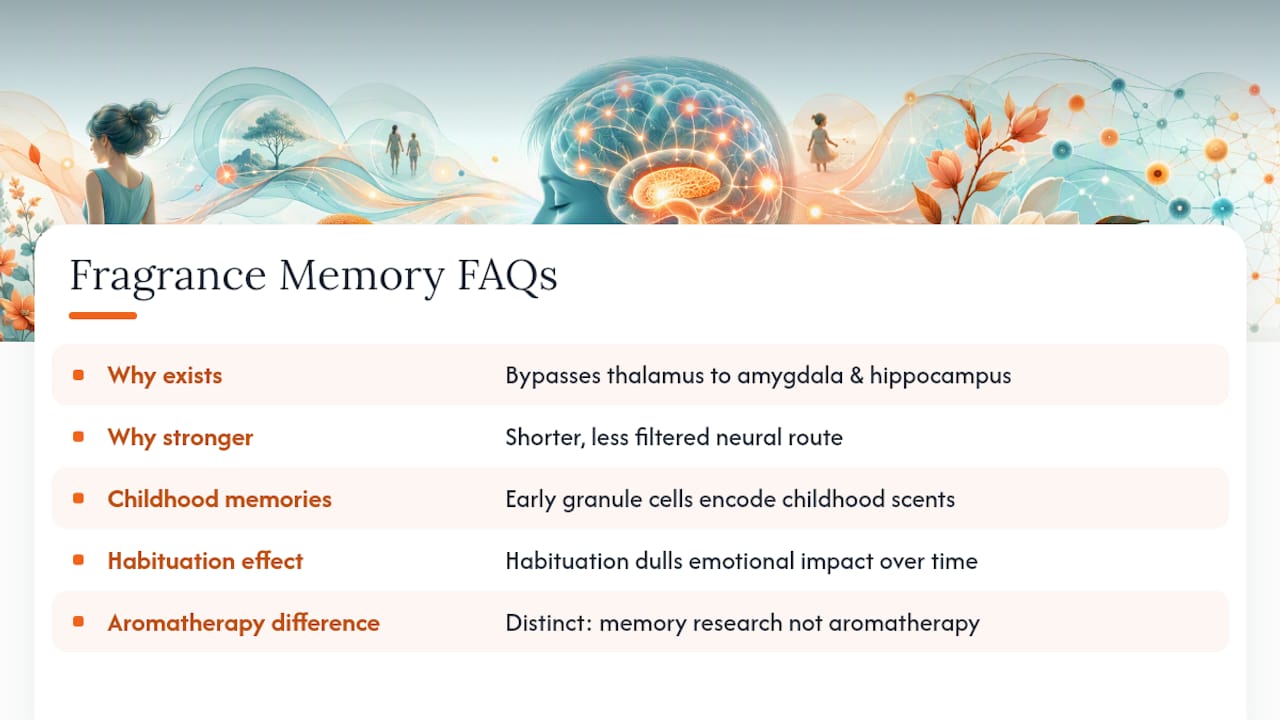
Is fragrance memory the same thing as aromatherapy? Not exactly. Odor-evoked memory research focuses on how specific autobiographical scents affect mood and stress, while aromatherapy makes broader wellness claims about essential oils that aren’t grounded in the same body of evidence.

