Dim, warm lighting reliably makes many scents read stronger because the brain reallocates attention away from visual processing and privileges olfactory input instead. That shift is not subtle or anecdotal. Peer-reviewed studies using NIRS and fMRI imaging show measurable changes in orbitofrontal cortex activation when lighting and fragrance align, and controlled consumer experiments confirm that reduced brightness increases perceived scent intensity.
Two things you can try right now:
-
At home: Dim your living room lights to a low level and light a warm, gourmand or woody candle. Give it five minutes. The base notes will arrive faster and feel more present than they would under bright overhead lighting.
-
At a venue or dinner table: Swap a cool-white bulb for a warm-white one with a lower color temperature before guests arrive. The fragrance in the room will register as richer before anyone consciously notices the light has changed.
TL;DR:
- Sensory compensation: when visual input drops, the brain leans harder on smell
- Cross-modal harmony: NIRS studies confirm the orbitofrontal cortex activates more strongly when light and scent feel congruent
- Wickandglow products are formulated with this effect in mind, pairing warm, complex fragrance profiles with curated mood playlists.
Pro Tip: Warm-white bulbs under 2700K are the single fastest upgrade for a fragrance-forward room. You do not need a dimmer switch — a lower-wattage warm bulb in a table lamp works just as well.
Table of Contents
What does the research actually show about lighting and scent?
The evidence spans controlled lab work and messier real-world tests, and the two do not always agree.
Core studies at a glance
The pattern across lab studies is consistent: dim or warm lighting increases reliance on non-visual senses. The field studies are more cautious. When researchers moved into actual retail or restaurant environments, layering scent with music and lighting simultaneously often produced no measurable sales lift. The likely culprit is sensory overload combined with poor congruency between the cues. A restaurant that pipes in heavy incense, plays loud music, and dims the lights to near-darkness is not amplifying scent. It is competing with itself.
Lab findings are also typically measured in controlled conditions where participants focus on a single stimulus. Real rooms have competing smells, distractions, and variable attention. That gap between lab and field is worth keeping in mind before redesigning an entire space around one study.
How does your brain process scent differently under dim light?
Three mechanisms work together, and understanding them separately makes the practical advice much easier to apply.
Sensory compensation
The brain allocates processing resources dynamically. When visual input drops, as it does in a dim room, the brain does not simply go idle in its visual cortex. Resources shift toward other sensory channels, particularly smell and taste. Controlled experiments that limited participants’ vision with dark-tinted glasses or dim rooms consistently produced more favorable and more intense sensory ratings for single-dimension stimuli. The effect is strongest when the scent is uncomplicated enough for the brain to process cleanly. A single-note vanilla or a focused woody accord benefits more than a dense, multi-layered fragrance that demands more cognitive work to parse.
Cross-modal integration in the orbitofrontal cortex
The orbitofrontal cortex sits at the intersection of sensory streams. It receives input from vision, olfaction, taste, and touch simultaneously, and it is where the brain assigns emotional labels to sensory experience. NIRS research shows that when a lighting color feels harmonious with a fragrance, the left OFC activates more strongly and more quickly than when the pairing feels mismatched. That faster activation means the emotional label, “cozy,” “intimate,” “warm,” arrives sooner and with more conviction.
“Lighting colors judged sensually harmonious with a fragrance activated the orbitofrontal cortex more than colors selected based on imagery alone, suggesting a physiological basis for cross-modal harmony that goes beyond personal preference.”
Analysis of harmony between color and fragrance in lighting environments, PMC 2022
This is why congruency matters more than simply dimming the lights. A warm amber candle under a cold blue-white LED will not trigger the same OFC response as the same candle under a warm 2700K lamp. The brain reads the mismatch and the emotional amplification stalls.
Mood priming and emotional labeling
Warm, dim light primes a relaxation and intimacy state before the scent even registers consciously. That emotional context changes how the brain interprets the fragrance. The same sandalwood that smells pleasant in a bright kitchen can feel deeply comforting in a candlelit room, not because the molecules changed, but because the emotional frame around them did. The brain builds a narrative around scent using visual cues, and dim lighting nudges that narrative toward warmth and closeness. Scents that align with that narrative, gourmand, woody, amber, read as more intense and more appropriate to the moment.
How do you use dim lighting to actually enhance scent at home?
Knowing the science is one thing. Translating it into a room you can sit in is another.
Step-by-step scene setup
-
Choose your light source first. Select a warm-white bulb at or below 2700K. A single table lamp or a cluster of candles works better than overhead fixtures because the light stays low and directional, which keeps the visual field dim without making the room feel unsafe.
-
Set the primary light source to a low lumen output appropriate for creating a dim ambiance. That is roughly the output of a single candle cluster or a low-wattage Edison bulb. Ambient fill from secondary sources (a hallway, a TV on standby) is fine.
-
Pick a congruent fragrance family. Under warm, dim light, gourmand (vanilla, caramel, tonka), woody (sandalwood, cedar, vetiver), and amber or resinous scents perform best. Their base notes are already dominant in the fragrance profile, and the lighting accelerates how quickly those notes register. Warm, dim light emphasizes mid and base notes, while cool, bright light extends top notes like citrus and ozonic accords.
-
Place your fragrance source at nose height or below. Candles on a coffee table or a diffuser on a low shelf project scent into the breathing zone more efficiently than a shelf above eye level. For room sprays, a single spritz at the center of the room, about four feet from the floor, distributes evenly. See Wickandglow’s guidance on candle placement for maximum scent for room-specific advice.
-
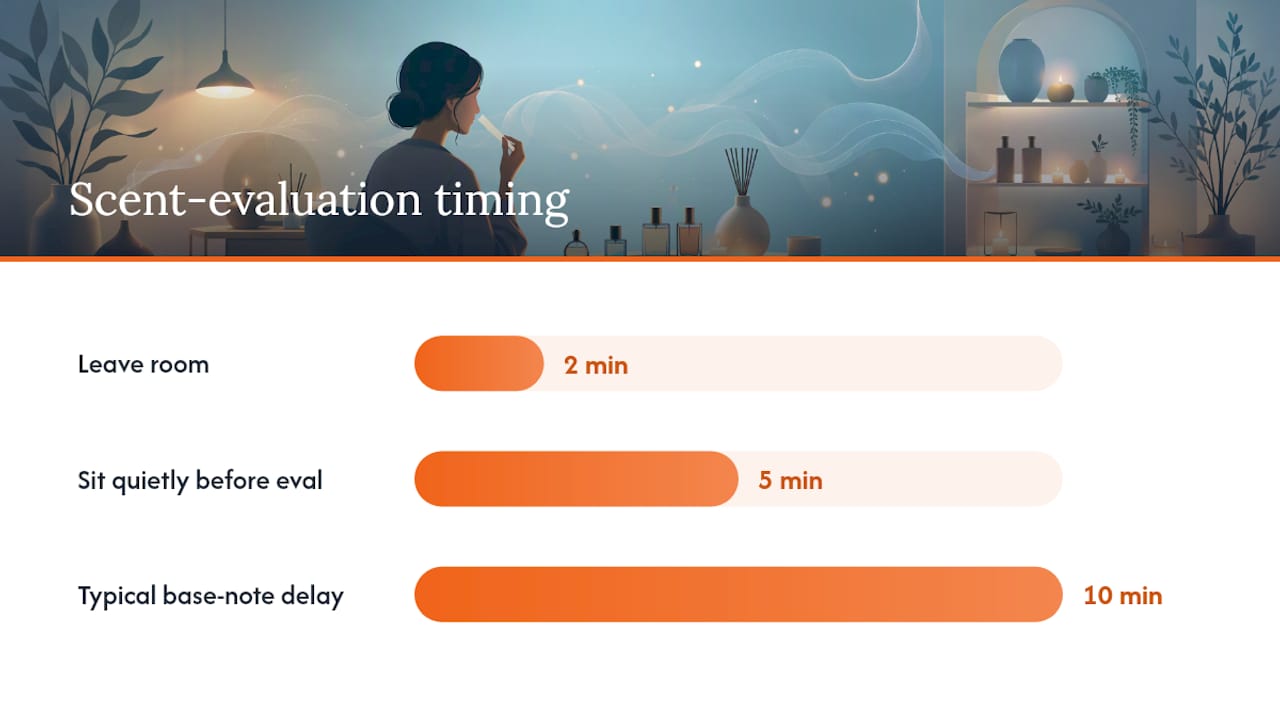
Allow five to ten minutes before evaluating. Sensory compensation builds gradually. The first two minutes in a dim room are still dominated by visual adjustment. By minute five, olfactory attention is fully engaged.
Pairing guide by scent family
| Lighting type |
Color temp |
Scent families that shine |
Notes to expect |
| Warm, dim |
Under 2700K |
Gourmand, woody, amber, musk |
Base notes dominant; emotional label: cozy, intimate |
| Warm, moderate |
2700K |
Floral, spice, soft woods |
Balanced profile; good for dining |
| Cool, bright |
— |
Citrus, ozonic, green |
Top notes extended; emotional label: fresh, alert |
Pro Tip: If you want to test the effect yourself, spritz a room spray once under bright overhead light and note the intensity. Then dim the lights to a single warm lamp and spritz again in the same spot 30 minutes later. The difference in perceived richness is usually immediate.
For room-by-room scent selection that accounts for natural light levels, Wickandglow’s guide on how to choose scents for each room is a useful companion.
When does dim lighting make scent worse, not better?
The effect is real, but it has clear limits. Ignoring them produces the opposite of what you want.
-
Mismatch kills the effect. A sharp citrus or ozonic fragrance under warm amber light creates a sensory contradiction. The brain registers the incongruence and the emotional amplification does not happen. Research confirms that partial congruity between light and scent often performs no better than a full mismatch.
-
Layering too many scents causes overload. Running a diffuser, a candle, and a room spray simultaneously in a small space does not triple the effect. It muddies the olfactory signal. The brain cannot assign a clean emotional label to a fragrance soup. One primary source per room is the practical ceiling. Wickandglow’s advice on mixing diffuser and candle scents covers how to layer intentionally without overloading the space.
-
Open flames in near-darkness are a safety risk. Candles should always be visible and placed away from flammable materials. If the room is too dark to see the flame clearly, it is too dark for an open flame. Flameless candles or a reed diffuser are the right call for very low-light settings.
-
UV and blue-spectrum light degrades fragrance compounds over time. LEDs with a strong blue spike in their spectral output can break down sensitive fragrance molecules, particularly citrus and delicate florals, when candles or diffusers are stored near them. Keep fragrance products away from direct light exposure between uses.
-
Accessibility matters. Dim lighting is not appropriate for every household or every guest. People with low vision, older adults, or anyone navigating an unfamiliar space need enough light to move safely. A single well-placed warm lamp at 200–300 lumens usually threads the needle between ambience and safety.
Pro Tip: Test any new lighting and scent combination in one room before committing to a whole-home setup. What works in a small bedroom may feel oppressive in an open-plan living area.
How Wickandglow applies this science in practice
Wickandglow’s fragrance development starts from a premise that most candle brands skip: the room the candle burns in is part of the product. That means lighting is a design variable, not an afterthought.
The approach draws directly on cross-modal congruency principles. Wickandglow’s warm, complex fragrance profiles, built around gourmand, woody, and amber accords, are formulated to perform under warm, low-light conditions. The base notes are weighted to arrive early and stay present, which aligns with how dim lighting accelerates base note perception. The curated R&B playlists that accompany each product add a third sensory layer, sound, that reinforces the emotional label the lighting and scent are already building.
Here is a simple ritual to replicate the effect at home:
- Choose a Wickandglow candle or room spray with a warm, base-heavy profile (sandalwood, vanilla, amber, or musk).
- Set your room to a single warm-white light source at or below 2700K, positioned low (table lamp or floor lamp, not overhead).
- Light the candle or spritz the room spray, then leave the room for two minutes.
- Return and sit quietly for five minutes before evaluating the scent. Let the sensory compensation cycle complete.
- Note which notes feel most present. Under warm, dim light, the base notes should dominate within the first few minutes rather than the usual ten.
“The brain builds a narrative around scent using visual cues. Dim lighting nudges that narrative toward intimacy and relaxation, which makes warm, comforting scents read as more intense and appropriate to the moment.”
The science of scent and lighting, beautys.life
Wickandglow’s intentional home fragrance philosophy is built around exactly this kind of deliberate sensory design. Fragrance is not just something that smells good. It is a tool for shaping how a room feels.
Key Takeaways
Dim, warm lighting enhances scent perception because the brain compensates for reduced visual input by increasing olfactory attention, and congruent light-scent pairings accelerate emotional processing in the orbitofrontal cortex.
| Point |
Details |
| Sensory compensation is the core mechanism |
Reduced visual input causes the brain to reallocate attention to olfaction, increasing perceived scent intensity. |
| Congruency matters as much as dimness |
Matching light warmth and scent warmth on both dimensions produces the strongest effect; partial matches often fall short. |
| Warm light under 2700K suits base-heavy scents |
Gourmand, woody, and amber fragrances perform best under warm, dim light; citrus and ozonic notes suit cooler, brighter settings. |
| Field results are more variable than lab results |
Real-world multisensory layering can cause overload; one primary fragrance source per room is the practical limit. |
| Wickandglow products are designed for warm, dim scenes |
Warm, base-heavy fragrance profiles paired with curated playlists align with cross-modal congruency principles. |
Why lighting and scent design are inseparable
Most people treat fragrance as a standalone choice: pick a candle, light it, done. The research tells a different story. The same fragrance molecule smells different depending on what the brain is primed to expect, and lighting is one of the most powerful primers available. Warm, dim light does not just set a mood. It physically changes which sensory channel the brain prioritizes and how quickly it assigns emotional meaning to what it detects.
What gets underestimated is how precise the congruency requirement is. Dimming the lights alone is not enough. A cold, blue-tinted lamp at low wattage will not produce the same OFC activation as a warm amber lamp at the same brightness. The spectral quality of the light, not just its intensity, is doing meaningful work. That is a detail most interior design guides skip entirely, and it is why so many “romantic dinner” setups still feel flat despite the candles on the table.
The practical implication is that fragrance selection and lighting selection should happen together, not independently. If you have already committed to a cool-white LED fixture, lean into citrus and green scents rather than fighting the light with a heavy amber candle. Work with the brain’s expectations, not against them.
Wickandglow’s warm-scent collection is built for exactly this
If you have read this far, you already know the setup: warm light, base-heavy fragrance, one source per room. Wickandglow’s luxury room spray is a fast way to test the lighting-scent effect without committing to a full candle burn. One spritz under a 2700K lamp, five minutes of patience, and the difference in perceived richness is usually obvious.
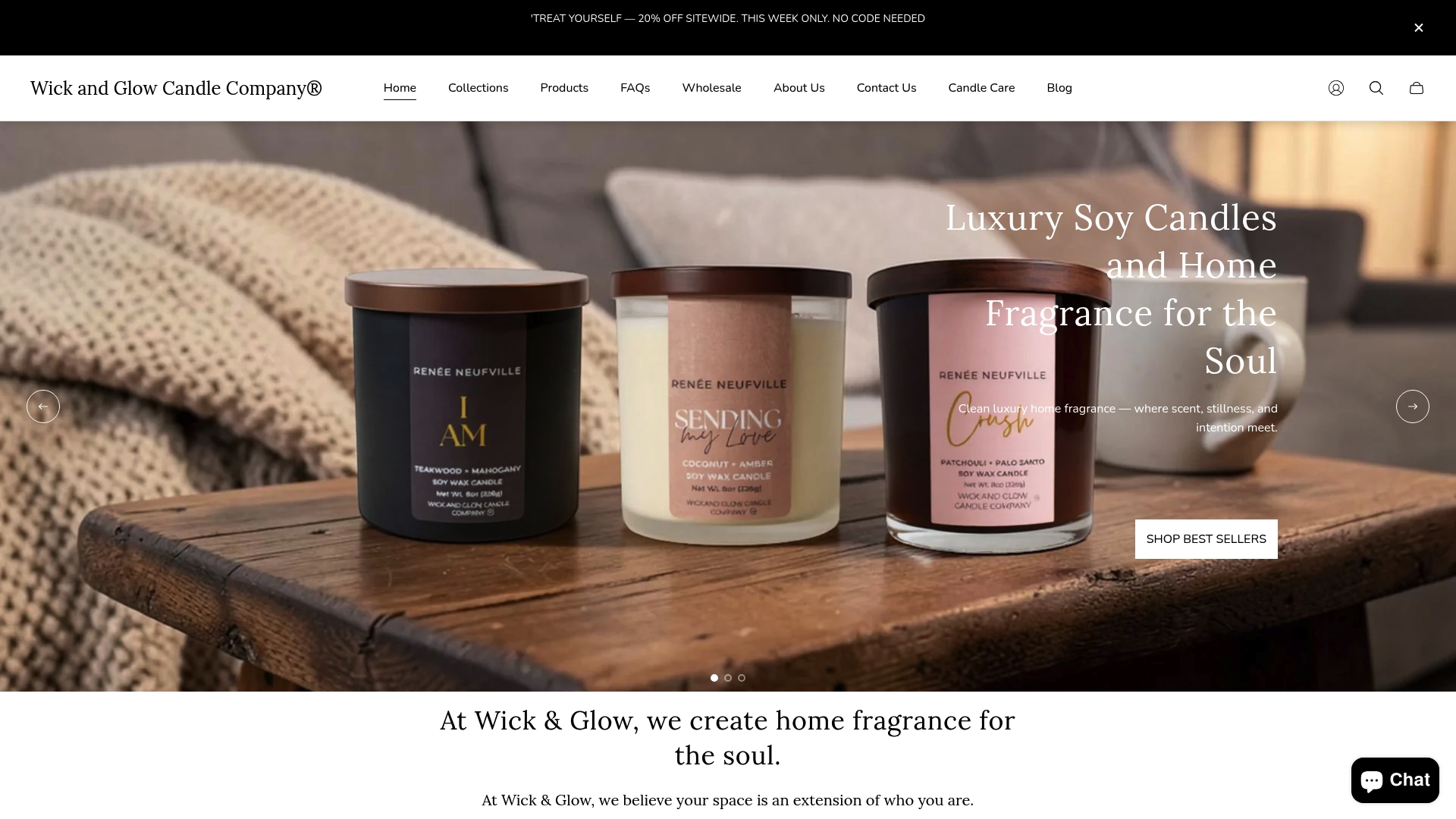
For a fuller experience, the Men Love Candles Too collection features warm, woody, and gourmand profiles that are formulated to perform under exactly the low-light conditions this article describes. Every product ships with a curated playlist, adding a congruent sound layer that reinforces the emotional label the lighting and scent are already building. Browse the collection, pick a fragrance that matches your room’s light, and run the five-minute ritual above. The science does the rest.
Selected studies and further reading
The studies below form the core evidence base for this article. Access status is noted where known.
-
Less Light, Better Bite: How Ambient Lighting Influences Taste Perceptions — Murray State University, open access. Three controlled experiments showing dim ambient lighting enhanced taste perception via sensory compensation. The primary source for the resource-reallocation mechanism.
-
Analysis of harmony between color and fragrance in lighting environments by the reaction of the orbitofrontal area — PMC, open access. NIRS study measuring OFC activation under harmonious vs. mismatched color-fragrance pairings. The strongest physiological evidence for cross-modal congruency.
-
The Effect of High, Partial, and Low Multisensory Congruity between Light and Scent on Consumer Evaluations and Approach Behavior — MDPI Sustainability, open access. Lab retail simulation showing full congruity between light warmth and scent warmth drives approach behavior; partial matches do not.
-
The influence of brightness on overall taste intensity perception — Food Quality and Preference, paywalled. Controlled brightness manipulation study supporting cross-modal sensory compensation applied to taste and, by extension, scent.
-
Review of ambient scent and multisensory design effects (Frontiers in Psychology) — Frontiers, open access PDF. Literature review covering field and lab studies; essential reading for understanding where the science holds and where it breaks down in real environments.
-
Crossmodal processing and consumer evaluation (Food Quality and Preference) — Paywalled. Consumer lab study tying ambient cue congruity to product evaluations via processing fluency; useful for applied retail and hospitality contexts.
-
Does lighting change how perfume smells? The science of scent — Open access. Applied synthesis of cross-modal perception literature with practical pairing guidance for warm vs. cool lighting and fragrance families.
-
How light affects our sense of taste — Casambi blog — Open access. Industry-facing synthesis covering spectral distribution, color temperature recommendations, and applied lighting strategy for culinary and home environments.
Recommended


