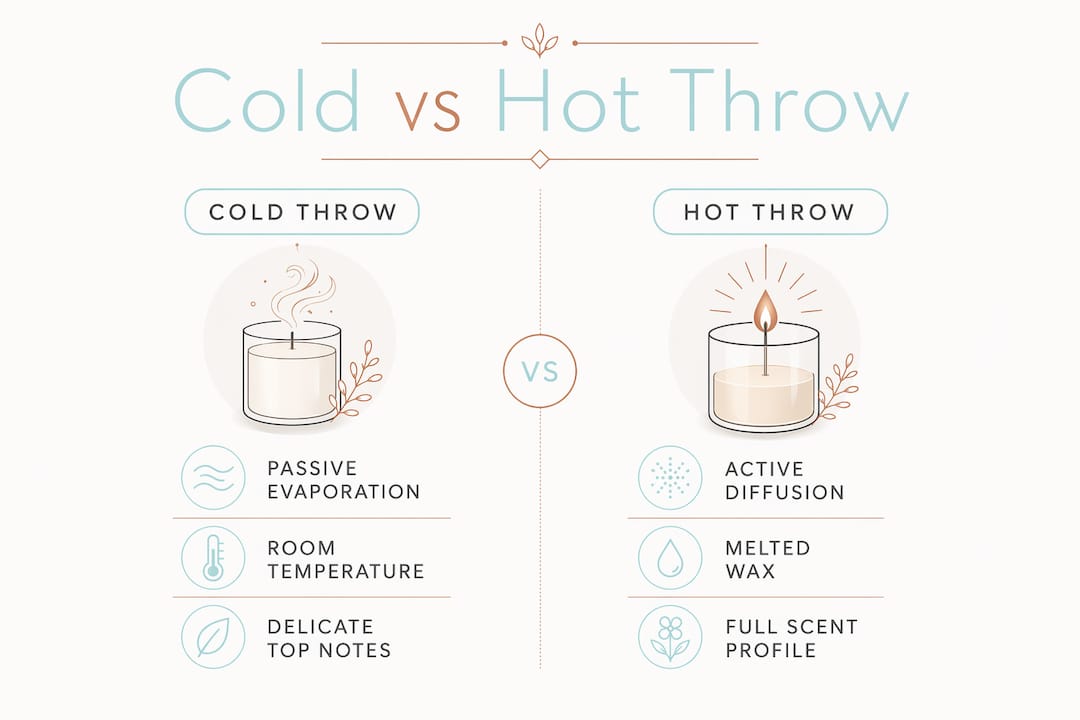
A candle’s scent is strongest when cold because volatile fragrance molecules) evaporate passively from the wax surface at room temperature, releasing concentrated top notes directly into the air around you. This passive release, known in the fragrance industry as cold throw, delivers an intense first impression that changes dramatically once heat enters the equation. Understanding cold throw versus hot throw explains not just why your unlit candle smells so vivid, but also why some candles disappoint once you strike the match. Wax type, fragrance oil chemistry, wick size, and room temperature all shape what you actually smell and when.
Why candles smell stronger cold: cold throw explained
Cold throw is defined as the fragrance a candle releases at room temperature without any heat source. It happens because fragrance oils are mixtures of volatile, semi-volatile, and non-volatile compounds, and the most volatile molecules evaporate first, even at ambient temperatures. Those volatile compounds are the top notes of a fragrance): citrus, light florals, fresh herbs. They hit your nose immediately and powerfully because nothing is competing with them.
Hot throw works differently. When a candle burns, heat melts the wax and creates a liquid pool that vaporizes fragrance oils at a much higher rate. That sounds like it should produce a stronger scent, but heat also burns off top notes faster and begins releasing the heavier heart and base notes. Sandalwood, vanilla, musk, and amber are base notes. They are richer and more complex, but they diffuse more slowly and feel less immediately sharp than top notes.
Here is what that means in practice:
-
Top notes (citrus, mint, light florals): highly volatile, evaporate quickly at room temperature and during early burn
-
Heart notes (jasmine, rose, spice): moderate volatility, emerge after top notes fade
-
Base notes (sandalwood, vanilla, musk): low volatility, linger longest but take time to develop
-
Cold throw captures mostly top notes, making the scent feel vivid and concentrated
-
Hot throw shifts toward heart and base notes as heat drives off the lighter compounds
Pro Tip: Smell a candle cold, then smell it again 10 minutes into the burn. If the scent profile shifts noticeably, that is the fragrance pyramid working exactly as it should. A well-formulated candle from a brand like Wickandglow will deliver both a compelling cold throw and a satisfying, evolved hot throw.
Understanding the fragrance notes structure in a candle is the single fastest way to set accurate expectations before you ever light a wick.
How temperature and environment shape candle scent intensity
Room temperature directly controls how fast fragrance molecules leave the wax surface. Warm rooms increase evaporation and cold rooms slow it, which creates a counterintuitive effect: a candle stored in a cool room may actually release a more concentrated, less dispersed cold throw because the molecules accumulate near the wax surface rather than spreading quickly through a warm, moving air mass.
Here is how different environmental conditions affect what you smell:
-
Cool, still room (60 to 65°F): Evaporation is slow. Fragrance molecules stay close to the candle, creating a dense scent pocket. You notice it most when you walk toward the candle.
-
Warm room (72 to 78°F): Evaporation speeds up. Scent disperses faster and fills the room more quickly, but the concentration near the candle feels lower.
-
Room with open windows or fans: Airflow carries fragrance molecules away before they accumulate. Even a strong candle can smell faint in a drafty space.
-
Small, enclosed room: Scent molecules concentrate faster. A candle that feels weak in a large living room can feel overwhelming in a small bathroom.
-
High humidity environments: Dense, humid air can actually carry scent molecules more effectively over short distances, intensifying perceived fragrance near the source.
Cold environments require longer burn times for a candle to form a full melt pool, which delays the point at which hot throw reaches its peak. This is why a candle lit in a cold room in winter can feel underwhelming for the first 30 minutes. The wax needs time to reach the right temperature before fragrance release accelerates.
The practical takeaway: burn candles in rooms between 68 and 72°F with minimal airflow for the most consistent and noticeable scent experience. Avoid placing candles directly under air vents or near open windows.
Why some candles smell stronger cold but weaker when lit
This is one of the most common frustrations for candle buyers, and the cause is almost always one of four things.
Fragile top notes burning off too fast. Some fragrance oils are formulated with a high proportion of volatile top notes that smell spectacular cold but degrade quickly under heat. If the heart and base notes are not strong enough to carry the scent once the top notes vanish, the candle smells noticeably weaker when burning.
Wax type mismatch. Paraffin wax burns hotter than soy wax and releases fragrance more aggressively during burning. Soy wax burns cooler, which can produce a softer hot throw even when the cold throw is impressive. Neither is inherently better, but the wax must be matched to the fragrance oil’s volatility profile. A fragrance designed for paraffin may underperform in soy if the formulation is not adjusted. You can explore how plant-based waxes affect scent release in detail if you are curious about the chemistry behind your candle’s ingredients.
Wick size problems. A wick that is too small creates a shallow melt pool that never reaches the jar’s edges, limiting how much fragrance oil gets vaporized. A wick that is too large burns too hot, degrading scent compounds before they can diffuse properly. Proper wick sizing is one of the most technically demanding parts of candle formulation, and it is where many mass-produced candles cut corners.
Olfactory fatigue. After 15 to 20 minutes in a scented room, your brain begins filtering out the fragrance signal. Scent perception diminishes with prolonged exposure, even when the actual scent concentration in the room is unchanged or increasing. This is why guests often notice your candle more than you do.
- Always trim your wick to 1/4 inch before each burn
- Burn long enough to form a full melt pool (typically 2 to 4 hours for a standard jar)
- Leave the room for 10 minutes and return to reset your scent perception
- Store candles with lids on to preserve volatile top notes between burns
Pro Tip: If your candle smells strong cold but faint when lit, try burning it in a smaller room first. A candle that struggles to scent a large open-plan space may perform beautifully in a bedroom or bathroom, where the enclosed air concentrates the fragrance.
How to get the most fragrance from your candle when burning
Maximizing hot throw is about controlling three variables: the candle’s formulation, your burn technique, and your room environment. You can only control two of those, so start there.
A balanced fragrance formula requires the right fragrance oil load, the right wax, and the right wick working together. Excessive fragrance oil does not automatically mean stronger scent. Too much fragrance oil can disrupt combustion, cause the wick to clog, and actually reduce scent diffusion. Quality candle makers test fragrance load carefully to find the point where scent is maximized without compromising the burn.
Curing time matters more than most buyers realize. A freshly poured candle needs at least one to two weeks for the fragrance oil to fully bind with the wax. Burning a candle too soon after it is made produces a noticeably weaker hot throw. Wickandglow candles are cured before shipping, which is one reason customers consistently report strong, lasting scent from the first burn.
Practical steps to maximize your candle’s hot throw:
-
Trim the wick to 1/4 inch before every single burn. A long wick creates a larger flame that burns too hot and too fast.
-
Burn for at least 2 hours on the first use to establish a full melt pool that reaches the jar’s edges. This prevents tunneling and maximizes fragrance surface area.
-
Keep the room between 68 and 72°F with doors closed to allow scent to accumulate.
-
Avoid burning near fans or vents that disperse fragrance before it can concentrate.
-
Layer your fragrance by combining a candle with a reed diffuser or room spray in the same scent family. This creates a continuous background scent that the candle then amplifies.
Scent layering is particularly effective because reed diffusers release fragrance continuously at room temperature, essentially maintaining a baseline cold throw in the room while the candle adds heat-driven intensity on top.
Cold throw vs. hot throw: a side-by-side comparison
| Feature |
Cold throw |
Hot throw |
| Heat source |
None. Passive evaporation at room temperature |
Active. Heat from flame melts wax and vaporizes oils |
| Dominant notes |
Top notes (volatile, sharp, immediate) |
Heart and base notes (richer, slower to develop) |
| Scent intensity |
Concentrated near the candle |
Diffuses through the room over time |
| Duration |
Fades as top notes evaporate |
Sustained while candle burns |
| Best environment |
Cool, still room |
Enclosed room, moderate temperature |
A strong cold throw tells you a candle contains real fragrance oil. It does not guarantee the hot throw will be equally strong or balanced. Evaluate both before judging a candle’s quality.
Cold throw is a useful indicator of fragrance presence, but it is not a reliable predictor of burn performance. Many buyers smell a candle in-store and assume the lit experience will match. The fragrance pyramid, wax type, and wick all determine whether that cold impression translates into a satisfying hot throw.
Key takeaways
Cold throw is the dominant reason candles smell stronger unlit: volatile top notes evaporate at room temperature and deliver a concentrated scent that heat then transforms into a slower, richer fragrance profile.
| Point |
Details |
| Cold throw is passive evaporation |
Fragrance molecules leave the wax at room temperature, releasing top notes without any heat. |
| Hot throw shifts the scent profile |
Heat burns off top notes and releases heart and base notes, changing what you smell. |
| Wax type affects burn scent |
Paraffin releases fragrance more aggressively when burning; soy burns cooler and softer. |
| Wick size controls fragrance release |
Too small limits melt pool; too large degrades scent oils before they can diffuse. |
| Environment shapes what you perceive |
Room size, temperature, and airflow all determine how concentrated the scent feels. |
What I’ve learned from living with candles that smell better cold
Most people buy a candle because it smells incredible in the store or straight out of the box. Then they light it and feel let down. I have seen this happen enough times to know it is almost never the candle’s fault. It is a mismatch between expectation and chemistry.
The cold throw you fall in love with is real. Those top notes are genuinely present in the fragrance oil. But they are designed to be the opening act, not the whole performance. When you light the candle, you are moving into the second and third acts: the heart and base notes that take longer to develop but last far longer and fill a room in a completely different way.
What I tell anyone who asks: stop judging a candle’s quality by its cold throw alone. Smell it cold to confirm the fragrance is there. Then burn it properly, in the right size room, with a trimmed wick and a full melt pool, and give it 30 minutes before you decide what you think. The candles that reward patience are almost always the ones worth buying again.
The brands that understand this, like Wickandglow, formulate for both throws intentionally. Their unique candle formulations are built to deliver a cold throw that excites and a hot throw that satisfies. That balance is harder to achieve than most people realize, and it is exactly what separates a thoughtfully made candle from a mass-produced one.
— B
If you have ever been disappointed by a candle that smelled extraordinary in the box but faded the moment you lit it, the problem was formulation. Wickandglow builds every candle to perform across both cold and hot throw, using soy wax blends, carefully tested fragrance loads, and wicks sized for each specific vessel.
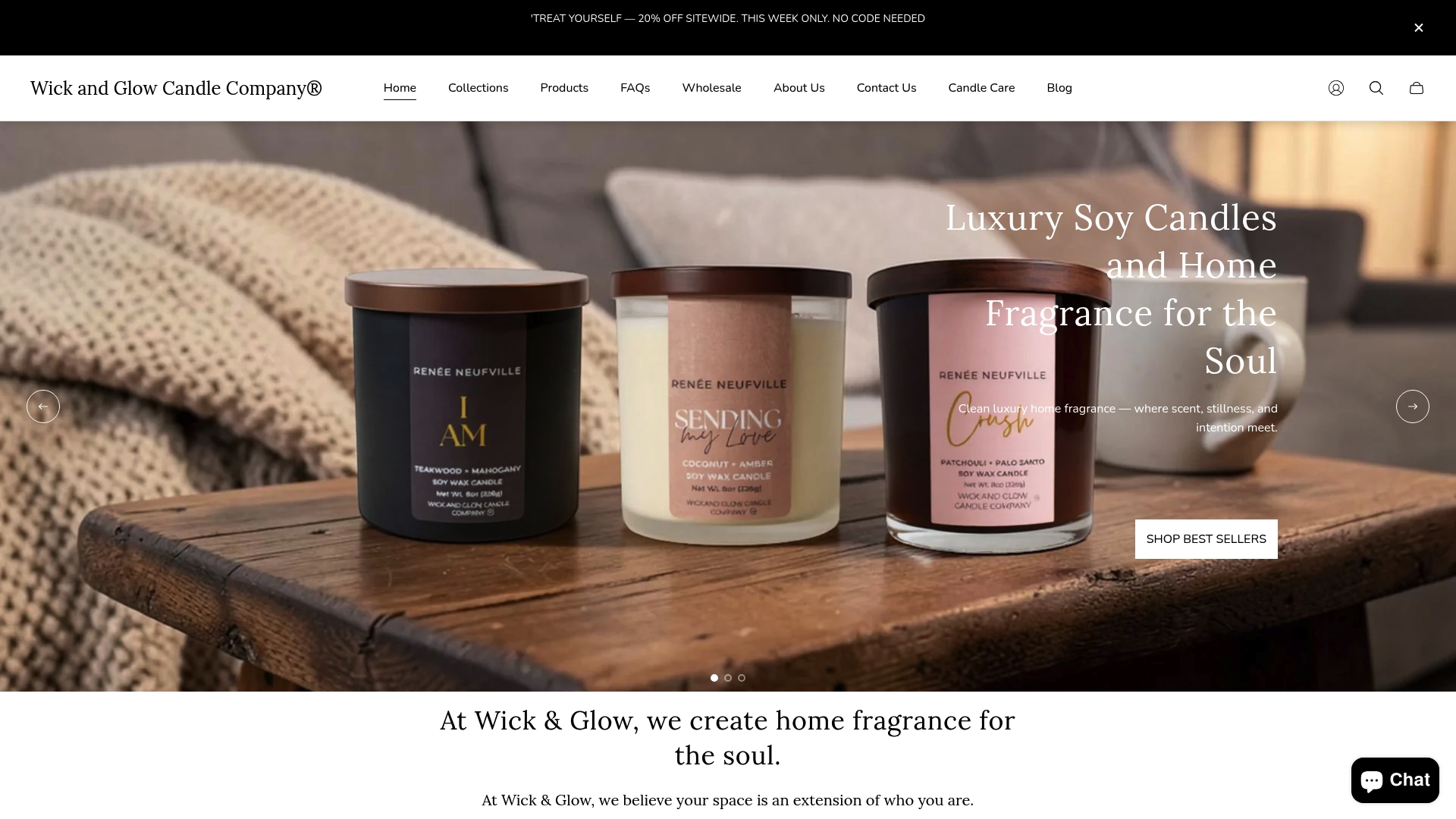
The Home Fragrance Scent Bundle combines a soy candle, reed diffuser, and room spray in one curated set, giving you continuous cold throw from the diffuser, instant scent from the spray, and a rich hot throw from the candle. It is the most effective way to layer fragrance in a room and keep it consistent throughout the day. Every product is cured, tested, and inspired by R&B music, so the scent experience comes with a playlist to match.
FAQ
Why does my candle smell stronger before I light it?
An unlit candle releases volatile top notes through passive evaporation at room temperature, a process called cold throw. These top notes are the sharpest and most immediately noticeable compounds in the fragrance oil, which is why the cold scent often feels more intense than the burning scent.
Do candles smell stronger in cold rooms?
Cold rooms slow evaporation, which keeps fragrance molecules concentrated near the candle rather than dispersing them quickly. This creates a denser scent pocket around the candle, making the cold throw feel more potent in cooler environments.
Why does my candle lose its scent after burning for a while?
Two things happen: olfactory fatigue causes your brain to stop registering the scent after 15 to 20 minutes of exposure, and the volatile top notes burn off early in the burn cycle. Leaving the room briefly and returning resets your perception and usually confirms the scent is still present.
Does wax type affect how strong a candle smells when burning?
Paraffin wax burns hotter and typically produces a stronger hot throw than soy wax, which burns cooler and releases fragrance more gently. Soy candles often have impressive cold throw but softer burn scent unless the fragrance formula is specifically adjusted for the wax type.
How do I get a stronger scent from my candle when it burns?
Trim the wick to 1/4 inch before each burn, allow a full melt pool to form across the entire surface (usually 2 to 4 hours), and burn in an enclosed room between 68 and 72°F. Layering with a reed diffuser in the same scent family amplifies the overall fragrance experience significantly.
Recommended


