Candle fragrance notes are the distinct scent layers — top, middle, and base — that combine to shape how a candle’s aroma develops, shifts, and lingers throughout its burn. In perfumery, this structure is called a fragrance pyramid, and the same architecture applies directly to how candle scents work. Understanding this layering system changes how you shop for candles, how you combine them with diffusers and sprays, and why a candle that smells sharp in the store transforms into something richer and warmer once it’s burning in your living room. Wickandglow builds every product around this principle, pairing intentional scent architecture with R&B-inspired playlists to create a full sensory experience.
How fragrance notes work in candles: top, middle, and base explained
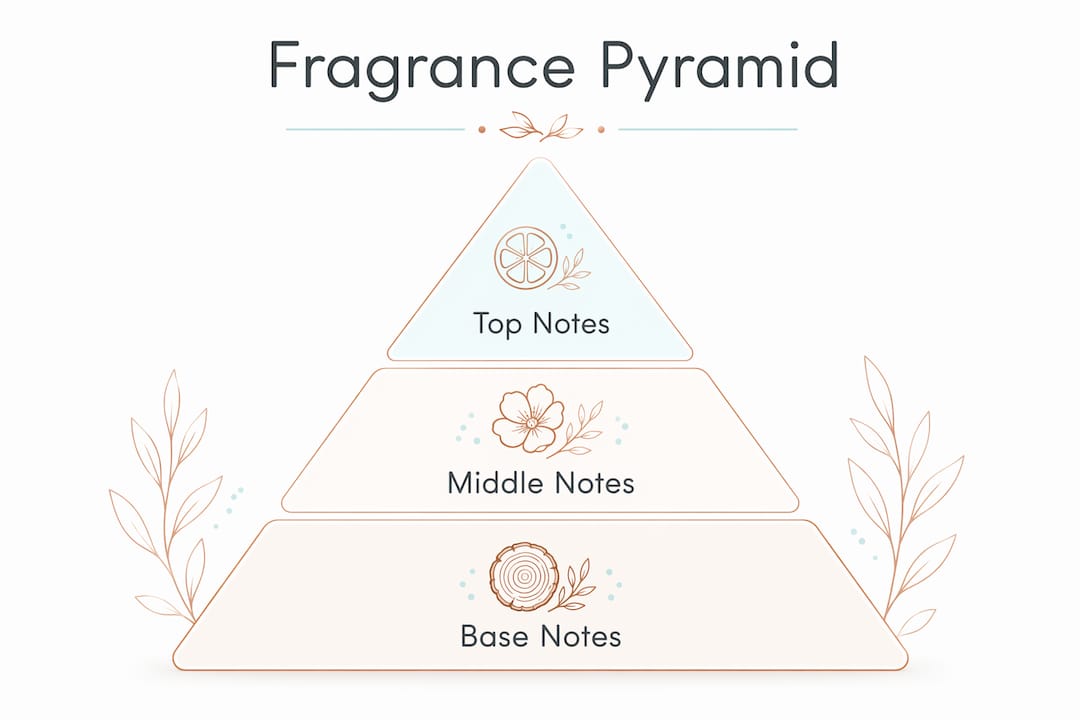
The fragrance pyramid divides any scent blend into three tiers, each with a different role, volatility level, and timing during the burn. These layers don’t fire in strict sequence. They overlap and transition into each other, which is exactly what creates that sense of a scent “opening up” as a candle burns.
Here is what each note type does:
-
Top notes are the lightest, most volatile compounds in the blend. They hit your nose first, within seconds of lighting the wick. Common top notes include citrus (bergamot, lemon, grapefruit), light herbs like basil or mint, and fresh aquatic accords. Top notes dissipate within 15 to 30 minutes of burning. They create the first impression, but they are not the heart of the candle.
-
Middle notes (also called heart notes) define the candle’s core character. Floral, herbal, and spicy ingredients dominate this tier: rose, jasmine, lavender, cinnamon, and clove are classic examples. Middle notes carry the scent through most of the burn time and represent the largest portion of any well-made blend. They are what you smell when you walk into a room where a candle has been burning for 20 minutes.
-
Base notes are the heaviest, slowest-releasing compounds. Sandalwood, cedarwood, vanilla, amber, and musk are the most common. These notes provide lasting depth and continue to linger even after the candle is extinguished. They anchor the entire blend and give a candle its warmth and staying power.
The transition between these tiers is gradual, not abrupt. A well-crafted candle feels like a single, evolving scent rather than three separate smells taking turns. Poor note architecture, on the other hand, produces a harsh opening or a flat, one-dimensional burn that fades quickly.
How professional candle makers blend fragrance notes
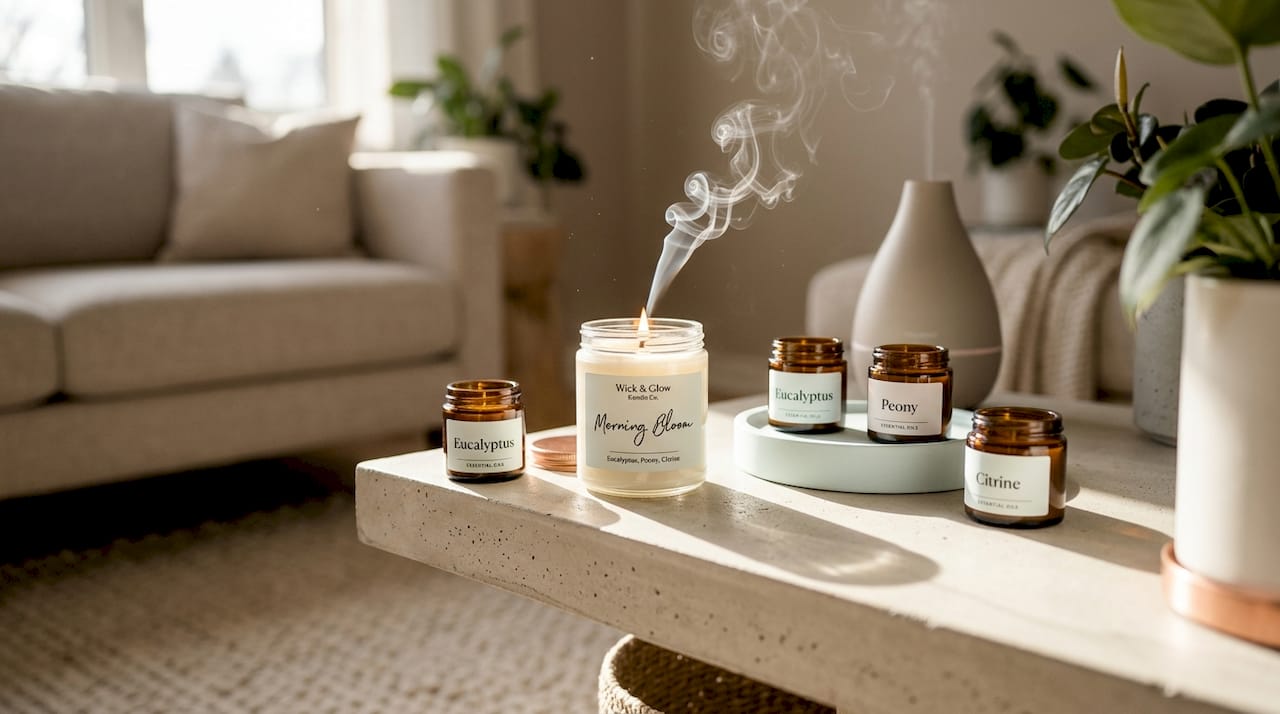
The industry standard for balanced candle fragrance is a ratio of 30% top, 50% middle, and 20% base notes. This ratio produces scent profiles that last 40 to 50 hours, and 60% of top-rated Etsy candle sellers use this structure to maintain 4.8-star reviews or higher. The math behind it reflects a simple truth: middle notes carry the experience, so they get the largest share.
Here is the process professional makers follow when building a blend from scratch:
-
Start with base notes. Add your heaviest, slowest-releasing oils first. This gives them time to integrate fully before lighter compounds are introduced. Layering in sequence increases scent complexity by up to 30% compared to mixing all oils at once.
-
Add middle notes second. These form the body of the blend. Measure by weight, not volume, for consistency across batches.
-
Finish with top notes. These are the most volatile, so adding them last preserves their character. They will still dissipate fastest during the burn, but their presence in the cold throw (the scent before lighting) is strong.
-
Test on a blotter strip. Hold the strip 6 inches from your nose and evaluate the blend at 5, 15, and 30 minutes. This simulates how the scent evolves over time without burning any wax.
-
Conduct a jar test. Pour a small test candle and evaluate both cold throw and hot throw after a full cure period.
| Fragrance note |
Recommended share |
Common examples |
| Top notes |
30% |
Bergamot, lemon, mint, grapefruit |
| Middle notes |
50% |
Lavender, rose, cinnamon, jasmine |
| Base notes |
20% |
Sandalwood, vanilla, amber, musk |
For soy wax specifically, the optimal fragrance load is 6 to 10%, with 8% being the most common. That translates to 1.28 ounces of fragrance oil per pound of wax. Going above 10% does not improve scent throw. It increases the risk of seepage and uneven burning.
Pro Tip: Never add fragrance oils above their flash point during the pour. If oils hit the wax at too high a temperature, volatile compounds burn off immediately, and your top notes disappear before the candle ever reaches a customer.
Why does a candle smell different burning versus in the bottle?
This is one of the most common points of confusion in understanding candle fragrance, and the answer comes down to volatility. When you smell a fragrance oil directly from the bottle, you are primarily smelling the top notes. They are the lightest molecules, so they evaporate fastest and reach your nose first. The result is a sharper, brighter impression than what the candle actually delivers once lit.
When a candle burns, heat releases the fragrance gradually through the wax. This process emphasizes balanced middle and base notes rather than the sharp top-note burst you get from the bottle. The wax acts as a slow-release medium, which is why the burning experience feels warmer and more complex.
Wax type matters here too. Soy wax has a lower melting point than paraffin, which means it releases fragrance at a gentler heat. This tends to produce a softer, more nuanced scent throw that suits complex blends well. Paraffin burns hotter and can push fragrance more aggressively, which works for simpler, single-note profiles but can flatten layered blends.
-
Wick size directly affects how much wax melts per hour. An undersized wick produces a weak hot throw. An oversized wick burns too hot, accelerating top note evaporation and shortening the scent’s lifespan.
-
Pour temperature affects how fragrance oils bind to wax. Pouring too hot or too cold disrupts the molecular bond and weakens both cold and hot throw.
-
Curing time is non-negotiable. A 1 to 2 week cure allows fragrance oils to fully stabilize in soy wax, improving scent performance across both throw types. Burning a freshly poured candle before it cures produces a noticeably weaker scent.
Pro Tip: If a candle smells faint when unlit but strong when burning, the cure is likely incomplete. Give it another 3 to 5 days before evaluating the cold throw.
How to choose and layer candle scents for your home
Knowing how fragrance notes work gives you a real advantage when selecting candles and building a home scent strategy. The goal is not to find one perfect candle. The goal is to create a cohesive scent environment where multiple products work together.
A strong home fragrance setup treats candles, diffusers, and room sprays as part of one layered strategy rather than separate purchases. A candle handles the warm, ambient base of a room. A reed diffuser like the Wickandglow luxury diffuser maintains a consistent middle-note presence between burns. A room spray delivers an instant top-note refresh when you need it.
| Ambiance goal |
Recommended note emphasis |
Example combination |
| Calm and relaxing |
Strong base, soft middle |
Sandalwood + lavender + bergamot |
| Energizing and fresh |
Strong top, light base |
Citrus + mint + light musk |
| Warm and intimate |
Strong base and middle |
Vanilla + rose + amber |
| Clean and airy |
Balanced top and middle |
Linen + eucalyptus + cedar |
Common mistakes to avoid when building your home scent profile:
-
Overloading the blend. Using more than 3 to 4 fragrance oils in one candle causes muddled scents in 70% of cases. The same principle applies when layering products across a room. Keep the note family consistent.
-
Choosing conflicting notes. Pairing heavy, resinous base notes (like oud or patchouli) with sharp, acidic top notes (like grapefruit) without a bridging middle note creates a jarring, incoherent scent.
-
Ignoring room size. A candle with a strong hot throw in a small bathroom will feel overwhelming. Match fragrance intensity to the space.
Key takeaways
Fragrance notes in candles work as a three-tier pyramid of top, middle, and base layers that overlap during the burn to create a balanced, evolving scent experience.
| Point |
Details |
| The fragrance pyramid |
Top, middle, and base notes each serve a distinct role in scent timing, depth, and longevity. |
| Professional blending ratio |
Use 30% top, 50% middle, and 20% base notes for balanced scent profiles lasting 40 to 50 hours. |
| Bottle vs. burn difference |
Fragrance oils smell sharper in the bottle because top notes dominate; burning wax releases a warmer, layered scent. |
| Curing matters |
Soy candles need 1 to 2 weeks to cure so fragrance oils stabilize and scent throw reaches full strength. |
| Layered home strategy |
Combine candles, diffusers, and room sprays with matching note families to build a cohesive home scent. |
Why fragrance architecture is the difference between a candle and an experience
Most people buy candles based on a single sniff in a store, which means they are evaluating top notes almost exclusively. That is like judging a song by its intro. The real quality of a candle reveals itself 20 minutes into the burn, when the middle notes take over and the base notes begin to warm underneath them.
What I have found, working closely with home fragrance, is that the candles people remember are never the ones with the loudest opening. They are the ones with a well-structured middle and a base that lingers in the room long after the flame goes out. That lingering quality is not accidental. It is the result of deliberate note architecture, precise fragrance loads, and patience with the curing process.
The emotional impact of a well-crafted candle is real. Scent is the sense most directly connected to memory and mood, and a candle that transitions smoothly through its fragrance pyramid creates a sensory arc. It feels like something is happening in the room, not just something burning. Wickandglow understands this deeply, which is why their candles are paired with R&B playlists. The scent and the music are both designed to move through phases, building atmosphere over time rather than delivering a single static impression.
Treat your home fragrance the way you treat a playlist. Think about the opening, the body, and the finish. Choose products that complement each other across note families. And give your candles time to cure before you judge them. The best scent experiences are never rushed.
— B
Explore Wickandglow’s fragrance collection

Wickandglow designs every candle, diffuser, and spray around the same fragrance pyramid principles covered in this article. Each product uses soy wax with precisely measured fragrance loads, balanced note ratios, and full cure periods before it ships. The home fragrance scent bundle pairs a soy candle, reed diffuser, and room spray in a single cohesive scent family, so you get top, middle, and base note coverage across your entire space. If you want to experience what intentional fragrance architecture actually feels like in a room, that bundle is the clearest demonstration Wickandglow offers. Browse the full collection at Wick & Glow and use your new understanding of fragrance notes to choose with confidence.
FAQ
What are the three fragrance notes in a candle?
The three fragrance notes are top notes (light, volatile, first impression), middle notes (the core scent during most of the burn), and base notes (heavy, slow-releasing, and long-lasting). Together they form the fragrance pyramid that defines how a candle’s scent develops over time.
How long do top notes last in a burning candle?
Top notes dissipate within 15 to 30 minutes of lighting a candle. After that, middle notes take over as the dominant scent, with base notes gradually emerging to provide warmth and depth.
Why does my candle smell different when burning versus unlit?
The unlit scent (cold throw) is dominated by volatile top notes. When the candle burns, heat releases fragrance gradually through the wax, bringing forward the warmer middle and base notes for a more complex, layered scent experience.
What fragrance load should I use for soy candles?
The optimal fragrance load for soy wax is 6 to 10%, with 8% being the industry standard. That equals 1.28 ounces of fragrance oil per pound of wax, measured by weight for accuracy.
How do I layer candle scents in my home?
Use candles for warm ambient scent, a reed diffuser for consistent middle-note presence between burns, and a room spray for instant top-note refreshes. Keep all three products within the same note family to build a cohesive home fragrance rather than competing scents.
Recommended


