A scent profile is the shorthand description of a fragrance’s overall olfactory character: the combination of notes, accords, and family classification that tells you how a fragrance will smell from first spray to final dry-down. When you see a product page listing “bergamot, jasmine, sandalwood,” that’s the profile at work. Before you buy, check the family label first (floral, woody, oriental, fresh), then scroll to the base notes — those are what you’ll actually live with all day. Perfumers like Kilian Hennessy and trainers like Joan Tanis of Maison Francis Kurkdjian both point to the fragrance pyramid and olfactive families as the two tools that make reading any product description faster and more reliable.
Key Takeaways
A scent profile is the combination of notes, accords, and family classification that defines a fragrance’s character from opening to dry-down — and reading it correctly is the fastest way to shortlist fragrances you’ll actually wear.
| Point |
Details |
| Definition |
A scent profile describes a fragrance’s olfactory character through its notes, accords, and family. |
| Heart and base notes matter most |
Top notes fade in minutes; heart and base notes are what you’ll smell for hours. |
| Family labels guide shopping |
Use olfactive families (floral, woody, oriental, fresh) to filter options before testing. |
| Always test on skin through dry-down |
Spray once, wait 30–90 minutes, and judge the fragrance at the base-note stage. |
| Wickandglow for family testing |
Wickandglow’s hand-poured soy candles let you explore scent families at home before buying a perfume. |
Table of Contents
What does a scent profile actually contain?
A scent profile, also called a fragrance or olfactive profile, is built from three layers: top notes, middle (heart) notes, and base notes. Each layer has a different role and a different lifespan on skin.
Top notes are the first thing you smell. They’re the most volatile molecules in the formula, which means they evaporate quickly. Citrus (bergamot, lemon, grapefruit), light herbs, and green notes dominate this layer. They’re designed to attract attention, not to last.

Heart notes emerge once the top layer fades. This is where the fragrance’s personality lives: florals like rose, jasmine, and ylang-ylang; spices like cardamom and cinnamon; or soft fruits. The heart is the largest portion of the formula by volume.
Base notes are the anchor. Sandalwood, vetiver, musk, amber, and patchouli are classic examples. They’re the heaviest molecules, the slowest to evaporate, and the ones that determine how a fragrance wears over hours. As Alpha Aromatics explains, base and heart notes are the true framework of a perfume — top notes are the handshake, but base notes are the conversation.

An accord is what happens when two or more notes are blended so thoroughly that they stop reading as individual ingredients and create a single, unified character. The “rose” in a floral fragrance is rarely a single rose note — it’s an accord built from several molecules that together smell more convincingly like a rose than any single one could.
Common groupings look like this:
-
Top: bergamot, lemon, pink pepper
-
Heart: rose, jasmine, iris, peony
-
Base: sandalwood, musk, vetiver, vanilla, amber
Pro Tip: Don’t judge a fragrance in the first five minutes. Spray once on your wrist, then go do something else for 30–45 minutes. The heart and base notes — the ones you’ll smell at your desk, in a meeting, or on your pillow — are what actually matter for a signature scent.
How do olfactive families and the fragrance wheel help you shop?
Olfactive families classify how a fragrance smells rather than just listing its ingredients. That distinction matters when you’re browsing online and can’t smell anything. Knowing you love “woody orientals” is more useful than knowing you once liked a perfume with sandalwood in it. Vogue’s fragrance guide notes that Joan Tanis frames family labels as shopping shortcuts, a way to filter dozens of options down to a workable handful before you ever open a bottle.
The fragrance wheel arranges families in a circle so that adjacent families share characteristics and opposite families contrast sharply. That structure is practical: if you love one family, the families next to it on the wheel are the safest places to explore next.
| Family |
Feels like |
Common note examples |
| Floral |
Romantic, soft, feminine |
Rose, jasmine, peony, lily |
| Woody |
Warm, grounded, earthy |
Sandalwood, cedarwood, vetiver |
| Oriental |
Rich, spicy, sensual |
Amber, vanilla, cardamom, oud |
| Fresh |
Clean, airy, light |
Bergamot, sea salt, green tea |
| Gourmand |
Sweet, edible, cozy |
Vanilla, caramel, tonka bean |
| Chypre |
Mossy, sophisticated, complex |
Oakmoss, labdanum, bergamot |
| Fougère |
Herbal, powdery, classic |
Lavender, coumarin, oakmoss |
| Amber |
Warm, resinous, enveloping |
Benzoin, labdanum, balsam |
Cross-over families are where things get interesting. A floral-oriental reads as a floral with warmth and depth underneath — think jasmine over amber. A citrus-aromatic is fresh but herbal, not just clean. These subfamily labels appear on product pages when a fragrance doesn’t sit cleanly in one category. The Fragrance World identifies seven main profiles used in modern perfumery, and most of the subfamilies you’ll see on labels are combinations of two of those seven. When you spot a hyphenated family name, read both halves: the first tells you the dominant character, the second tells you what’s underneath.
You can also explore fragrance families in more depth to understand how subfamilies branch from the main categories and where your preferences might cluster.
Does a scent profile change on your skin?
The formula doesn’t change. The way it smells on you can change considerably.
A fragrance’s chemical composition is fixed at the time of manufacture. What varies is how your skin interacts with those molecules. Skin pH, oiliness, moisture level, and even hormonal fluctuations all affect how fragrance molecules volatilize and how prominently each layer reads. As Vogue’s guide to scent profiles explains, skin chemistry is why the same fragrance can smell powdery on one person and sharp on another.
Here’s a rough timeline for what you’re experiencing:
-
0–15 minutes: Top notes dominate. Bright, volatile, often citrus or green.
-
30–90 minutes: Heart notes emerge. The fragrance’s real personality shows up.
-
2–6 hours: Base notes take over. This is the dry-down: what lingers on skin and clothing.
Storage matters too. Heat, light, and humidity degrade fragrance molecules over time, shifting the profile toward sharper or flatter versions of itself. Keep samples in a cool, dark drawer. And always test on skin, not paper: a strip tells you what a fragrance smells like in isolation; your wrist tells you what it smells like as part of you.
How to read a perfume label or product description
Most product descriptions are written to sell, not to inform. A few signals cut through the noise.
Words worth trusting:
-
Notes — specific named ingredients (bergamot, iris, vetiver) are meaningful.
-
Accord — a blended character with a name (“leather accord,” “sea accord”) tells you the perfumer built something intentional.
-
Heart or dry-down — any description that distinguishes these layers is giving you real structural information.
-
Eau de parfum vs. eau de toilette — EDP concentrations (typically 15–20%) last longer than EDT (8–12%); this affects how prominently the base notes read.
Red flags in marketing copy:
- “Fresh” with no family or note listed — “fresh” alone means nothing.
- A list of 15+ unrelated notes — real fragrances have a coherent character; a note dump is usually marketing.
- “Scent inspired by” instead of named accords — this signals a dupe or a vague approximation, not a defined profile.
For your signature scent, prioritize in this order: family first, base notes second, longevity claims third. Then test. No description replaces skin time.
How to choose a signature scent step by step
This workflow moves you from curiosity to a reliable shortlist without burning through your nose or your budget.
-
Identify your preferred families. Think about scents you’ve liked — candles, lotions, a perfume you borrowed. Do they cluster in floral, woody, fresh, or oriental? That’s your starting family.
-
Gather 3–6 candidates using profile descriptions. Use family labels and base notes to filter. A clear fragrance breakdown (family + top/heart/base) lets you compare options before you smell anything.
-
Test on skin, one at a time. The single-spray rule: one fragrance per wrist per session. Two at once and they’ll bleed into each other.
-
Wait through the dry-down. Minimum 30 minutes, ideally 90. Kilian Hennessy has noted that top notes attract attention while heart and dry-down notes form the lasting signature — so the opening is not the verdict.
-
Compare longevity and sillage. How far does it project? How long does it last? Check after 4 hours. If you’ve forgotten you’re wearing it, the base has faded.
-
Consider season and occasion, then finalize. Fresh and floral families tend to suit warm weather and daytime wear; oriental and woody families carry better in cooler months and evening settings.
A few practical notes on testing:
- Spray on the inner wrist or inner elbow, not the back of the hand (too much friction).
- Avoid rubbing — it breaks down the top notes artificially and skips the natural dry-down.
- Test no more than two or three scents in a session; olfactory fatigue sets in quickly and makes everything smell the same.
- Fabric holds fragrance differently than skin — useful for longevity testing, but not for reading the profile accurately.
When talking to a sales associate or reading a product page, ask or look for: concentration (EDP vs. EDT), recommended season, and whether the brand lists the dry-down separately from the opening.
Scent-profile breakdowns of four well-known perfumes
These four examples show how notes, family, and dry-down work together in practice.
Maison Francis Kurkdjian Baccarat Rouge 540 sits in the floral-amber family. Top notes of saffron and jasmine open bright and slightly medicinal; the heart is a warm jasmine-cedar accord; the base settles into ambergris and fir resin. The dry-down is what made this fragrance famous: a clean, almost metallic sweetness that reads differently on every skin. It’s a textbook example of a linear-leaning fragrance that still evolves.
Byredo Gypsy Water is a woody-fresh fragrance. Bergamot, lemon, and pepper open the top; juniper berries and orris carry the heart; sandalwood, vanilla, and amber anchor the base. The dry-down is warmer and softer than the opening suggests — a common surprise for first-time wearers who expect the fresh opening to persist.
Carolina Herrera Good Girl is a floral-oriental. Almond and coffee top notes give it an immediate gourmand edge; jasmine and tuberose dominate the heart; tonka bean, cocoa, and sandalwood close the base. The dry-down is rich and sweet, with the coffee note becoming more prominent as the florals fade. It’s a strong evening fragrance that demonstrates how a gourmand accord can anchor a floral.
Chanel No. 5 is the classic floral-aldehyde. Aldehydes, neroli, and ylang-ylang open the top; rose and jasmine form the iconic heart accord; sandalwood, vetiver, and vanilla close the base. The dry-down is powdery and warm, and it’s one of the most studied examples of how an accord (the aldehyde-floral combination) can create a character that transcends any single note.
How perfume scent profiles translate to home fragrance
The same family vocabulary that helps you choose a perfume works for candles, diffusers, and room sprays — with a few practical differences in how each format delivers the scent.
Candles throw fragrance through heat, which amplifies warmer, heavier notes. Gourmand and oriental families (vanilla, amber, tonka) perform especially well in candle format because the heat opens up the base notes that might otherwise take hours to emerge on skin. Fresh and citrus families can work in candles but tend to fade faster in the throw. Woody families translate well to reed diffusers, which release fragrance slowly and continuously — the slow diffusion suits the long, steady character of cedarwood or sandalwood. Room sprays behave most like a fragrance’s top notes: immediate, bright, and shorter-lived, which makes fresh and floral families a natural fit.
Understanding how fragrance notes work in candles helps you set realistic expectations for throw and longevity before you buy.
| Perfume family |
Best home format |
Expected throw and longevity |
| Floral |
Candle or room spray |
Moderate throw; room spray fades in 1–2 hours |
| Woody |
Reed diffuser |
Low-medium throw; long, steady longevity |
| Oriental / Amber |
Candle |
Strong throw; long-lasting with heat |
| Fresh / Citrus |
Room spray |
Bright, immediate; shorter longevity |
| Gourmand |
Candle |
Sweet, warm throw; excellent longevity |
Wickandglow’s candles are hand-poured with clean, vegan, phthalate-free soy wax and paired with curated R&B playlists — each one built around a specific emotional character rather than a generic scent category. That intentionality shows up in how the fragrance behaves: the throw is consistent, and the base notes are prominent from the first full burn.
Pro Tip: Before you light a new candle, do a cold sniff directly from the jar. That gives you the top-note character. The first full burn (at least two hours) reveals the heart and base — which is the real test of whether the scent works in your space.
For guidance on building a consistent home scent, the same testing patience you’d apply to a perfume dry-down applies here.
The moment I stopped buying the opening note
Most people buy a fragrance because the first 30 seconds smell incredible. That was me for years. A citrus burst, a clean green note, something that smelled like a summer morning — and I’d be sold before the top notes had even finished doing their job.
The shift happened when I tested a woody oriental and almost put it back after two minutes. It smelled sharp and slightly medicinal. I left it on and went about my afternoon. Ninety minutes later, the base had settled into something warm, almost smoky, with a faint sweetness I hadn’t expected. That’s the fragrance I ended up wearing for two years.
The lesson isn’t complicated, but it runs against every instinct you have in a store: the opening is an introduction, not a promise. Try two families back-to-back on separate days, note how each one makes you feel at the two-hour mark, and let that be your data. Your emotional response to the dry-down is the only review that matters.
Test a scent family at home before committing to a bottle
Buying a full bottle of perfume based on a 30-second in-store test is a gamble. A cleaner approach: test the family at home first, in a format that lets you live with it across a full day or evening.
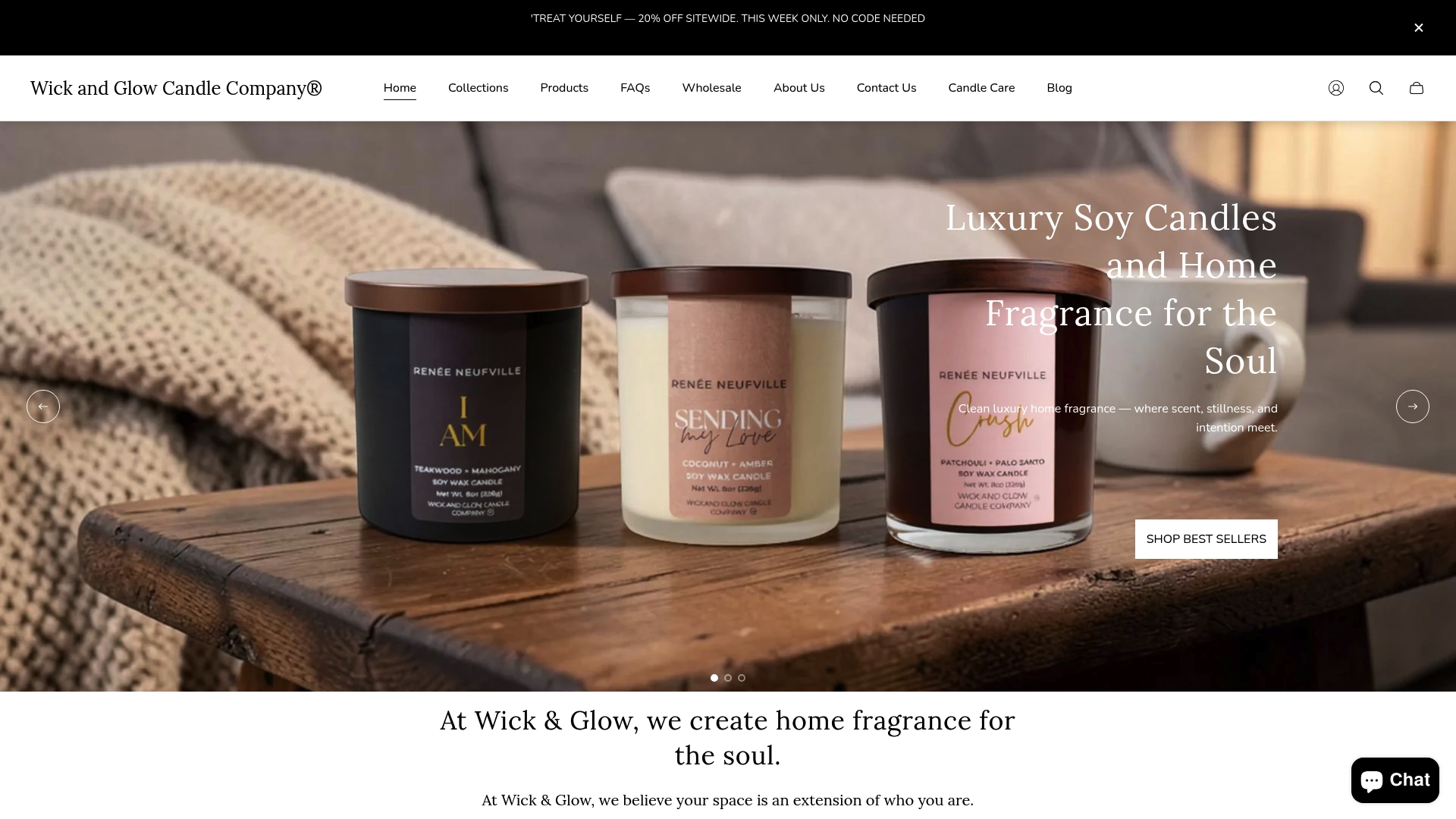
A Wickandglow candle gives you exactly that. Each hand-poured soy candle is built around a specific scent character — woody, floral, gourmand, or oriental — so you can spend an evening with a family before you commit to wearing it. The Exhale Luxury Candle is a good starting point for anyone drawn to warm, grounded profiles. If you want something sweeter and more enveloping, the Can We Talk Luxury Candle leans into the gourmand-floral space. Both are made with clean, phthalate-free ingredients and paired with curated playlists that match the emotional character of the scent. Browse the full collection at Wickandglow and find the family that fits your space — and your next perfume shortlist.
Sources
Recommended


