
- Article published at:
- Article author: Wick and Glow
- Article tag: en
- Article comments count: 0
Discover what a scent profile is and how to choose the perfect fragrance for you. Learn about notes, accords, and family classifications.
Learn More
Drawer menu

Anchor a room’s mood in three steps: pick a base note that runs through the house, assign complementary top and middle notes per room, then pair a passive format (reed diffuser or cold-air diffuser) with one active layer (candle or spray). That combination gives you a steady background scent plus a moment of presence whenever you need it. Fragrance layering builds a subtle, multidimensional experience across a home rather than relying on a single dominant product, and you can test the whole idea tonight in 30 minutes.
Your 3-step starter checklist:
Try it tonight: Place a cedar reed diffuser in your living room, light a fig candle, and sit with it for 30 minutes. If the fig reads clearly over the cedar without either note disappearing, the pairing works.
Fragrance anchoring specific spaces works best when a shared base note runs passively through the home and active formats (candles, sprays) layer mood-specific middle and top notes on top.
| Point | Details |
|---|---|
| Start with a shared base | Choose one grounding note (cedar, amber, sandalwood) and run it through shared spaces via a reed or cold-air diffuser. |
| Map notes to rooms | Assign top notes (citrus, herbs) to kitchens and entries; middle notes to living rooms; base notes to bedrooms. |
| Combine passive and active formats | A reed diffuser as the anchor plus one candle or spray as the active layer is the reliable ceiling for any room. |
| Repeat a ritual to lock in the anchor | Same scent, same playlist, same action for 48–72 hours builds a genuine mood association faster than scent alone. |
| Wickandglow as a clean starting point | Wickandglow’s soy candles, reed diffusers, and room sprays are phthalate-free and playlist-paired, making them ready-made anchors. |
The logic comes straight from perfumery. Every fragrance has three layers: top notes hit first and fade within 15–30 minutes (citrus, herbs, light florals), middle notes carry the emotional core for an hour or more (warm spices, rose, jasmine), and base notes anchor everything and linger longest (woods, resins, musks). When you translate that structure to rooms, you’re essentially mapping notes to spaces by function: top notes for entry halls and kitchens where you want a quick lift, middle notes for living and dining rooms where people linger, and base notes for bedrooms and cozy corners where longevity matters most.
Format matters as much as fragrance family. Reed diffusers and cold-air nebulizers release scent slowly and consistently, making them ideal passive anchors. Candles and room sprays release faster and more intensely, which is why they work as active highlights rather than background. Pairing a low-intensity passive base with an active layer gives large rooms a cohesive scent story without one note bulldozing the other.
Perfumer Ruth Mastenbroek puts it plainly in Homes & Gardens:
Pro Tip: When you introduce a new active layer (a candle or spray), let the passive anchor run for at least 20 minutes first. That way the base note is already in the air and the active layer reads as an addition, not a replacement.
How fragrance affects home atmosphere and mood is well documented, and the short version is this: scent is processed by the limbic system, the same brain region that handles memory and emotion. That’s why a specific smell in a specific room can feel like a place, not just a product.
A scent map is simply a written plan that assigns a mood and a note combination to each room. It takes about 10 minutes to draft and saves you from buying products that clash. Starting with a single scent family and a grounding base note is the most reliable way to prevent clashes across the home.
For a signature home scent that lasts, the base note is the non-negotiable constant. Everything else can rotate seasonally.
Match the format to how the room is used. Passive anchors (reed diffusers, cold-air nebulizers) belong in shared or background spaces. Active formats (candles, room sprays) belong where you want presence and ritual.
| Room | Best Format | Notes |
|---|---|---|
| Entry hall | Reed diffuser or room spray | Small space; a single 4 oz spray or a 5-stick reed diffuser is enough |
| Living room | Reed diffuser (base) + candle (active) | Pair a woody reed with a complementary candle; keep candle 3+ feet from curtains |
| Kitchen | Room spray or electric diffuser | Avoid open flames near stovetops; spritz after cooking to reset the air |
| Bathroom | Reed diffuser or room spray | High humidity accelerates reed diffusion; flip reeds every 3–4 days |
| Bedroom | Candle (pre-sleep ritual) + reed diffuser | Extinguish candle before sleeping; let the reed carry the base overnight |
| Home office | Cold-air nebulizer or reed diffuser | Consistent low-level scent supports focus without distraction |
Cold-air nebulizing diffusers work well as low-maintenance background options for open-plan homes. Avoid placing any diffuser directly under an HVAC return vent — the airflow pulls scent away before it can settle into the room. The role of texture in home fragrance also matters: wax-based formats (candles, wax melts) release scent differently than oil-based reeds or water-mist diffusers, and mixing textures adds dimensionality.
Use a low-intensity passive base, a medium active middle layer, and a quick top-note highlight. That three-tier structure keeps the scent dynamic without becoming dominant.
Layering checklist:
Scent recipes by mood:
| Mood | Base Note | Middle Note | Top Note | Recommended Format |
|---|---|---|---|---|
| Relax | Sandalwood | Lavender | Chamomile | Reed diffuser + lavender candle |
| Energize | Cedar | Eucalyptus | Lemon | Cold-air diffuser + citrus spray |
| Cozy | Amber | Warm spice | Vanilla | Candle (primary) + amber reed |
| Clean | White musk | Cotton | Bergamot | Room spray + light reed diffuser |
| Romantic | Patchouli | Rose | Ylang-ylang | Candle + rose reed diffuser |
| Focus | Cedar | Rosemary | Peppermint | Cold-air diffuser + rosemary spray |
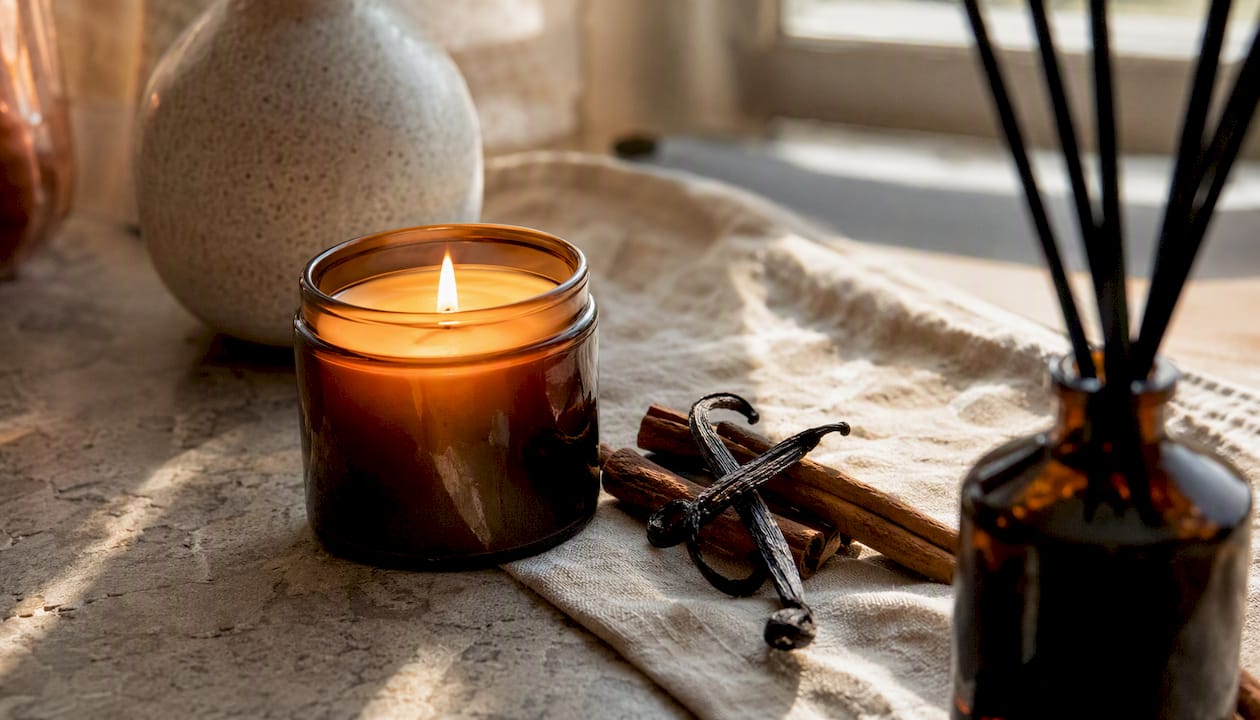
For practical guidance on mixing diffuser and candle scents, the key rule is that the base note should always be quieter than the active layer — not competing with it.
Control intensity with four levers: distance from the room’s center, format choice, run-time, and ventilation. A powder room needs far less scent power than a large vaulted living room — scale product size and run-time accordingly.
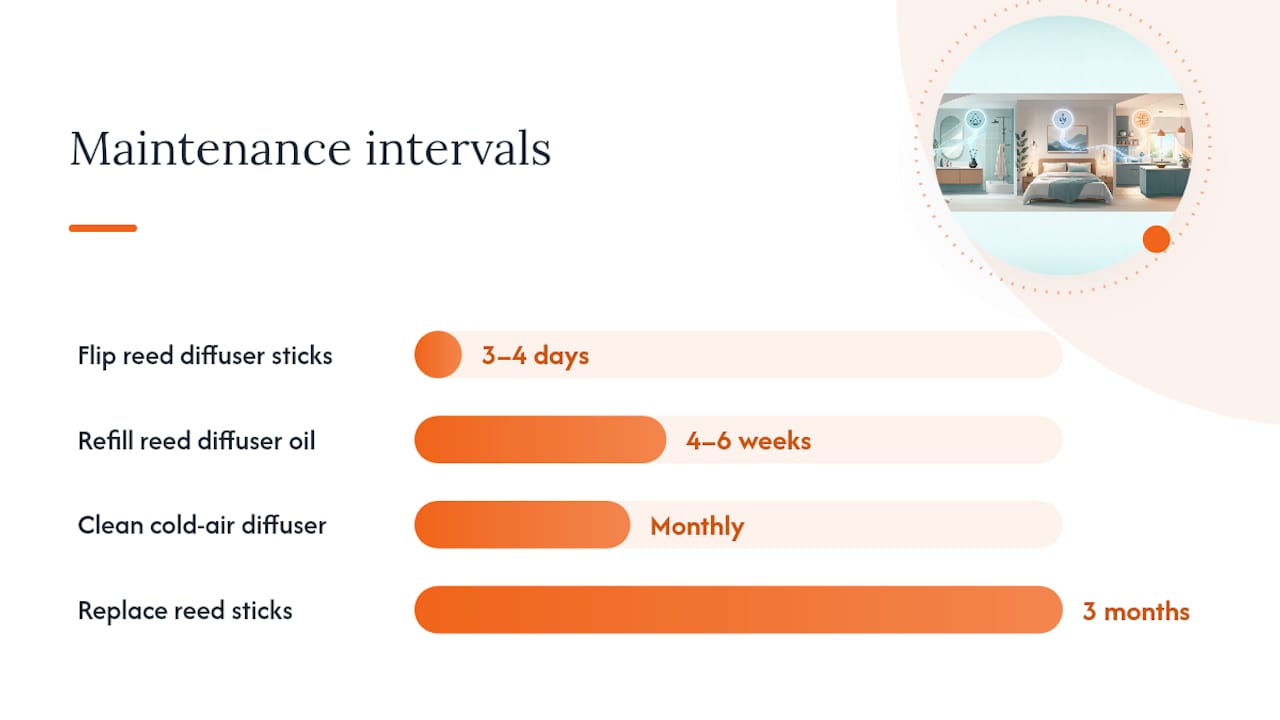
| Task | Frequency |
|---|---|
| Flip reed diffuser sticks | Every 3–4 days (more often in humid rooms) |
| Refill reed diffuser oil | Every 4–6 weeks or when oil level is low |
| Trim candle wick | Before every burn (to ¼ inch) |
| Replace reed sticks | Every 3 months (sticks clog and stop diffusing) |
| Clean cold-air diffuser | Monthly rinse with isopropyl alcohol |
| Rotate room spray | Spritz 2–3 times per session, 8–12 inches from surface |
Safety checklist:
Pro Tip: If your scent fades faster than expected, the issue is usually placement, not product strength. Move the diffuser away from windows and doors, where airflow disperses scent before it settles.
How to layer candle and room spray safely covers the specifics of combining active formats without creating a fire or fragrance hazard.
Pairing scent with a consistent music cue and a repeatable physical action strengthens the association faster than scent alone. The brain links sensory inputs that arrive together repeatedly, so a ritualized scent experience builds a stronger anchor than simply leaving a diffuser running.
A 3-step ritual example:
Repeat this for 48–72 hours without changing any variable. After that window, you’ll notice the scent alone starts to cue the mood even before the music plays. That’s the anchor forming. For hotel-level scent consistency at home, aspirational scent-layering techniques follow the same ritual logic: same scent, same space, same time.
Most people buy a candle, light it, and hope for the best. The room smells good for an hour, then nothing. The problem isn’t the candle. It’s the absence of a base.
Once you run a passive anchor continuously and treat the candle as a highlight rather than the whole show, the room holds a scent identity even when the candle is out. The entry smells like the entry. The bedroom smells like the bedroom. Guests notice before you say a word.
Working with Wick & Glow’s product range made this concrete. Their hand-poured soy candles are built to layer — the fragrance profiles are intentional, not generic, and the playlist pairing turns the lighting ritual into something you actually look forward to repeating. That repetition is what builds the anchor.
Wickandglow’s hand-poured soy candles, reed diffusers, and luxury room sprays are built specifically for the passive-plus-active layering method this article describes. Every product uses clean, vegan, phthalate-free ingredients, so you’re not trading air quality for ambiance. The playlist-paired experience means each product comes with a ready-made ritual cue, which is the fastest way to build a genuine scent anchor.
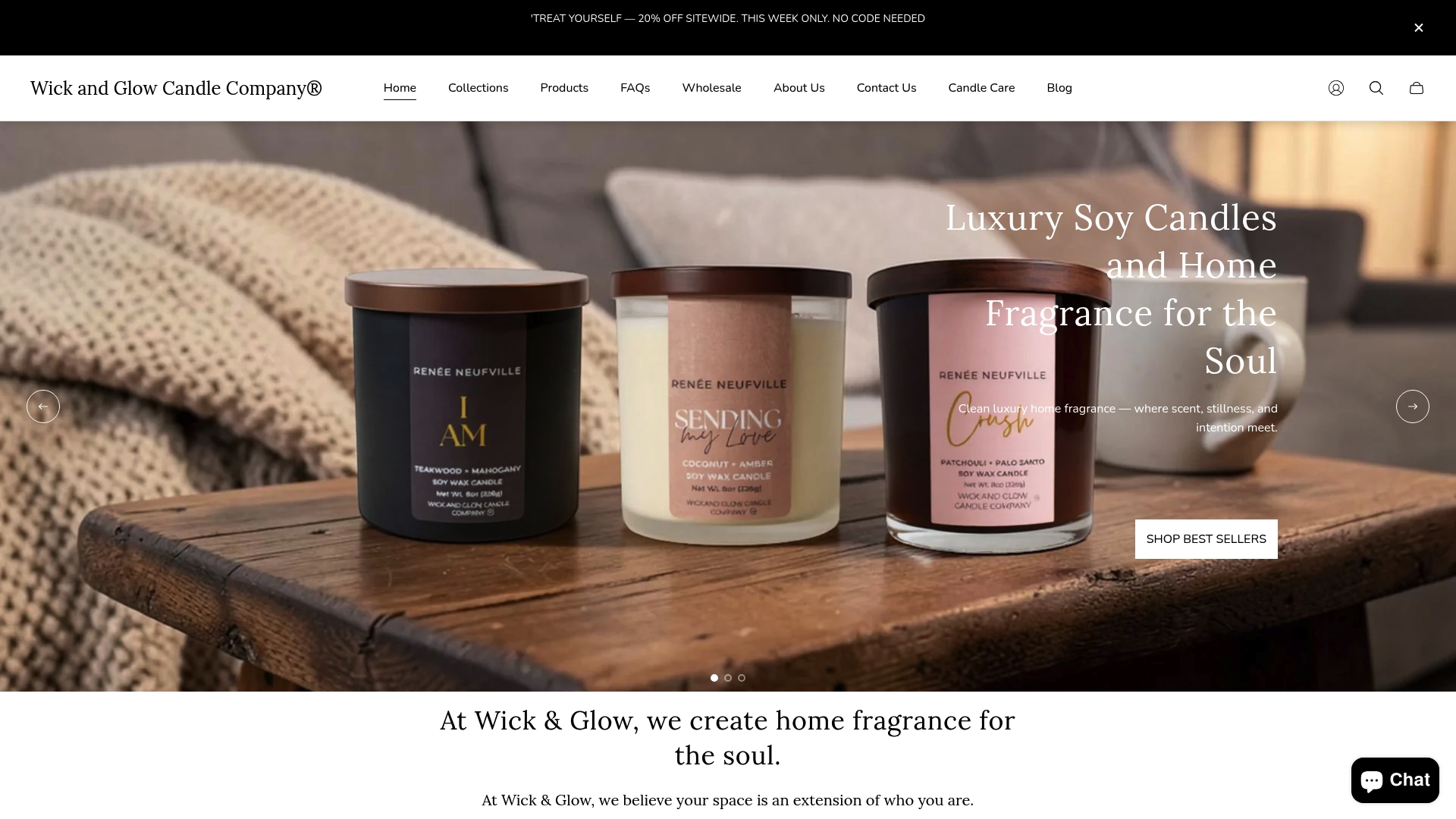
The Men Love Candles Too collection works as a starter kit for anyone building a first scent map: the fragrance profiles are grounded in warm, woody base notes that pair cleanly with most middle-note additions. Browse the full collection at Wickandglow and pick one passive format plus one active format to start your first room experiment today.

