A signature home scent is defined as a consistent, intentional fragrance identity built from a dominant scent family layered with complementary notes to shape how your home feels and is remembered. Creating one is less about buying the right candle and more about applying the same design logic that luxury hotels use. The scent pyramid model, which organizes fragrance into top, middle, and base notes, is the professional standard for this kind of layering. When you create a signature home scent with this structure, you stop chasing random fragrances and start building something that actually reflects you. Wickandglow approaches this exact idea by pairing each fragrance with an R&B playlist, proving that scent and mood are inseparable.
How to create a signature home scent by choosing your scent family
The first decision is your dominant scent family. Every other choice flows from it. The major families are woods, citrus, floral, amber, spice, tea, and soft musk. Each one carries a distinct emotional tone.
-
Woods (cedarwood, sandalwood, vetiver): grounded, warm, masculine or gender-neutral
-
Citrus (bergamot, lemon, grapefruit): energizing, clean, welcoming
-
Floral (rose, jasmine, peony): romantic, soft, classic
-
Amber and spice (clove, cardamom, tobacco): rich, cozy, evening-oriented
-
Tea and herbs (green tea, eucalyptus, mint): fresh, calm, spa-like
Pick one family as your anchor. Consistency across rooms is what makes a scent feel like yours rather than a collection of unrelated candles. You can vary the intensity and delivery method from room to room, but the core family should stay the same.
Once you have your dominant family, choose one or two accent notes. Vanilla is the most universally effective base note, pairing naturally with citrus, sandalwood, or light florals across cultural contexts. A sample blend that works well: cedarwood as the base, bergamot as the top note, and lavender as the heart note. That combination gives you warmth, brightness, and calm in a single identity.
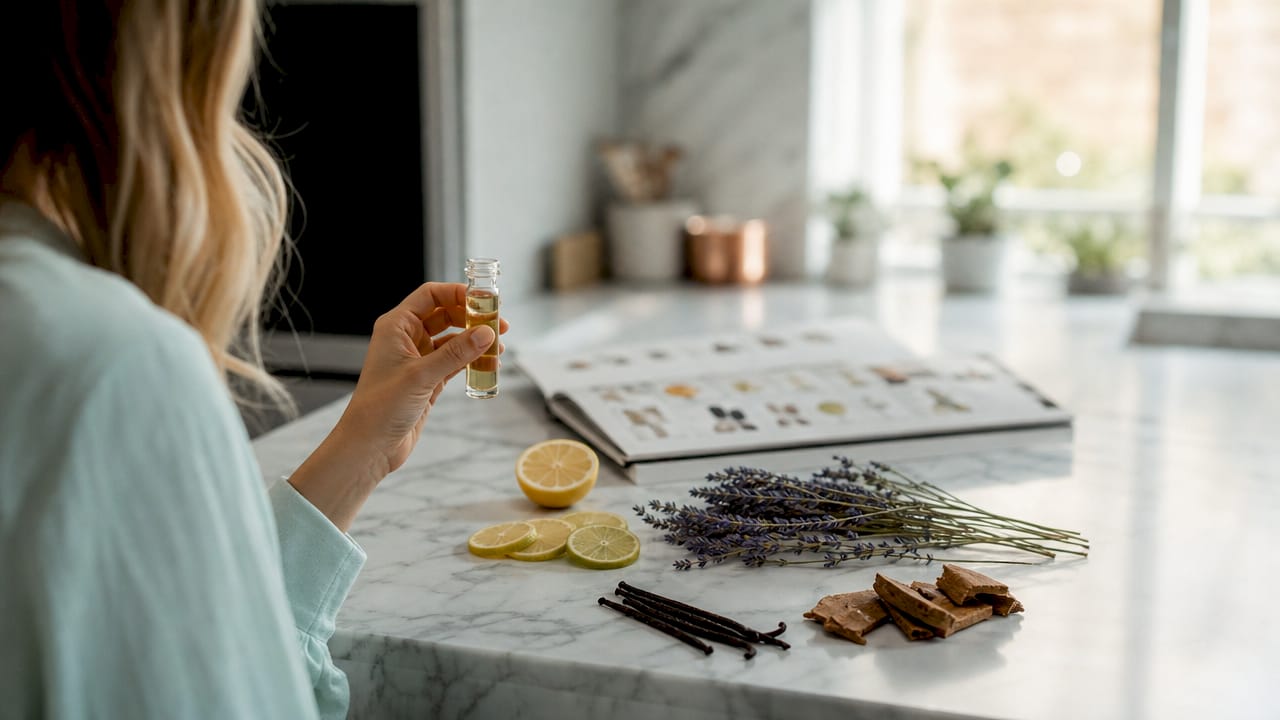
The scent pyramid organizes these choices into three layers. Top notes are what you smell first, usually citrus or herbs, and they fade within 15–30 minutes. Heart notes, often florals or spices, carry the character of the fragrance. Base notes, like woods or musk, anchor the blend and linger longest. A well-built home fragrance recipe uses all three.
Pro Tip: Write down your chosen scent family and two accent notes before you buy anything. Treating it like a brief keeps you from impulse-buying fragrances that don’t fit your identity.
What are the best ways to apply scent in each room?
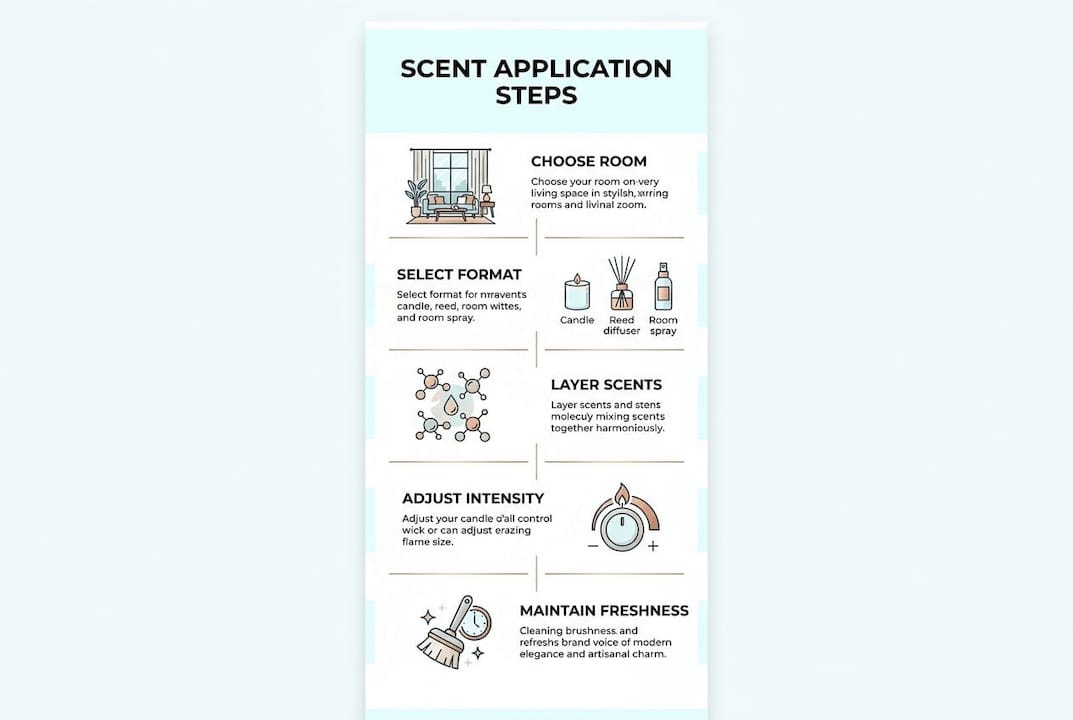
Scent application is where most people go wrong. They use the same candle everywhere, and the result is either overwhelming or inconsistent. Using the same scent format in every room creates scent chaos; the fix is to match your delivery method to the room’s size and function.
Here is a room-by-room approach:
-
Entryway: This is your most important zone. Scent-scaping experts treat the entryway as the first impression, the place where your signature scent identity gets imprinted on every guest. Use a reed diffuser here for continuous, low-maintenance diffusion.
-
Living room: This is your highest-traffic space. A soy candle works well because the visual element adds to the ambiance. Burn it during gatherings or evenings to reinforce the mood.
-
Kitchen: Keep it light. Citrus top notes cut through cooking odors without competing. A room spray used after cooking is more practical than a candle near an open flame.
-
Bathroom: Subtle is the rule. A small reed diffuser or a single tea light candle keeps the scent present without becoming oppressive in a confined space.
-
Bedroom: Lower intensity, shorter diffusion time. Ultrasonic diffusers with scheduled output work well here because you can set them to run for 30 minutes before sleep and shut off automatically.
Stronger diffusion suits larger spaces; subtle application fits smaller, more intimate rooms. That principle alone solves most scent-layering problems. For a deeper breakdown of matching fragrance to each space, Wickandglow’s guide on scents for each room is worth reading before you shop.
Pro Tip: Layer formats, not just fragrances. Run a diffuser as your base layer, then light a candle for events. The two formats together create depth that a single product cannot.
How to make a DIY reed diffuser for your personalized scent
Reed diffusers are the most practical tool for daily scent maintenance. They work without heat, run continuously, and let you control intensity by adjusting the number of reeds. Building one yourself also lets you dial in your exact fragrance blend.
Here is how to assemble one:
-
Choose your vessel. A narrow-necked glass bottle slows evaporation and extends the life of your blend. Wide-mouthed containers release scent faster but need refilling more often.
-
Select your carrier base. Professional-grade fragrance bases like DPG (dipropylene glycol) produce the most consistent scent throw. Coconut oil works but evaporates unevenly. Alcohol-based carriers release scent quickly but fade fast.
-
Blend your fragrance oils. Follow the scent pyramid: add your base note oil first (about 50% of the blend), then your heart note (30%), then your top note (20%). This ratio mirrors how professional fragrance houses build their formulas.
-
Insert the reeds. Start with 4–6 reeds for a small room. Add more for larger spaces. Flip the reeds after 24 hours to saturate them fully.
-
Place strategically. Position the diffuser near an air vent or doorway where natural airflow carries the scent without direct sunlight hitting the bottle, which degrades fragrance oils.
| Variable |
Effect on scent throw |
| More reeds |
Stronger, faster diffusion |
| Fewer reeds |
Subtle, longer-lasting output |
| Narrow vessel neck |
Slower evaporation, extended life |
| Wide vessel neck |
Faster release, shorter lifespan |
| Near airflow |
Broader scent distribution |
Flip reeds regularly to refresh scent output, and replace them entirely when the fragrance fades and flipping no longer helps. Clogged or dried reeds stop diffusing even when liquid remains in the bottle.
Pro Tip: Add a few drops of your top note oil to the reeds directly when the scent feels flat. It refreshes the blend without requiring a full refill.
Wickandglow’s luxury reed diffuser is a strong reference point if you want to see how a professionally blended diffuser performs before committing to a DIY version.
How do you maintain a signature scent without going nose-blind?
Olfactory fatigue, commonly called nose blindness, is the single biggest threat to a signature home scent. Your brain stops registering a smell after prolonged exposure. The scent is still there; you just stop noticing it.
The fix is rotation, not replacement. Changing accent notes seasonally preserves the novelty of your signature scent without abandoning the core identity you have built. Keep your base and heart notes consistent. Swap your top note with the season: citrus in spring and summer, spice or warm herbs in fall and winter.
Here are the key maintenance habits:
-
Schedule diffusion. Run diffusers for 30–60 minutes at a time rather than continuously. Your nose resets during the off periods.
-
Rotate accent products. Keep your dominant scent family constant but cycle between two or three accent note variations across the year.
-
Refresh your reeds monthly. Flip them weekly and replace them every 4–6 weeks for consistent output.
-
Check for safety. Some essential oils, particularly eucalyptus, tea tree, and certain citrus oils, are harmful to cats and dogs at high concentrations. Use non-toxic fragrance options if you have pets or young children.
Restraint and balance maintain a sanctuary-like atmosphere better than intensity ever does. The goal is a scent that guests notice when they walk in, not one that announces itself from the driveway. Pairing your fragrance choices with complementary decor, like the crystal accents that work well in bathrooms and bedrooms, reinforces the overall sensory environment without adding more fragrance.
Pro Tip: Step outside for five minutes before evaluating your home’s scent. Fresh air resets your nose and gives you an honest read on what guests actually experience when they walk in.
Key Takeaways
A personalized home fragrance identity requires one dominant scent family, layered delivery formats, and seasonal accent rotation to stay fresh and memorable over time.
| Point |
Details |
| Start with a scent family |
Choose one dominant family (woods, citrus, floral) and build every other choice around it. |
| Use the scent pyramid |
Layer top, middle, and base notes to create a fragrance that evolves and lasts. |
| Match format to room |
Use diffusers for daily control, candles for ambiance, and sprays for quick refreshes. |
| Prevent nose blindness |
Rotate accent notes seasonally and schedule diffusion in timed intervals, not continuously. |
| Prioritize restraint |
Subtle, consistent scent beats intensity every time, especially in smaller rooms. |
Why I think most people overcomplicate home fragrance
Most people treat home scent like a shopping problem. They buy more products hoping the right combination will appear. The actual problem is almost always a lack of a clear starting point.
The hospitality industry figured this out decades ago. Luxury hotels don’t need expensive products to create a memorable scent identity. They use restraint, consistency, and placement. A single well-chosen fragrance in the lobby does more work than a dozen competing scents spread across every floor.
What I have found works at home is treating the entryway like a hotel lobby. Get that one zone right first. Everything else follows from it. Once the entryway scent is locked in, extending it to the living room and bedroom feels natural rather than forced.
The other thing worth saying: diffusers are underrated for daily life. Candles are beautiful and create real ambiance, but they require attention. A diffuser runs quietly in the background and keeps your scent identity present without any effort. I use both, but the diffuser does the heavy lifting on ordinary days.
Trust your instincts on scent selection. If a fragrance makes you feel at home the moment you smell it, that is the right signal. Fragrance is one of the few design decisions that is entirely personal and entirely yours to make.
— B
Wickandglow fragrances built for your signature scent
Wickandglow designs every fragrance with layering in mind. Each candle, diffuser, and room spray is built around a specific emotional tone, which makes it easier to build a cohesive scent identity rather than guessing at combinations.
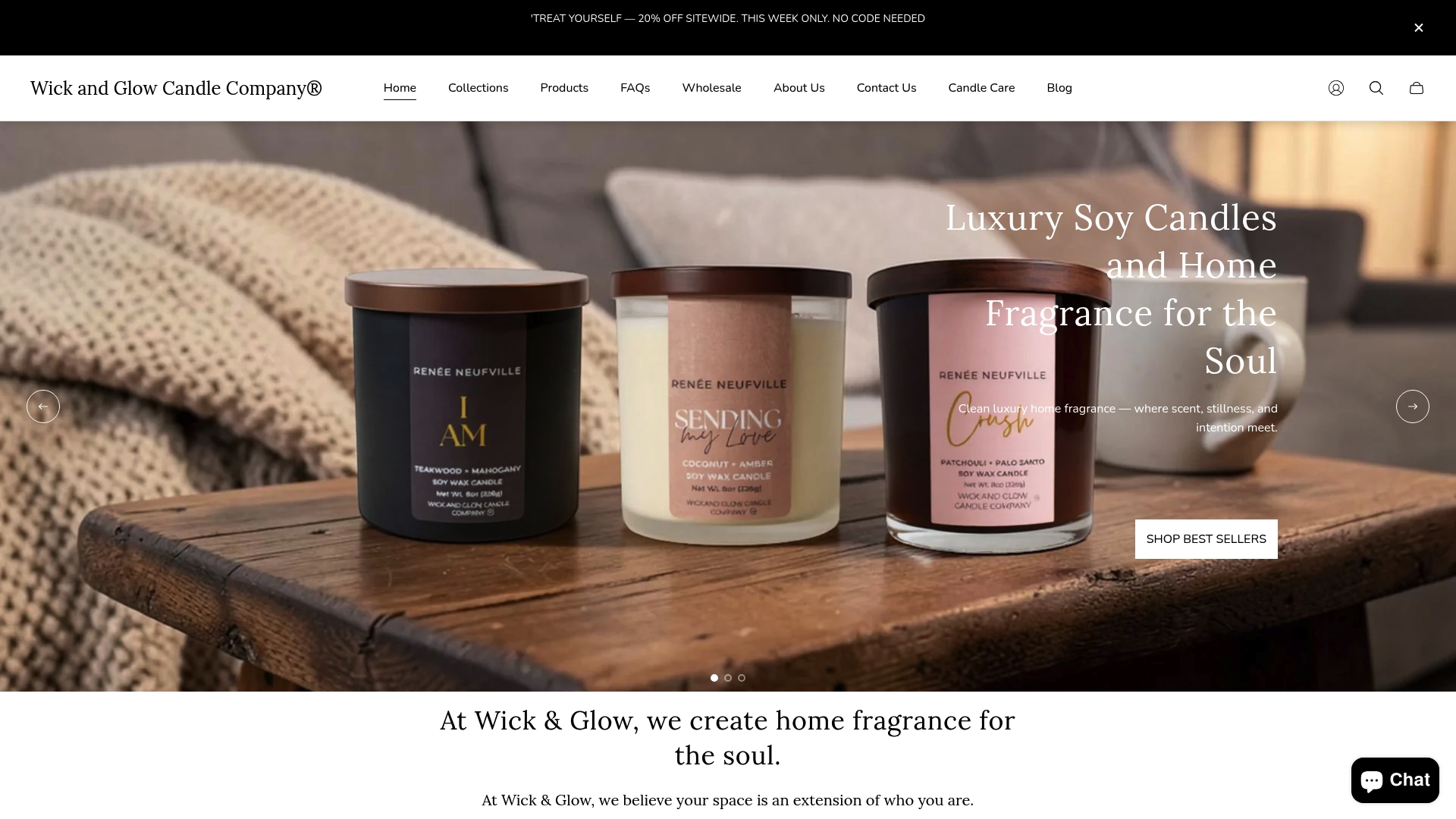
The Men Love Candles Too collection is a strong starting point for anyone drawn to wood, amber, and spice families. Every product uses non-toxic, phthalate-free formulations, so they are safe for homes with pets and children. Wickandglow’s home fragrance bundle pairs a soy candle, reed diffuser, and room spray in one scent, giving you all three delivery formats to layer across your home from day one.
FAQ
What is a signature home scent?
A signature home scent is a consistent fragrance identity built from a dominant scent family and layered complementary notes, applied throughout your home to create a memorable and personal atmosphere.
How do I choose the right scent family for my home?
Pick the scent family that matches the emotional tone you want your home to carry. Woods and amber create warmth; citrus and tea create freshness; florals create softness.
Can I create a DIY home perfume for my living space?
Yes. A DIY reed diffuser using a professional carrier base like DPG, combined with fragrance oils layered by the scent pyramid, produces a consistent and long-lasting result.
How do I stop going nose-blind to my home fragrance?
Rotate your accent notes seasonally and run diffusers on a timed schedule rather than continuously. Your nose resets during the off periods, keeping the scent perceptible.
Is it safe to use fragrance diffusers around pets and children?
Some essential oils are harmful to pets at high concentrations. Choose non-toxic, phthalate-free formulations and keep diffusion times short in rooms where pets and children spend the most time.
Recommended


