Fragrance transparency is a business imperative, not a marketing trend. Brands that disclose what’s in their scented products earn measurably higher consumer trust, reduce liability exposure, and meet the access requirements of clean-retail channels that are growing faster than conventional mass market. The International Fragrance Association (IFRA) maintains a Transparency List of 3,691 fragrance and functional ingredients currently used in global formulations, giving brands a credible reference point for disclosure. The FDA regulates cosmetics under the Federal Food, Drug, and Cosmetic Act but largely leaves fragrance ingredient disclosure to industry self-regulation, which means the risk of getting caught flat-footed by state-level legislation falls entirely on the brand.
Three things you can do today:
-
Publish your ingredient list on every product page, even if it currently reads only “fragrance” or “parfum” — that single word signals a gap to informed buyers.
-
Send your fragrance supplier a written request for a full composition disclosure or, at minimum, a certified allergen list and a statement of phthalate-free formulation.
-
Document every known allergen in your current formulations in a shared internal file, so your compliance, marketing, and customer-service teams are working from the same data.
Table of Contents
Why fragrance transparency matters for brands right now
Consumer expectations have shifted faster than most brand teams realize. Buyers now evaluate fragrance products on whether they feel safe and whether the brand’s values match their own, not just on scent profile. According to a LinkedIn-sourced survey, 94% of consumers report being more likely to stay loyal to brands that offer complete transparency. That figure comes from a social-media post rather than a peer-reviewed study, so treat it as directional, but the direction is consistent with every clean-beauty market report published in the last three years.
The business risk of opacity is concrete. A BCPP testing report found 338 fragrance chemicals across 140 tested products; 99 of those chemicals were linked to chronic health concerns, and 75% of the detected harmful chemicals were fragrance-related and often unlisted on labels. When a retailer or a plaintiff’s attorney finds that kind of gap between what’s on your label and what’s in your formula, the cost is not just reputational.
Retailer access is the third lever. Clean-retail channels and specialty wellness stores increasingly require brands to disclose fragrance components as a condition of shelf placement. Salon and professional-use buyers face their own liability concerns: the Right to Know movement specifically targets professional workers who are exposed to fragrance chemicals at high frequency and need ingredient data to make informed purchasing decisions. A brand that cannot produce a full or partial disclosure gets passed over.
Consumers now judge fragrance brands on whether the product feels safe and aligns with their values, not only on how it smells. Transparency is no longer a niche differentiator — it is a baseline expectation in the clean-beauty segment.
Pro Tip: Before your next product launch, run a small A/B test: publish a full ingredient list on one SKU’s product page and leave a second comparable SKU with only “fragrance” listed. Track add-to-cart rate, return rate, and customer-service inquiries over 60 days. The data will make the business case internally far faster than any industry report.
A 2024 academic study found that independent, verified ingredient data — including blockchain-enabled traceability — builds more consumer and buyer trust than supplier certificates alone. That gap between what a supplier certifies and what an independent audit confirms is exactly where brand reputations get damaged.
What does “fragrance” on a label actually hide?
The single word “fragrance” (or its INCI equivalent, “parfum”) is a legal placeholder that can cover dozens to hundreds of individual chemicals. Trade-secret protections allow fragrance houses to withhold full composition data from brand owners, which means many brands genuinely do not know every ingredient in their own products. INCI (International Nomenclature of Cosmetic Ingredients) is the standardized naming system used on U.S. cosmetic labels; ingredients must be listed in descending order of concentration, but “fragrance” sits as a single entry regardless of how complex the underlying blend is.
Allergen disclosure works differently in the EU than in the U.S. The EU requires brands to call out 26 specific fragrance allergens by name when they exceed threshold concentrations (0.01% in rinse-off products, 0.001% in leave-on products). The U.S. has no equivalent federal requirement. That regulatory gap is exactly why California’s SB 312 matters.
A few things to know about how labels work in practice:
- Ingredients are listed by concentration, highest first, but “fragrance” can appear anywhere in the list depending on its total percentage.
- Allergens embedded within a fragrance blend are not required to be broken out on a U.S. label under current federal rules.
- “Fragrance-free” and “unscented” claims are not strictly regulated in the U.S. — a product can carry that claim while still containing masking fragrances.
- IFRA’s 2025 Transparency List covers 3,691 ingredients; it is a reference tool, not a mandatory disclosure standard.
Sample label comparison:
| Label Type |
What It Shows |
What It Hides |
| Standard U.S. label |
“Fragrance” as a single INCI entry |
Individual aroma chemicals, solvents, fixatives |
| EU-compliant label |
Named allergens above threshold (e.g., Linalool, Limonene) |
Sub-threshold allergens, non-allergen components |
| Full-disclosure label |
Every INCI name in the blend, listed by concentration |
Nothing — this is the transparency standard |
| “Fragrance-free” claim |
No intentional scent ingredient listed |
Possible masking agents at low concentrations |
On your product pages, publish the full INCI list even when it is long. On-pack, you are constrained by space, but you can add a URL or QR code pointing to a dedicated ingredient page. That two-step approach satisfies informed buyers without requiring a label redesign for every SKU.
What U.S. regulations and standards should your brand know?
The FDA’s authority over cosmetics comes from the Federal Food, Drug, and Cosmetic Act, updated by the Modernization of Cosmetics Regulation Act of 2022 (MoCRA). MoCRA added new requirements for facility registration, serious adverse event reporting, and safety substantiation, but it did not mandate full fragrance ingredient disclosure. Brands are still largely self-regulating on what goes inside “fragrance.”
That self-regulation gap is being filled at the state level. California’s Cosmetic Fragrance and Flavor Ingredient Right to Know Act (SB 312, signed 2020) requires companies to report fragrance and flavor ingredients linked to health concerns to the California Department of Public Health, which maintains a publicly searchable Safe Cosmetics Program database. If you sell in California, you are already subject to this reporting obligation. Other states are watching California’s model closely, and federal legislation has been introduced in multiple sessions to create a national equivalent.
The FDA does not require brands to disclose individual fragrance ingredients on cosmetic labels. That regulatory gap is the single biggest reason state-level bills like California’s SB 312 exist — and why brands that wait for federal mandates are already behind.
IFRA provides the industry’s primary voluntary safety framework. Its standards set concentration limits for specific fragrance ingredients across product categories, and its 2025 Transparency List gives brands a reference for which ingredients are in active use globally. RIFM (Research Institute for Fragrance Materials) generates the safety data that underpins IFRA standards. Neither IFRA compliance nor RIFM data submission is legally required in the U.S., but both are increasingly expected by retailers and professional buyers.
Steps to take now:
- Register your manufacturing facilities with the FDA under MoCRA if you have not already done so.
- Check whether any of your fragrance ingredients appear on the California Safe Cosmetics Program’s reportable list.
- Review IFRA’s current standards for your product categories and confirm your supplier is formulating within those limits.
- Build a simple internal database that maps each SKU to its fragrance supplier, the supplier’s IFRA compliance statement, and any California-reportable ingredients.
How do you implement fragrance ingredient disclosure step by step?
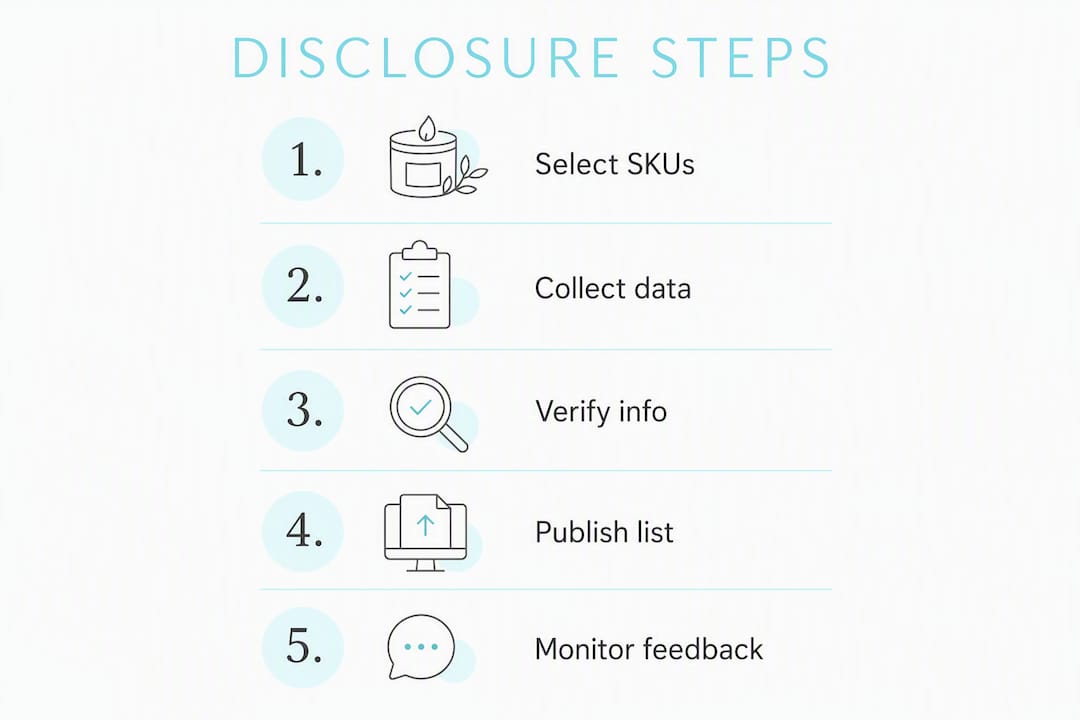
Moving from “fragrance” on a label to full or partial disclosure is a cross-functional program, not a one-off label change. Here is a practical sequence:
-
Audit your current portfolio. List every SKU, its fragrance supplier, and what disclosure data you currently hold. Note gaps: missing allergen lists, missing IFRA compliance letters, missing full INCI breakdowns.
-
Send formal disclosure requests to suppliers. Ask for: (a) full INCI composition with CAS numbers, (b) a certified allergen list against EU 26 allergens as a baseline, © an IFRA compliance certificate for your product category, and (d) a written statement on phthalates, musks, and any California-reportable ingredients.
-
Commission targeted lab testing for high-priority SKUs. Gas chromatography/mass spectrometry (GC/MS) can identify fragrance components independently of what a supplier discloses. This is your verification layer.
-
Conduct a legal review. Have counsel confirm what you can publish without triggering trade-secret disputes with your supplier, and review any “fragrance-free” or “clean” claims for FTC accuracy.
-
Update product pages and on-pack copy. Publish full INCI lists on your website. Add a QR code or URL to physical labels pointing to the ingredient page. Flag allergens with a callout box.
-
Notify retail partners. Send updated ingredient data to any retailer that requires it as a condition of listing. Clean-retail channels often have their own submission portals.
-
Train your customer-service team. They will get questions. A one-page FAQ covering your disclosure approach, what “phthalate-free” means, and how to read your ingredient list will reduce escalations.
Timeline and cost drivers:
-
Months 1–2 (Discovery): Supplier outreach and internal audit. Primary cost: staff time.
-
Months 2–4 (Testing): GC/MS testing for priority SKUs. Lab costs vary by provider and scope; budget for multiple SKUs if your portfolio is large.
-
Months 3–5 (Legal and label): Legal review plus label and web copy updates. Packaging reprints are often the largest single cost driver.
-
Months 6–18 (Scale and maintain): Roll out to full portfolio, build supplier audit cadence, update retailer submissions.
Pro Tip: Start with your three best-selling SKUs, not your full catalog. A pilot disclosure on a small set of products lets you test consumer response, identify supplier friction, and refine your process before committing to a full portfolio rollout.
Governance matters as much as process. Assign a named owner in product development or compliance to track supplier data, a marketing lead to own the consumer-facing copy, and a supply-chain contact to manage supplier relationships and audit schedules.
What safety concerns are tied to fragrance chemicals?
The hazard categories that come up most often in fragrance safety reviews fall into four groups: contact allergens, endocrine-disrupting chemicals (EDCs), phthalates used as fixatives, and respiratory irritants. The BCPP report that tested 140 products found 338 fragrance chemicals present; 99 of those chemicals were linked to chronic health concerns, and 75% of the detected harmful chemicals were fragrance-related and undisclosed on labels.
Common fragrance safety concerns:
-
Contact allergens: Linalool, limonene, citral, geraniol, and eugenol are among the most frequently flagged. They can cause sensitization reactions, particularly in leave-on products.
-
Phthalates: Diethyl phthalate (DEP) is commonly used as a fragrance solvent and carrier. It is classified as an endocrine disruptor in some regulatory frameworks. Learn more about phthalates in candles and why their absence matters.
-
Synthetic musks: Nitromusks and some polycyclic musks have raised concerns about bioaccumulation and hormonal activity.
-
Respiratory irritants: Certain aldehydes and terpenes can trigger reactions in people with asthma or chemical sensitivities, particularly in home fragrance products used in enclosed spaces.
Safety documentation checklist before publishing disclosures:
| Document |
Purpose |
Who Provides It |
| Full INCI composition |
Identifies every ingredient |
Fragrance supplier |
| IFRA compliance certificate |
Confirms concentration limits met |
Fragrance supplier |
| GC/MS test report |
Independent verification of composition |
Accredited lab |
| Allergen list (EU 26 baseline) |
Flags sensitizers for consumer disclosure |
Supplier or lab |
| California SB 312 reportable ingredient check |
Confirms state reporting compliance |
Internal compliance team |
| Safety Data Sheet (SDS) |
Occupational and emergency safety |
Supplier |
Transparency accelerates your response when something goes wrong. If a customer reports a reaction, a brand with a full ingredient list on file can identify the likely sensitizer within hours. A brand relying on “fragrance” has to start from scratch with the supplier, which delays response and compounds reputational damage.
How do you disclose without exposing your proprietary blend?
This is the question most brand owners get stuck on, and the answer is more practical than the legal anxiety suggests. Fragrance houses protect their formulas as trade secrets, which means the brand owner often does not receive a full composition list from the supplier. Moving toward transparency usually means choosing suppliers willing to provide open formulations, verified ingredient reports, or structured partial disclosures.
Confidentiality-friendly approaches that still serve consumers:
-
Allergen-only disclosure: Publish the EU 26 allergen list for your product even if you cannot publish the full formula. This is the minimum that informed buyers expect and the most legally defensible partial disclosure.
-
Functional category disclosure: Instead of listing “Linalool 0.3%,” you can state “contains naturally derived floral terpenes” — less precise, but more informative than “fragrance.”
-
Threshold-based reporting: Commit to disclosing any ingredient present above a defined threshold (e.g., 0.1% by weight). This protects low-concentration proprietary components while surfacing the bulk of the formula.
-
Supplier affidavit model: Your supplier provides a signed statement confirming the formula contains no restricted ingredients, no California-reportable chemicals above threshold, and no phthalates. You publish the affidavit summary, not the formula.
-
Third-party verified summary: An independent lab or certification body reviews the full formula and issues a public summary confirming safety and allergen status. The formula stays confidential; the verification is public.
Pro Tip: When negotiating new supplier contracts, add a clause requiring the supplier to provide a full INCI list to a named third-party auditor under NDA, even if they will not provide it directly to you. This gives you a verification path without forcing the supplier to surrender their IP.
Sample supplier disclosure request language: “Please provide, under mutual NDA, a complete INCI ingredient list with CAS numbers for [Product Name], an IFRA compliance certificate for Category [X], a certified list of EU 26 fragrance allergens present above 0.01% (rinse-off) or 0.001% (leave-on) thresholds, and a written declaration confirming absence of phthalates and California Prop 65-listed fragrance chemicals.”
What does a phased transparency rollout actually cost?
Cost concentrates in four areas: lab testing, label and packaging reprints, legal review, and web development. The relative weight of each depends on your portfolio size and how far your current disclosures fall from the target state.
Common cost drivers:
- Lab testing (GC/MS per SKU) varies by scope and lab; testing a complex fragrance blend costs more than a simple single-note formula.
- Packaging reprints are often the largest line item, especially for brands with physical retail presence. Digital-first brands can update web disclosures immediately and defer physical label changes to the next print run.
- Legal review of supplier contracts and public disclosure language is a one-time cost that scales with portfolio complexity.
- Web development for a dedicated ingredient page or interactive ingredient lookup is typically a modest investment but requires ongoing maintenance as formulas change.
Phased rollout plan:
-
Pilot phase (months 1–3): Select 3–5 SKUs. Complete supplier outreach, GC/MS testing, legal review, and web disclosure for those SKUs only. Measure consumer response and retailer feedback.
-
Scale phase (months 4–12): Extend the process to the remaining portfolio in priority order (bestsellers, then new launches, then legacy SKUs). Align label reprints with scheduled packaging refreshes to reduce cost.
-
Full rollout and maintenance (months 12–18+): All SKUs disclosed, supplier audit cadence established, internal database live, and retailer submissions current. Build annual review into your product-development calendar.
Brands that treat transparency as a portfolio program rather than a one-off project consistently report lower long-term costs because they build supplier disclosure requirements into new product contracts from the start, eliminating the need for retroactive audits.
How do consumers actually read ingredient transparency?
Most consumers do not read INCI lists the way a cosmetic chemist does. They scan for signals: a short list feels cleaner than a long one, recognizable ingredient names feel safer than chemical nomenclature, and explicit callouts (“phthalate-free,” “no synthetic musks”) carry more weight than a buried absence.
What buyers look for on a product page:
- A visible, complete ingredient list — not hidden behind a “more info” toggle.
- Allergen callouts in plain language (“contains linalool, a naturally occurring component of essential oils”).
- Origin or sourcing claims (“naturally derived,” “plant-based”) with enough specificity to be credible.
- Third-party verification badges (IFRA-compliant, EWG Verified, Leaping Bunny) that signal independent review.
Common misinterpretations to address proactively: “fragrance-free” does not mean no aroma chemicals are present, and “natural fragrance” is not a regulated term in the U.S. If you use either phrase, add a one-line clarification on the product page. A tooltip or expandable FAQ section works well for this.
Placement guidance: put the full INCI list on the product page itself, not only on a separate ingredient glossary page. Add a dedicated ingredient FAQ page for consumers who want more context. For products with complex formulas, a downloadable Safety Data Sheet (SDS) gives professional buyers and salon workers the detail they need without cluttering the consumer-facing page.
Reading candle ingredient labels is a skill most buyers are still developing. Short, plain-language explanations next to your ingredient list close that gap faster than any badge.
How Wick & Glow practices fragrance transparency
Wickandglow publishes its clean-ingredient commitments directly on product pages and in its brand content, making the disclosure approach visible at every stage of the purchase journey. Every product in the Wickandglow line is formulated to be phthalate-free and vegan, and those claims are stated explicitly rather than buried in fine print. The brand’s clean, non-toxic home fragrance content explains the formulation philosophy in plain language, giving buyers the context to understand what “clean” means in practice for candles, diffusers, and sprays.
Wickandglow’s disclosure approach in practice:
-
Phthalate-free declaration stated on product pages and in brand content, not just on packaging.
-
Vegan formulation confirmed across the product line, addressing a growing segment of buyers who cross-check ingredient sourcing.
-
Clean-ingredient framing tied to the brand’s R&B-inspired storytelling, so transparency becomes part of the product experience rather than a compliance footnote.
-
Supplier-level commitment to clean, intentional ingredients reflected in every custom blend and corporate gifting order.
The business impact has been consistent with what the broader market data suggests: buyers who find clear ingredient information on a product page convert at higher rates and generate fewer post-purchase ingredient-related inquiries. Fewer returns tied to ingredient concerns reduce both direct costs and customer-service load.
Transparency at Wickandglow is not a separate initiative from the product itself. The clean-ingredient commitment is built into the formulation brief, which means disclosure is straightforward because there is nothing to hide.
Other brands can adapt this model by starting with a single non-negotiable claim (phthalate-free, allergen-disclosed, IFRA-compliant) and building outward from there. One clear, verifiable claim stated plainly on the product page is worth more than a vague “clean” badge with no supporting detail.
Key Takeaways
Fragrance transparency is a measurable business advantage: brands that disclose ingredients build consumer loyalty, reduce liability exposure, and meet the access requirements of clean-retail channels that are expanding across the U.S. market.
| Point |
Details |
| Consumer loyalty is at stake |
94% of consumers report higher loyalty to fully transparent brands, making disclosure a retention tool. |
| “Fragrance” hides real risk |
A single INCI entry can cover hundreds of chemicals; a BCPP testing report found 338 fragrance chemicals in 140 products, with 99 linked to chronic health concerns and 75% of detected harmful chemicals being fragrance-related and undisclosed. |
| U.S. regulation is catching up |
California SB 312 requires reporting of harmful fragrance ingredients; MoCRA added new FDA oversight; more state bills are pending. |
| Disclosure is operationally achievable |
A phased pilot covering 3–5 SKUs, supplier outreach, and GC/MS testing is a practical starting point for any brand. |
| Wickandglow leads by example |
Wickandglow’s phthalate-free, vegan formulations with plain-language ingredient disclosure show how transparency integrates into brand identity. |
The case for transparency goes deeper than compliance
The conventional wisdom in the fragrance industry is that trade-secret protection is a supplier problem, not a brand problem. That framing is wrong, and it is costing brands. When a customer has a reaction, when a retailer asks for a full disclosure, or when a state regulator requests a report, the brand is the one answering. The supplier’s NDA does not protect the brand from any of those conversations.
What the transparency conversation often misses is that disclosure is also a product-development forcing function. Brands that require full ingredient data from suppliers before signing a contract end up with cleaner, better-documented formulas. The discipline of asking “what is in this, exactly?” changes what gets sourced. Wickandglow’s phthalate-free, vegan commitment is not just a marketing claim; it is a procurement standard that shapes every formulation decision.
The brands that will struggle in the next five years are not the ones that disclosed too much. They are the ones that kept “fragrance” on the label while the market moved to full ingredient lists, clean-retail channels tightened their requirements, and state legislatures filled the gap the FDA left open. Waiting for a federal mandate is a strategy for being last.
Start with one claim you can fully defend. Publish it clearly. Build from there.
Wickandglow’s clean fragrance line is built on this standard
Every Wickandglow product starts with a clean-ingredient brief: phthalate-free, vegan, and formulated with intention. That is not a retroactive claim added to marketing copy; it is the formulation standard the brand has held from the start. For brand owners and marketers who want a concrete example of what ingredient transparency looks like in a home fragrance line, the Wickandglow catalog is it.
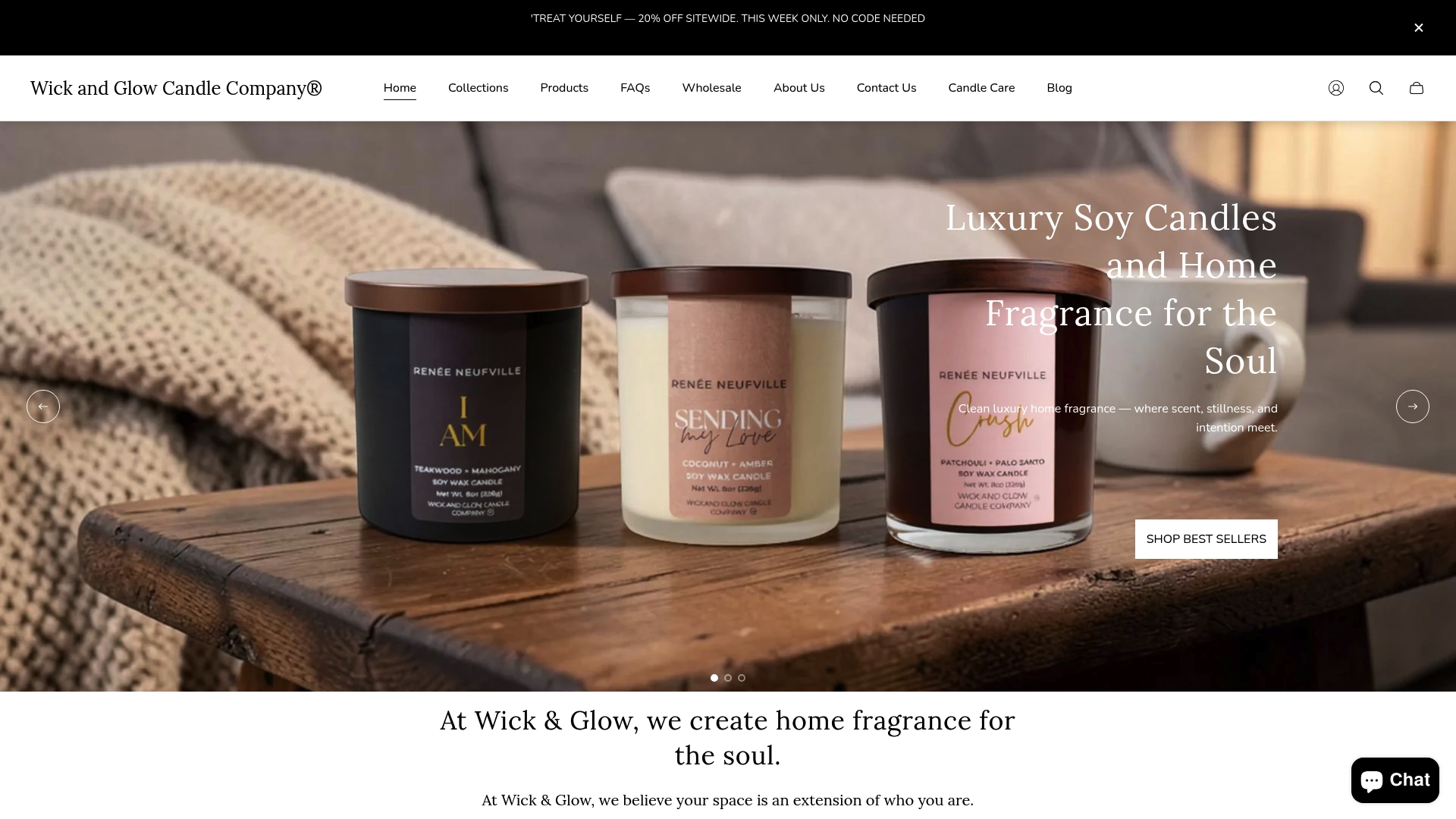
The R&B Mixtape: Self-Care Edition luxury soy candle set is a good place to see the approach in action: clean ingredients, a curated scent story, and a product page that does not hide behind “fragrance.” For custom blends or corporate gifting orders where ingredient transparency is a procurement requirement, Wickandglow’s team can provide full formulation documentation. Browse the full collection at wickandglow.com or reach out directly to discuss a custom order built to your disclosure standards.
Useful sources and resources for U.S. brands
| Resource |
What It’s For |
| IFRA Transparency List |
Reference list of 3,691 fragrance ingredients in active global use; use to cross-check your supplier’s formula against industry norms. |
| IFRA Standards |
Voluntary concentration limits by product category; use to confirm your supplier’s IFRA compliance certificate is current. |
| Safe Cosmetics — Fragrance Disclosure |
Explains the fragrance loophole, California SB 312, and the Right to Know movement; use for regulatory context and advocacy background. |
| California Safe Cosmetics Program |
State database of reported cosmetic ingredients linked to harm; check whether your ingredients require reporting. |
| BCPP Fragrance Report |
Independent testing of 140 products; use to understand the hazard categories most likely to appear in fragrance blends. |
| Good On You — Ingredient Transparency |
Analysis of disclosure gaps across beauty brands; useful for benchmarking your current disclosure against market practice. |
| MDPI Blockchain Provenance Study |
Academic review of traceability technology options; use when evaluating supplier verification tools. |
| Fragrance Loophole Explainer |
Plain-language explanation of “fragrance-free” claim risks; use when reviewing your own marketing copy for accuracy. |
For lab testing, GC/MS analysis of fragrance components is available through accredited cosmetic testing laboratories. When selecting a lab, confirm they can provide a full INCI breakdown from the tested sample and a report formatted for regulatory submission.
Recommended


