Non-toxic candle burning tips are the practices that let you enjoy candlelight and fragrance without filling your home with unnecessary pollutants. The wax type, wick material, and how you burn your candles all affect what goes into your indoor air. Choosing natural waxes like soy, beeswax, or coconut wax paired with cotton or wood wicks gives you a cleaner starting point. But the material is only half the story. How you prepare, place, and extinguish your candles determines whether you get a genuinely healthy candle experience or just a prettier version of the same problem.
What candle ingredients actually make a candle non-toxic?
The candle industry uses “non-toxic” as a broad descriptor, but the recognized standard is clean burning: candles that produce minimal soot, no heavy metals, and no synthetic chemical off-gassing. Knowing what separates a clean-burning candle from a conventional one is the foundation of every safe candle burning practice.
Wax type matters most. Paraffin wax is a petroleum byproduct and releases benzene and toluene when burned. Soy wax, beeswax, and coconut wax are plant or animal-derived and burn at lower temperatures with less soot. Beeswax is the gold standard for air quality because it burns the longest and cleanest. Soy wax is the most widely available and affordable healthy candle option. Coconut wax sits between the two in cost and performance.
Here is a quick comparison of the most common wax types:
| Wax type |
Burn quality |
Eco-friendly |
Cost |
| Paraffin |
Sooty, high emissions |
No |
Low |
| Soy |
Clean, moderate scent throw |
Yes |
Moderate |
| Beeswax |
Cleanest, long burn |
Yes |
High |
| Coconut wax |
Clean, strong scent throw |
Yes |
High |
Wicks are the second critical variable. Metal-core wicks, once common in cheap candles, can release lead particles into the air. The only wicks worth using are 100% cotton or wood. Both burn cleanly, produce minimal soot, and self-trim as the candle burns down. When you’re learning how to choose non-toxic candles, the wick is often the detail buyers overlook.
Fragrance and dye choices round out the picture. Synthetic fragrance oils frequently contain phthalates, which are endocrine-disrupting compounds. Look for candles scented with essential oils or phthalate-free fragrance oils, and skip any candle with heavy artificial dyes. Wickandglow’s candle care guide breaks down exactly what to look for on a candle label before you buy.
Pro Tip: When shopping for eco-friendly candle care products, check the label for “100% soy” or “100% beeswax.” Blended waxes often include paraffin, and brands are not always required to disclose the ratio.
How to prepare your candle for the cleanest possible burn
Preparation is where most people lose the benefits of buying a non-toxic candle in the first place. A high-quality soy candle burned carelessly produces more soot and emissions than a well-maintained conventional one.
Follow these steps every time you light a candle:
-
Trim the wick to 1/4 inch before every single burn. A trimmed wick produces a smaller, steadier flame that generates less soot and smoke. Untrimmed wicks are the leading cause of black residue on jar walls and excessive smoke.
-
Place the candle in a heat-safe container. The safest candles sit in glass jars or ceramic holders that contain liquid wax and prevent surface damage. Never burn a candle directly on wood or fabric surfaces.
-
Set the candle on a stable, level surface. A tipped candle is a fire hazard regardless of how clean the wax is. Use a holder heavy enough that it won’t shift.
-
Keep the candle away from drafts, vents, and fans. Moving air causes the flame to flicker, which increases soot output and uneven burning. A steady flame is a cleaner flame.
-
Allow the wax to melt to the edges on the first burn. Soy and coconut wax have a “burn memory.” If you extinguish the candle before the melt pool reaches the jar’s edge, the candle will tunnel on every subsequent burn, wasting wax and concentrating emissions.
-
Stop burning when 1/2 inch of wax remains. Burning a candle to the bottom overheats the container and can crack glass or scorch surfaces.
Pro Tip: A dedicated wick trimmer cuts at the correct angle and catches the trimmed wick so it doesn’t fall into the wax. Scissors work in a pinch, but they leave debris behind.
What are the best practices for burning non-toxic candles safely?
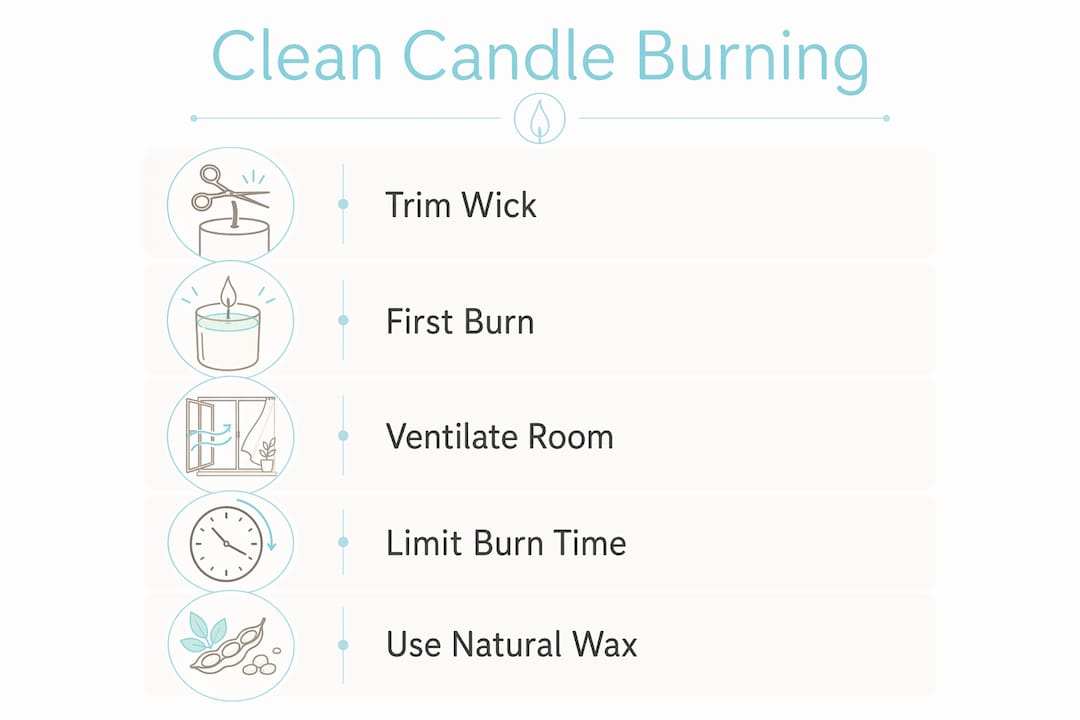
Buying a clean-burning candle is a good start, but your burning habits determine the actual air quality in your home. Burning candles produces ultrafine particles around 7 to 8 nanometers and gases including nitrogen dioxide and PAHs, even from natural wax. That means moderation and ventilation are non-negotiable parts of any safe candle burning practice.
Here are the habits that make the biggest difference:
-
Burn candles in well-ventilated rooms. Open a window slightly or run an air purifier while candles are lit. This dilutes particle concentration before it builds up.
-
Limit the number of candles burning at once. One or two candles in a medium-sized room is reasonable. Burning six candles in a small bedroom multiplies emissions proportionally.
-
Keep candles at least 12 inches from anything flammable on all sides, including above the flame. Nearly 60% of candle fires start because combustible materials are too close to the flame. That single habit eliminates the majority of candle fire risk.
-
Never leave a burning candle unattended. The NFPA reports that 21% of candle fires result from unattended flames. This applies to every room, not just bedrooms.
-
Ventilate after extinguishing. Combustion products linger in indoor air after the flame goes out. Leave a window cracked for 10 to 15 minutes after burning to clear residual particles.
-
Use a snuffer or spoon to put out the flame. Blowing out candles scatters sparks and hot wax, which creates both a fire risk and a mess. A snuffer is a $5 tool that eliminates both problems.
“Non-toxic does not mean zero emissions. Every candle flame is a combustion event. The goal is to minimize exposure through smart habits, not to assume a natural wax label makes all precautions unnecessary.”
Bedrooms deserve special attention. 36% of candle fires originate in bedrooms, which are typically smaller, less ventilated, and more likely to have a person fall asleep nearby. If you want candlelight in the bedroom, burn for 30 minutes before sleep, extinguish properly, and ventilate before closing the door.
How to troubleshoot common candle problems before they become hazards
Even with the right candle and good habits, problems come up. Recognizing them early keeps your candle burning experience both safe and satisfying.
-
Tunneling. This happens when the melt pool never reaches the jar’s edge, leaving a ring of hard wax around a deep center hole. The fix is a loose tinfoil collar placed around the top of the jar with a hole in the center. The foil traps heat and softens the wax edges until the pool evens out. Tunneling candles also release more emissions per burn because the flame is working harder to reach unmelted wax.
-
Excessive smoke or soot. Black smoke from a candle almost always means the wick is too long. Extinguish the candle, let it cool, trim the wick to 1/4 inch, and relight. If the problem continues, the candle may be in a draft.
-
Large, flickering flame. A flame taller than 1 inch is burning too hot and producing more soot and particles. Extinguish, trim, and move the candle away from any air source.
-
Mushrooming wick. A carbon buildup at the tip of the wick, shaped like a mushroom, signals incomplete combustion. Always trim this off before the next burn.
Here is a quick reference for diagnosing and fixing the most common issues:
| Problem |
Likely cause |
Fix |
| Tunneling |
First burn too short |
Use tinfoil collar; burn to full melt pool |
| Black soot on jar |
Wick too long |
Trim to 1/4 inch before each burn |
| Flickering flame |
Draft or wick length |
Move candle; trim wick |
| Mushrooming wick |
Incomplete combustion |
Trim carbon buildup before relighting |
| Candle won’t stay lit |
Wick too short |
Carefully remove wax around wick base |
Key takeaways
Non-toxic candle burning requires the right materials and consistent habits: natural wax, clean wicks, proper trimming, and ventilated rooms working together.
| Point |
Details |
| Choose natural wax and clean wicks |
Soy, beeswax, or coconut wax with 100% cotton or wood wicks minimizes soot and chemical emissions. |
| Trim the wick every time |
Cut to 1/4 inch before each burn to prevent soot, large flames, and mushrooming. |
| Ventilate during and after burning |
Open a window while candles burn and for 10 to 15 minutes after to clear lingering particles. |
| Keep 12 inches of clearance |
Maintain distance from all flammable materials on every side to prevent the majority of candle fires. |
| Fix tunneling immediately |
A tinfoil collar evens the melt pool and reduces excess emissions from an overworked flame. |
Why I think most candle advice misses the real point
Most articles about healthy candle options stop at “buy soy wax.” That advice is correct but incomplete, and it gives people a false sense of security. I’ve seen beautifully labeled soy candles with untrimmed wicks burning in closed bathrooms, producing more visible soot than a cheap paraffin candle burned correctly in a ventilated kitchen.
The honest truth is that the label matters less than the habit. A $6 beeswax candle burned in a sealed room with a half-inch wick is worse for your air quality than a well-maintained soy candle burned near an open window. The science backs this up: even natural wax candles emit combustion byproducts that linger indoors after the flame goes out.
What I’ve found actually works is treating candle burning as a short-duration ritual rather than a background activity. Light a candle intentionally, for 60 to 90 minutes, in a room with airflow. Trim the wick before you light it. Extinguish it properly and air the room out. That approach, repeated consistently, gives you the ambiance and fragrance you want without accumulating indoor air quality problems over time.
I also think flameless options deserve more credit than they get. Battery-operated candles and candle warmers eliminate combustion entirely while still delivering scent and warm light. They’re not a replacement for the real thing, but they’re a smart complement for spaces where ventilation is limited or where you want fragrance running for hours.
The brands doing this right, including Wickandglow, build the care instructions into the product experience rather than leaving it to the buyer to figure out. That matters because most candle-related health issues are entirely preventable with the right information up front.
— B
Bring intentional fragrance home with Wickandglow
Wickandglow was built for people who want their home to feel like something, not just smell like something. Every candle is made with soy wax, clean wicks, and phthalate-free fragrance inspired by R&B songs, complete with a playlist to match the mood.

If you’re ready to build a non-toxic candle routine from the ground up, the home fragrance scent bundle pairs a soy candle with a reed diffuser and room spray so you can layer scent without relying on a burning flame all day. The non-toxic room spray is phthalate-free and vegan, giving you fragrance without any combustion at all. For maintenance, the Wickandglow wick trimmer keeps every burn clean from the first light to the last.
FAQ
What makes a candle non-toxic?
A non-toxic candle uses natural wax such as soy, beeswax, or coconut wax, a 100% cotton or wood wick, and fragrance free from phthalates and synthetic dyes. These materials produce fewer harmful emissions than paraffin-based candles with metal-core wicks.
How often should you trim a candle wick?
Trim the wick to 1/4 inch before every single burn, including the very first one. Untrimmed wicks are the primary cause of excessive soot, large flames, and black residue on jar walls.
Is it safe to burn candles in the bedroom?
Burning candles in the bedroom carries higher risk because the space is typically smaller and less ventilated, and 36% of candle fires originate there. If you burn candles in a bedroom, limit sessions to 30 minutes, keep the window cracked, and never fall asleep with a candle lit.
Do natural wax candles still produce harmful particles?
Yes. Even soy and beeswax candles produce ultrafine particles and gases during combustion. Ventilating the room during and after burning significantly reduces your exposure to these byproducts.
What is candle tunneling and how do you fix it?
Tunneling occurs when a candle burns straight down the center without melting the wax at the edges, usually because the first burn was cut short. Wrap a loose tinfoil collar around the top of the jar with a hole in the center to trap heat and even out the melt pool.
Recommended


