Ambient fragrance reliably changes how people judge a room’s size, distance, brightness, warmth, and social density, often without them ever noticing the smell itself. A 2015 controlled study of 63 participants found that orange scent made rooms feel brighter and taller, while lavender made the same spaces feel warmer and more pleasant, with both scents outperforming an unscented control on perceived spaciousness. Researchers tracking physiological response with EEG have confirmed the effect runs deeper than mood: peppermint shifted prefrontal alpha brain activity associated with reduced mental fatigue in test subjects. Wickandglow builds its entire candle and diffuser line around this premise, treating scent as a spatial design tool rather than an afterthought.
Three findings matter most if you’re applying this in a real space:
-
Size and light shift with specific notes. Citrus scents like orange tend to read as brighter and taller; lavender reads as warmer and more enveloping.
-
Distance compresses under scent exposure. Across four studies with 479 total participants, objects paired with a matching scent were judged closer than they actually were, a bias that held even when participants were paid to be accurate.
-
Warmth and social comfort respond to congruence, not intensity. A scent that matches the room’s lighting, materials, and sound tends to raise perceived coziness; a mismatched one can flatten the effect entirely, according to a review of ambient scent in multisensory environments.
If you’re designing or retrofitting a space, the takeaway is simple: pilot one scent at low concentration for a week before committing to a signature fragrance across an entire property. Small, controlled tests beat guessing every time.
Key Takeaways
Fragrance changes measurable spatial judgments, size, distance, warmth, and social density, through learned association and physiological arousal, and works best when piloted at low intensity and matched to a room’s existing sensory design.
| Point |
Details |
| Scent shifts spatial judgment |
Orange increases perceived brightness and height; lavender increases warmth and pleasantness, per controlled research. |
| Distance perception is biased |
Matching scents can make objects feel closer, an effect confirmed across nearly 500 participants. |
| Congruence beats intensity |
Scent paired with matching light, sound, and materials outperforms a strong scent used in isolation. |
| Individual variation is real |
Genetics, culture, and adaptation mean no single scent or dose works identically for every visitor. |
| Start small and test |
Wickandglow’s candles and diffusers offer a practical, low-risk way to pilot fragrance intensity and profile in a single room before committing further. |
Table of Contents
How Fragrance Affects Spatial Perception in Controlled Studies
The experimental record on scent and spatial perception is smaller than you’d expect for something with this much design buzz around it, but what exists is consistent enough to act on. The strongest, most frequently cited work comes from a handful of controlled lab studies and a couple of larger multi-study efforts, and the pattern across them points the same direction: specific scents shift specific spatial judgments, and the shifts are measurable, not just anecdotal.
| Study |
Scent(s) Tested |
Sample Size |
Main Finding |
Practical Implication |
| Effect of Smell in Space Perception |
Orange, lavender |
N=63 |
Orange increased perceived brightness and height; lavender increased warmth and pleasantness, according to a controlled study with 63 participants |
Match scent family to the spatial impression you want (bright vs. warm) |
| Sniffing the distance |
Target-associated scents |
N=479 (four studies) |
Scented objects judged closer than unscented ones |
Scent can be used to make focal points or entryways feel more immediate |
| Peppermint EEG study |
Peppermint |
Mixed-method, EEG + survey |
Increased prefrontal alpha, reduced subjective sluggishness |
Useful in workspaces or reading nooks where alertness matters |
| Ambient scent and well-being review |
Various |
Literature synthesis |
Scent effects depend on congruence with other senses |
Don’t treat scent as an isolated lever; check lighting and sound too |
The orange and lavender study is small by clinical-trial standards, 63 people is a modest sample, but it remains one of the only experiments to directly isolate scent as the variable changing spatial judgment rather than mood alone. That specificity is why it gets cited constantly in both academic reviews and design literature.
The distance-bias research carries more statistical weight. Four separate studies, nearly 500 combined participants, and the effect survived when researchers offered cash incentives for accurate distance estimates. That’s a meaningful detail: people tried hard to be right and still misjudged distance under scent exposure. It suggests the bias operates below conscious correction, which is exactly the kind of effect a home fragrance or retail scenting strategy can lean on.
Where the literature gets thinner is on generalizability. Most studies pull from university populations in a single country, run in artificial lab rooms rather than lived-in spaces, and rarely track effects beyond a single session. Nobody has published a large field study on, say, how a signature scent performs in a 2,000 square foot retail floor over six months. Designers should read the individual findings as directionally reliable and treat any specific percentage or magnitude as a lab result, not a guarantee for their exact space.
Why Scent Changes How You Read a Room: The Mechanism
Fragrance doesn’t just decorate a room’s atmosphere, it hijacks the same neural circuitry your brain uses to judge distance, size, and safety. Understanding why helps you predict which scents will work for which spatial goals instead of guessing.
The path runs like this: an odor molecule binds to receptors in your nasal epithelium, signals travel to the olfactory bulb, and from there information routes almost directly into the limbic system, hitting the amygdala (emotional tagging), the hippocampus (memory association), and the orbitofrontal cortex (conscious appraisal). Nearly every other sense passes through the thalamus first for a kind of filtering layer. Smell skips that step. That’s part of why a scent can trigger an emotional or spatial judgment before you’ve consciously registered what you’re smelling.
A few mechanisms do most of the work:
-
Associative learning and priming. If you’ve learned that citrus means “clean,” walking into a citrus-scented room primes cleanliness judgments and, by extension, makes the space feel more open and better maintained.
-
Multisensory integration and crossmodal correspondence. Your brain expects certain scents to pair with certain visual or tactile qualities (light, airy scents with bright rooms; warm, resinous scents with dim, textured ones). When scent and setting align, the crossmodal correspondence research shows processing gets easier and evaluations turn more positive.
-
Physiological arousal. Measurable shifts in EEG alpha waves, electrodermal activity (EDA), and blood volume pulse (BVP) accompany scent exposure, meaning fragrance produces real autonomic changes, not just self-reported mood shifts.
-
Attention shifts. A strong or novel scent can redirect attention toward or away from visual features of a space, which indirectly changes how someone estimates its dimensions.
Here’s a concrete design example: a real estate stager wants an empty apartment to feel move-in ready and larger than its square footage. Citrus notes prime cleanliness, and cleanliness judgments correlate with perceived spaciousness. That’s a mechanistic chain, not a coincidence, and it’s why light citrus scenting shows up so often in staging and hospitality settings.
Pro Tip: If your goal is to prime a specific behavior (cleaning, lingering, buying), pick the scent for its learned association first and its raw pleasantness second. A scent people find “just okay” but strongly associate with the target behavior will often outperform a scent they love but don’t connect to that context.
What Scent Families Do to a Room’s Size, Warmth, and Mood
Fragrance families cluster into predictable perceptual effects, and matching the right family to the right room does more design work than most people expect from a candle or diffuser.
-
Citrus (orange, bergamot, grapefruit): reads as bright, clean, energizing. Increases perceived height and light in a space, per the orange/lavender study. Best in entryways, kitchens, small bathrooms.
-
Lavender and other soft florals: reads as warm, calming, pleasant. Increases perceived coziness and can soften a cold, minimalist room. Best in bedrooms, reading nooks, spa-style bathrooms.
-
Woody (sandalwood, cedar, vetiver): reads as grounded, mature, intimate. Tends to reduce a sense of vast empty space, useful in oversized living rooms that feel impersonal. Best in living rooms, home offices, dens.
-
Mint and eucalyptus: reads as alert, cool, expansive. Peppermint’s alpha-wave boost supports focus, which pairs well with a sense of open, functional space. Best in home offices, gyms, laundry rooms.
-
Floral (rose, jasmine, gardenia): reads as romantic, soft, intimate. Can shrink perceived social distance, useful for gathering spaces meant to feel warm rather than grand. Best in dining rooms, powder rooms, guest suites.
-
Spicy and gourmand (vanilla, clove, cinnamon): reads as rich, dense, socially warm. Raises perceived social density, meaning rooms feel more populated or “lived in.” Best in kitchens, living rooms during colder months.
Intensity matters as much as scent family. A citrus note at low concentration reads as fresh; the same note pushed too hard reads as artificial or cloying, and that shift undermines the brightness effect you were going for in the first place. Congruence with visual cues compounds this: a woody scent in a room full of glass and chrome will fight the material language of the space rather than reinforce it. Wickandglow’s approach to fragrance in interior design treats scent selection as inseparable from the room’s existing palette, not an accessory added after the fact.
Pro Tip: Start every new scent deployment at roughly half the concentration you think you need. You can always add a second candle or increase diffuser output; you can’t un-scent a room that’s already overwhelmed a guest’s first impression.
Pairing Scent With Light, Sound, and Materials
Scent never operates alone in a real room, and treating it as an isolated variable is the single most common mistake in applied fragrance design. It works in concert with lighting, acoustics, and surface materials, and the alignment between those inputs, what researchers call congruence, determines whether the combined effect helps or actively hurts a space’s perceived quality.
A practical congruence checklist before deploying any scent:
-
Arousal alignment: does the scent’s energy level (bright and stimulating vs. soft and calming) match the room’s lighting temperature and music tempo?
-
Semantic match: does the scent’s cultural association (clean, cozy, luxurious, energetic) match the room’s intended function?
-
Timing: is the scent introduced gradually enough that it reads as ambient rather than as a sudden, noticeable event?
-
Material echo: does the scent’s character (woody, floral, mineral) reflect the textures and finishes already in the room?
One useful reference point comes from crossmodal correspondence research: when scent, lighting, and sound share a coherent “arousal profile,” people process the environment more fluently and rate it more favorably, according to architectural design research on multisensory environments. A soft floral paired with warm, dim lighting and a slow acoustic playlist reinforces the same emotional register three times over. Wickandglow builds its candles around exactly this logic, pairing each scent with a curated playlist so the auditory and olfactory cues arrive already matched rather than left to chance.
Sensory overload can occur when multiple strong sensory inputs compete instead of reinforcing each other, and the outcome is rarely neutral. It’s usually a net negative. A loud, bright room with a heavy, sweet gourmand scent doesn’t read as “rich.” It reads as cluttered, even if a visitor can’t articulate why.
The masking effect deserves its own caution. A strong enough scent can suppress your read on other sensory details entirely, the way an overpowering candle can make you stop noticing the room’s lighting or furniture arrangement altogether. If a scent is so dominant that guests comment on it before commenting on anything else in the room, it’s probably overdosed. The goal is a scent that supports the room’s other design choices, not one that becomes the room’s entire personality.
A Step-by-Step Protocol for Choosing and Testing a Scent
Most fragrance decisions in built spaces get made on gut feeling, and that’s how you end up with a lobby that smells like a candle store instead of a coherent brand experience. A short, structured pilot beats intuition almost every time, and it doesn’t require a lab.
-
Define the perceptual aim. Decide explicitly: do you want the space to feel bigger, warmer, brighter, or more socially inviting? Different goals call for different scent families, as outlined above.
-
Select the scent family and specific note. Narrow to two or three candidates based on the room’s existing materials, lighting, and function.
-
Choose the delivery method. Candles offer warm, localized diffusion with visual ambiance built in; reed diffusers give consistent low-level output with no flame; sprays allow quick, temporary bursts for events or showings.
-
Set a conservative starting dose. Begin at the lowest intensity the product allows, then increase only if a pilot shows the effect isn’t registering.
-
Run a controlled pilot. Test the scented condition against an unscented control in the same room, ideally at the same time of day, for at least a week.
-
Collect both subjective and physiological data where possible. Simple room-scale ratings work; EDA or EEG measures add rigor if you have access to the equipment.
-
Review and adjust. Compare results against your original aim and either commit to a lasting deployment or adjust concentration and note.
A workable testing protocol for a small commercial space or even an ambitious home project looks like this:
- Recruit 10 to 15 people who spend time in the space regularly (staff, family, repeat visitors).
- Use a five-point Likert scale to rate the room on size, warmth, brightness, and comfort, once unscented and once scented.
- Add a simple distance-estimation task: ask participants to estimate the distance to a fixed object across the room, both conditions.
- Run each condition for at least three to five days to account for daily variation.
- If equipment is available, EDA sensors offer a low-cost way to track arousal changes without asking participants to self-report.
Before you dose anything, account for the room’s existing odor profile by understanding what causes indoor odors and how to manage them effectively, as detailed in Causes and Solutions for Indoor Odor Control. Cleaning products, building materials, and daily activity all contribute to what researchers call an indoor odor microclimate, and a new fragrance interacts with that background rather than entering a blank canvas. A candle that tested perfectly in a showroom might clash with a kitchen that already carries strong cooking odors.
Pro Tip: Always post visible signage when scenting a shared or commercial space, and build in an easy opt-out (a well-ventilated adjacent area, or a scent-free zone). It costs nothing and prevents the single most common complaint in scented environments: guests who feel ambushed rather than welcomed.
How Researchers Actually Measure Scent’s Effect on Perception
Reading a scent study critically means understanding what its measurement tools can and can’t tell you. Three types of data dominate the literature, and each answers a different question.
-
Subjective ratings (Likert scales, semantic differentials): ask people directly how big, warm, or pleasant a space feels. Cheap and easy to run, but vulnerable to demand effects, if people suspect they’re being tested for a scent’s influence, they may answer to please the researcher.
-
Distance-biasing and estimation tasks: ask participants to judge physical distance or size directly, sidestepping some self-report bias. This is the method behind the 479-participant distance study, and its strength is that the outcome (a number, a physical judgment) is harder to fake than a mood rating.
-
Electrodermal activity (EDA): measures skin conductance changes tied to sympathetic nervous system arousal. A spike suggests heightened attention or emotional response, though it can’t tell you whether that response is positive or negative.
-
Electroencephalography (EEG): measures brainwave patterns, with alpha activity in the prefrontal cortex often linked to relaxation or reduced mental fatigue, as seen in the peppermint study.
-
Blood volume pulse (BVP): tracks changes in blood flow tied to heart rate and stress response, offering another window into physiological arousal alongside EDA.
The limitations matter as much as the methods themselves. Sample sizes in this field tend to run small, 63 participants is typical, not an outlier, which limits how confidently you can generalize a finding to a different population or culture. Most studies also draw from a narrow demographic slice (often university students in one country), and olfactory adaptation, the tendency for a scent to fade from conscious awareness after 10 to 20 minutes of exposure, complicates any study that measures perception only once rather than over time.
Statistical significance and practical significance aren’t the same thing either. A study can report a statistically reliable shift in perceived room height that amounts to a fraction of a rating-scale point, technically real, but not necessarily something a visitor would consciously notice walking through your lobby. When you read a scent study, ask not just “was this significant?” but “would a normal visitor actually feel this?”
Not Everyone Smells the Same Room the Same Way
Fragrance design that assumes a uniform response across all visitors will eventually disappoint someone, and understanding why helps you build a more resilient scent strategy from the start.
Genetics plays a real role here. Variations in olfactory receptor genes, OR5A1 being one documented example, change how intensely a person detects and how they hedonically rate certain molecules. Two people standing in the same room can have genuinely different sensory experiences of the identical scent, one finding it pleasant and moderate, the other finding it either faint or overpowering. That’s not a preference difference you can design around with better marketing copy; it’s a biological one.
Cultural background shapes association strength too. A scent that reads as “clean” in one cultural context might read as “medicinal” or “unfamiliar” in another, because the associative learning that gives scent its power depends on repeated cultural exposure, not universal wiring.
Adaptation, or olfactory fatigue, changes the timeline of any scent’s effect. Most people stop consciously noticing a scent after roughly 10 to 20 minutes of continuous exposure, even though the scent is still physically present and may still be shaping perception below conscious awareness. This means a scent’s strongest impression happens in the first few minutes a visitor enters a space, which has real implications for where and how you concentrate fragrance delivery.
-
Design for the genetic variance: default to lower intensities rather than bold, room-filling doses, since a strong scent has more room to alienate a sensitive minority than a subtle one does.
-
Layer in non-olfactory cues: pair scent with visual or tactile signals (warm lighting, soft textures) so the spatial impression doesn’t depend on smell alone, which protects the experience for anosmic visitors or those with reduced sensitivity.
-
Offer signage and opt-outs: especially in shared commercial or workplace settings, a small note about active scenting respects guests with allergies or sensitivities.
-
Refresh rather than intensify: if a scent seems to be “fading” to regular occupants, that’s often adaptation, not under-dosing. Increasing concentration to compensate usually backfires with new visitors who haven’t adapted yet.
Making a Small Living Room Feel Warmer: A Working Example
Here’s how the research translates into an actual weekend project, using a common design brief: a small living room that reads as cold, cramped, or underdecorated despite reasonable furniture and lighting choices.
-
Assess the room’s existing odor microclimate. Check for lingering cooking smells, pet odors, or musty notes from upholstery before adding anything new. A candle can’t fix a room that already smells unaired.
-
Select a warm scent family. Lavender, sandalwood, or a soft vanilla gourmand all read as warming based on the perceptual mapping covered earlier.
-
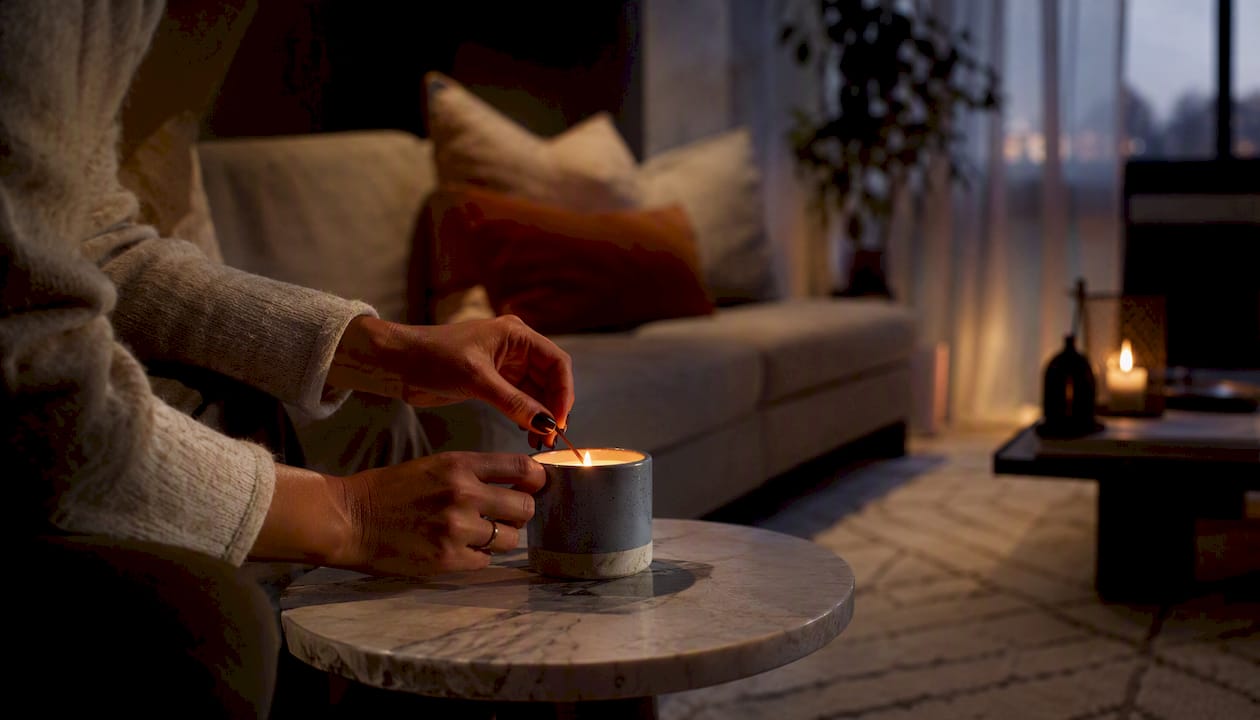
Choose product form based on room size and ventilation. A candle works well in a small living room because it adds warm, flickering light alongside scent, reinforcing the same “cozy” impression through two senses at once. A diffuser suits a room with less supervision or where an open flame isn’t practical.
-
Set dosing conservatively. One candle burned for two to three hours in the evening is enough to test the effect in a room under 200 square feet; resist the urge to run multiple fragrance sources simultaneously during the pilot.
-
Check ventilation. Crack a window or run light air circulation for at least part of the day so the scent doesn’t oversaturate soft furnishings and become present around the clock.
-
Pair with complementary sensory cues. Warm-toned lighting (2700K bulbs), a slow instrumental or R&B playlist, and soft textiles reinforce the same emotional register the scent is aiming for.
A simple blind-rating pilot for this project:
- “This room feels spacious.” (1 = strongly disagree, 5 = strongly agree)
- “This room feels warm and inviting.”
- “I would want to spend time relaxing in this room.”
- “This room feels well cared for.”
- “The scent in this room (if any) feels appropriate for the space.”
Run the same five questions with friends or family on a scented evening and an unscented one, then compare averages. You don’t need statistical software, just a noticeable gap between the two conditions tells you the fragrance is doing real perceptual work.
Wickandglow’s product design reflects exactly this kind of reasoning: candles for rooms where warm light reinforces the scent’s emotional message, and layered options for larger spaces that need more consistent, longer-lasting diffusion than a single candle can provide. Choosing the right scent for a specific room matters more than choosing the “best” scent in the abstract.
Fragrance in the Real World: Arenas, Museums, and Retail
Applied scent design shows up in commercial and cultural spaces more often than most visitors realize, and each context surfaces a different lesson about what works and what breaks.
Signature scents in large venues. Sports and entertainment venues have adopted branded, consistent scents piped through HVAC systems to create a recognizable arrival cue, part of a broader trend documented in architectural design literature on scent as place identity. The lesson: consistency across visits builds brand association faster than novelty does, but HVAC-based dispersion demands careful calibration since a system built for airflow, not fragrance, can create uneven concentration across a large floor.
Museum scenting for immersive exhibits. Museums increasingly use targeted scent stations to reinforce a historical or thematic exhibit, layering an olfactory cue onto visual and audio elements already in place. The lesson: scent works best as reinforcement of an existing multisensory narrative, not as a standalone attraction, and it requires careful containment so one exhibit’s scent doesn’t drift into the next room.
Retail citrus and perceived cleanliness. Retail environments frequently deploy light citrus notes near entrances to prime a “clean, fresh” impression before a shopper even reaches the merchandise, drawing on the same brightness-and-cleanliness association covered in the mechanisms section above. The lesson: entryway scenting has an outsized effect on first impressions relative to its cost, because it shapes the very first sensory judgment a visitor makes.

Operationally, all three contexts share the same constraints: HVAC interaction determines whether a scent disperses evenly or pools unpredictably, consent and signage matter more in spaces with vulnerable or captive populations (healthcare waiting rooms, for instance), and reversibility, the ability to shut off or change a scent quickly, protects against a bad deployment becoming a lasting negative association.
When Scent Backfires: Risks, Allergies, and Ethical Limits
Fragrance is a powerful spatial tool, and powerful tools cause real damage when used carelessly. A few failure modes show up repeatedly in both the research and in practice, and each has a straightforward mitigation.
-
Allergy and sensitivity risk: some fragrance compounds trigger headaches, respiratory irritation, or allergic reactions in a meaningful minority of visitors; screen for known allergens in shared or public-facing spaces before deployment.
-
Consent in public vs. private spaces: a home fragrance choice affects only the people who choose to be there, while a public or workplace scent affects everyone who enters, including people who never opted in, which raises the bar for signage and opt-out access.
-
Sensory incongruence: a scent that clashes with a room’s lighting, materials, or acoustic profile can actively lower perceived quality rather than improve it, undoing the exact effect you were aiming for.
-
Overload from stacking sources: multiple candles, diffusers, and sprays running simultaneously in one space often produce a muddled, unpleasant blend rather than a stronger version of any single scent.
-
Irreversible commitment: installing a scent through HVAC or built-in diffusion systems makes it costly to reverse if the deployment doesn’t land well; start with removable sources (candles, portable diffusers) before committing to permanent infrastructure.
A short risk-mitigation checklist before any deployment: confirm ventilation is adequate, post visible signage in shared spaces, offer a scent-free alternative area where feasible, start at low concentration, and build in a fast way to shut the scent off if feedback turns negative.
When and How to Use Fragrance to Shape a Room’s Feel
The evidence supports a confident but bounded conclusion: fragrance is one of the more reliable, least expensive levers available for changing how a space feels, provided you respect congruence, dosing, and individual variation.
Do:
- Match scent family to your specific perceptual goal (citrus for bright/clean, lavender for warm/calming, woody for grounded/intimate).
- Start every deployment at low intensity and run a short pilot before committing.
- Pair scent with matching light, sound, and materials rather than treating it as an isolated fix.
- Account for the room’s existing odor microclimate before adding anything new.
- Offer signage and opt-outs in any shared or commercial space.
Don’t:
- Assume a scent that tested well in one room will perform identically in a room with different materials or lighting.
- Stack multiple strong scent sources and expect the effect to simply add up.
- Ignore genetic and cultural variability by choosing one intense, unadjustable signature scent for a diverse population.
- Skip the pilot phase because a scent smells appealing to you personally.
If you take one action from this entire guide, run a one-week, low-intensity pilot in the room you actually care about, using an unscented control day for comparison, before making any permanent fragrance decision.
A Practitioner’s Note on Trusting the Nose
The biggest mistake I see in fragrance design isn’t choosing the wrong scent, it’s skipping the pilot entirely because someone in the room “just knows” what will work. The research doesn’t support that kind of confidence, and neither does experience. Orange and lavender produce opposite spatial effects for reasons that have nothing to do with which one smells nicer on a blotter strip; they work because of what they’re associated with, and those associations vary enough between individuals that a single confident guess is a coin flip dressed up as expertise.
What the evidence actually rewards is restraint. Low intensity, a short controlled trial, and a willingness to change course if the room’s response doesn’t match the plan. That’s a less glamorous story than “signature scent transforms space,” but it’s the one that holds up when you check it against what the data actually shows.
If there’s one practical bias I’d push designers toward, it’s choosing product form deliberately rather than defaulting to whatever’s on hand. A candle does two sensory jobs at once, light and scent, which is exactly why it tends to outperform a diffuser in small, intimate rooms where warmth is the goal. Save the diffuser for spaces that need constant, unattended coverage instead.
How Wickandglow Turns This Research Into a Product You Can Actually Use
Everything covered here, congruence, low-dose piloting, matching scent family to spatial goal, is exactly what Wickandglow builds into every candle, diffuser, and spray it sells. Each fragrance is developed with a specific emotional and spatial impression in mind, then paired with a curated playlist so the auditory and olfactory cues reinforce each other instead of competing, the multisensory congruence the research keeps pointing back to.
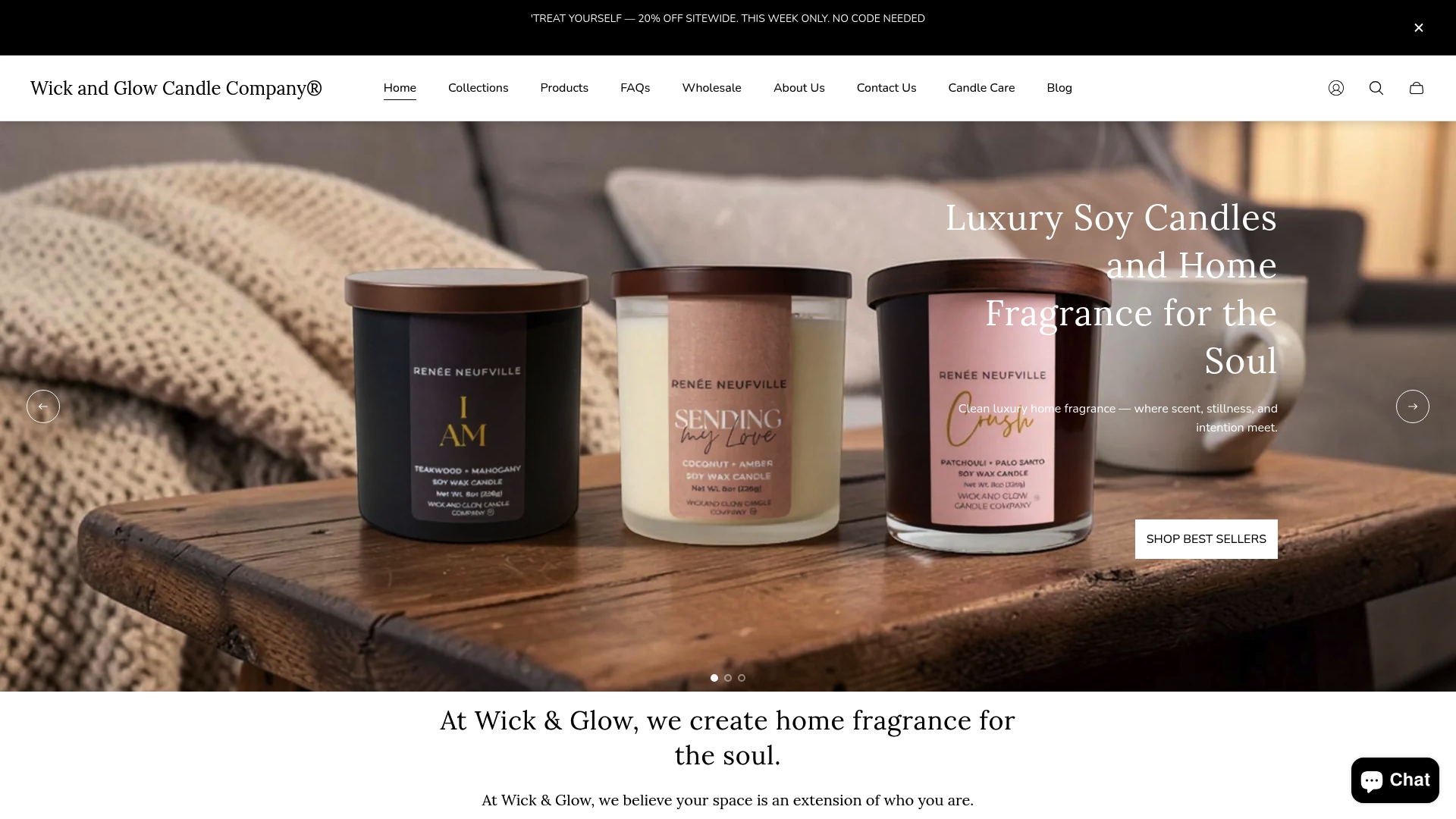
The Exhale Luxury Candle is a strong starting point for anyone running the low-intensity pilot outlined above, its slow, even burn makes it easy to test a warm, enveloping scent profile in a living room or bedroom without overwhelming the space. If you want to compare a different product form, the Feels Good 8 oz candle is sized right for a one-room test, and the Can We Talk Luxury Candle offers a distinct profile if your goal leans toward intimate, socially warm gatherings rather than bright, open spaciousness. Order one, run the week-long pilot from this guide, and see what your space tells you.
Frequently Asked Questions
Does fragrance actually make a room feel bigger, or is that just marketing?
Controlled research backs it up. The 2015 study on smell and space perception found orange scent specifically increased perceived brightness and height compared to an unscented control, which reads as a larger, more open space to most people.
How does scent affect how far away something seems?
Studies show scented objects get judged as closer than they physically are. Across four studies with 479 participants, this distance bias held up even when people were paid for accuracy, suggesting it operates below conscious control.
What’s the fastest way to test if a scent works in my space?
Run a one-week pilot: burn or diffuse the scent at low intensity for several days, then compare simple room-feel ratings (size, warmth, comfort) against an unscented control period. No lab equipment needed.
Can fragrance and interior design work against each other?
Yes. Scent that doesn’t match a room’s lighting, materials, or sound can create sensory incongruence, which research on ambient scent and well-being links to reduced positive evaluations rather than improved ones.
Do all people respond to the same scent the same way?
No. Genetic variation in olfactory receptor genes changes how strongly people detect and enjoy certain scent molecules, and cultural background shapes what associations a scent carries in the first place.
Is candle scent or diffuser scent better for changing how a room feels?
It depends on the room. Candles add warm light alongside scent, which reinforces coziness in small spaces, while diffusers give steadier, unattended coverage better suited to larger or higher-traffic areas.
Sources
Recommended


