Your home can shift your nervous system in under a minute. That’s not marketing copy — it’s how olfaction works. The olfactory bulb connects directly to the limbic system, the brain’s emotional and memory hub, which means scent bypasses the cognitive filter that most sensory input has to pass through. Use that pathway deliberately, and your home fragrance becomes a mindfulness tool. Use it carelessly, and you just have a room that smells like a candle store.
Here are five rules that separate mindful home scent environment tips from generic air-freshener advice:
-
Signal, not saturation. A trace scent you notice when you enter a room is more effective than a heavy fragrance you stop noticing after ten minutes.
-
One anchor per room. Competing scents cancel each other out and create olfactory noise, not calm.
-
Time-aware diffusion. Run your diffuser intermittently with short active diffusion followed by longer rest periods. This prevents olfactory fatigue and keeps the signal fresh.
-
Clean ingredients. Choose phthalate-free, plant-based options whenever possible. What you breathe matters.
-
Test and rotate. Introduce one new scent at a time, wait at least a week before judging, and rotate seasonally.
Your 10-minute starting checklist:
- Walk each room and identify its primary purpose (sleep, focus, relaxation, morning energy).
- Pick one scent family per room from the guide below.
- Choose a delivery method suited to that room’s size and your schedule.
- Set a 15-minute diffusion timer and note your reaction.
Research on olfactory-limbic pathways and olfactory architecture design points to the same conclusion: low-level, intermittent, plant-derived scent is more reliable for creating calm associations than constant heavy fragrance.
Key Takeaways
Intentional home scenting works because scent connects directly to the brain’s emotional and memory centers, making a consistent, low-intensity botanical signal one of the most reliable tools for shifting your nervous-system state at home.
| Point |
Details |
| Signal over saturation |
A trace scent you notice on entry is more effective than heavy fragrance that causes olfactory fatigue. |
| One anchor per room |
Competing scents create noise; a single botanical per space builds a reliable conditioned cue. |
| 15/45 diffusion rule |
Run an ultrasonic diffuser for 15 minutes, rest for 45 to keep the signal perceptible and prevent habituation. |
| Clean ingredients matter |
Choose phthalate-free, soy or beeswax products and ventilate before and after active diffusion sessions. |
| Wickandglow ritual approach |
Each Wickandglow fragrance pairs with a curated playlist, giving you a scent-and-sound ritual structure ready to use. |
Table of Contents
Which scent families actually calm you down?
Scent families aren’t just aesthetic categories. Each one tends to support a distinct nervous-system state, which makes choosing faster once you know what you’re trying to feel.
-
Floral/herbal (lavender, chamomile, clary sage). The go-to for sleep and wind-down. Lavender is the most studied botanical in this context, with small trials suggesting it can reduce subjective anxiety, though evidence across the aromatherapy literature is mixed and context-dependent. Best in bedrooms and bathrooms.
-
Resins and woods (sandalwood, vetiver, frankincense, cedarwood). Grounding and anchoring. These work well for meditation spaces and home offices where you want focused calm rather than drowsiness.
-
Citrus and green (bergamot, lemon, yuzu, green tea). Wakeful calm. Bergamot in particular sits at the intersection of uplifting and soothing, which makes it useful for morning routines without the sharp edge of straight lemon.
-
Herbs and botanicals (rosemary, eucalyptus, peppermint). Alertness and clarity. Rosemary is a reasonable choice for a home office or kitchen, where you want mental sharpness without stimulant-level intensity.
A note on sensitivity: heavy white florals like tuberose and gardenia, and some synthetic musks, are among the most commonly reported irritants. If someone in your household gets headaches from strong floral scents, start with the wood or citrus families instead. For room-by-room selection guidance, how to choose scents for each room is a practical starting point.
Pro Tip: Bergamot is one of the few botanicals that bridges the citrus and floral families, making it a reliable neutral anchor for shared spaces where you need a scent everyone can live with.

How to build a scent ritual for morning, meditation, and sleep
The reason rituals work isn’t mystical. It’s associative learning: pair a consistent sensory signal with a repeated behavior, and the signal eventually triggers the state on its own. Harvard research on scent and memory confirms that scent-triggered emotional recall is among the strongest of any sensory modality. That’s the mechanism behind a scent ritual.
Ritual 1: Morning reset (5–7 minutes)
- Open a window for two minutes before you start.
- Mist a citrus or bergamot room spray once in the kitchen or bathroom.
- Breathe normally for five minutes while you make coffee or wash your face. Don’t try to “do” anything with the scent.
- Repeat the same spray every morning for seven days.
Ritual 2: Pre-meditation quiet (10–15 minutes)
- Trim your candle wick to ¼ inch before lighting.
- Light a sandalwood or frankincense candle five minutes before you sit.
- Let the scent fill the room passively. No diffuser running simultaneously.
- Extinguish the candle when you finish. The scent lingers as a closing cue.
Ritual 3: Pre-sleep downshift (20–30 minutes)
- Run a lavender or chamomile ultrasonic diffuser for 15 minutes, then switch it off.
- Dim lights at the same time you start the diffuser.
- Avoid screens for the duration. The scent works better when it’s not competing with blue light and cortisol.
For deeper ritual templates and habit-building frameworks, how to build a home fragrance ritual covers the habit-stacking side in more detail.
Pro Tip: Consistency matters more than the specific botanical you choose. A scent you use every night for two weeks will become a sleep cue regardless of whether it’s lavender or cedarwood. Pick one and stick with it.
What delivery method works best for your space?
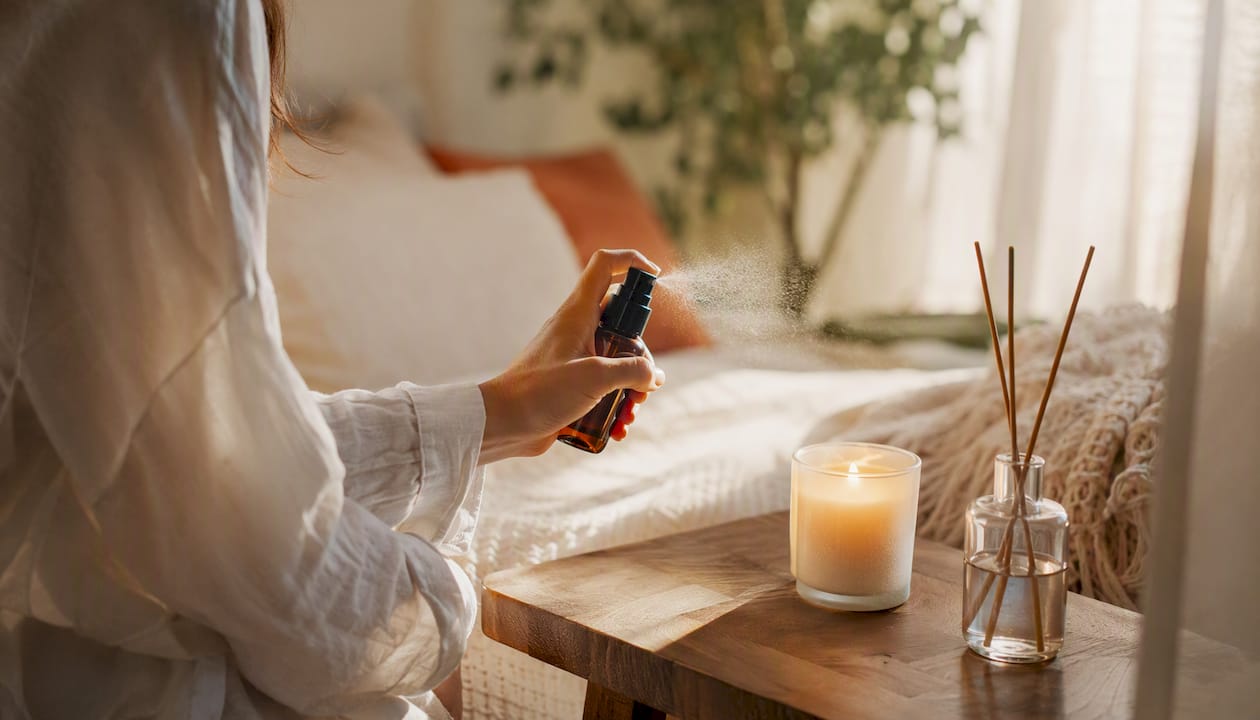
Each format has a different job. Matching the method to the room and your schedule is where most people go wrong, usually by defaulting to candles everywhere.
| Method |
Ideal room size |
Intensity control |
Typical longevity |
Best use |
| Ultrasonic diffuser |
Small to medium |
High (timer, mist level) |
2–4 hours per fill |
Meditation, bedroom rituals |
| Reed diffuser |
Small to large |
Low (reed count) |
2–4 months per bottle |
Set-and-forget living room, hallway |
| Soy or beeswax candle |
Small to medium |
Medium (wick trim, burn time) |
long-lasting burn time typical |
Ritual moments, dining, bath |
| Room spray |
Any |
Very high (one spritz at a time) |
30 minutes |
Quick resets, morning routine |
| Simmer pot |
Medium to large |
Medium (water ratio, heat) |
several hours per session |
Kitchen, open-plan spaces |
Intensity control techniques worth knowing:
- Reduce reed count in a diffuser by half to drop intensity without switching products.
- The 15/45 rule: run an ultrasonic diffuser for 15 minutes, rest for 45. This prevents olfactory fatigue and keeps the scent perceptible rather than invisible.
- Trim candle wicks to ¼ inch before every burn. A long wick produces soot and burns hotter, which pushes fragrance out too fast and shortens the candle’s life.
- For room sprays, one spritz at head height in the center of the room is usually enough. Two is the ceiling.
Scent layering is the most underused longevity technique: run a reed diffuser as your base, add a candle as a mid-layer during ritual moments, and use a room spray as a top note for quick resets. The three formats together create a richer, longer-lasting scent presence than any single format at high intensity. For a practical walkthrough of combining formats, how to layer candle and room spray is worth bookmarking.
Pro Tip: Store essential oils in a cool, dark place with the cap tight. Heat and light degrade the top notes first, which is why an oil that smelled bright when you bought it can smell flat six months later.
How to scent your home without harming your air quality
The first rule of healthy home scenting isn’t about which oil to buy. It’s about ventilation and source control. Practical healthy-scenting guidance consistently puts cleaning and airflow before any fragrance method, and that priority is correct. Masking an odor with fragrance doesn’t remove the source; it just adds more particles to the air.
Safety checklist:
- Ventilate first. Open a window or run a fan before and after any active diffusion session.
- Choose phthalate-free products. Phthalates are synthetic plasticizers used in some fragrance formulations; they’re linked to endocrine disruption in animal studies, and avoiding them is a reasonable precaution even where human evidence is still developing.
- Prefer soy or beeswax candles over paraffin. Paraffin is petroleum-derived and produces more soot and volatile organic compounds at high burn temperatures.
- Use intermittent diffusion. Continuous diffusion in a small, unventilated room concentrates airborne compounds faster than most people realize.
- Monitor reactions. Headaches, eye irritation, or a scratchy throat after diffusing are signals to reduce intensity or switch botanicals.
For pets, infants, and pregnancy:
Essential oil diffusion in small rooms with cats or dogs warrants real caution. Cats lack the liver enzymes to metabolize many phenols and terpenes, making eucalyptus, tea tree, and clove genuinely risky for them. Dogs are more tolerant but still sensitive to high concentrations. If you have pets, passive methods (reed diffusers, lightly scented candles in well-ventilated rooms) are safer than active ultrasonic diffusion.
During pregnancy, the evidence on specific essential oils is limited, but the precautionary principle applies: avoid high-concentration diffusion, especially in the first trimester, and consult a healthcare provider before using any botanical therapeutically. This is general information, not a substitute for medical advice.
A review of the aromatherapy literature notes that while some essential oils show promise for reducing subjective anxiety in small pilot studies, effects are modest and context-dependent. Treat scent as a supportive tool, not a clinical intervention.
How to choose and test a scent without getting it wrong
The most common mistake is buying three new candles at once and lighting all of them in the same week. Olfactory fatigue sets in, nothing stands out, and you end up with a collection you don’t use.
A simple decision process:
- Define the room’s nervous-system goal (sleep, focus, grounding, morning energy).
- Pick one anchor botanical from the matching scent family.
- Choose a delivery method based on room size and how much attention you want to give it.
- Start at the lowest usable intensity.
Testing protocol:
- Sniff a strip or the product cap before buying. If it’s unpleasant cold, it won’t improve warm.
- Run a 15-minute diffusion test in the target room at low intensity.
- Leave the room for an hour, then return. Your fresh impression is more reliable than your in-room assessment.
- Wait 24 hours before deciding. Scent memory is short; what felt too strong yesterday often reads as pleasant the next day.
- Rotate on a two-week schedule. Keeping one scent per room for two weeks builds the associative signal. Switching daily prevents it from forming.
Seasonal rotation keeps the signal fresh and prevents habituation. A light citrus in spring and summer, a warmer resin or spice in fall and winter, gives your nose a reset and makes each scent feel intentional again. For scent-scaping across rooms, the principle is the same: distinct scent zones create distinct psychological spaces, which is the whole point of mindful home fragrance.
Pro Tip: Coffee beans between sniffs are a myth. Sniffing your own skin (the inside of your wrist) is a more effective palate cleanser because it’s a neutral, familiar scent your brain already filters out.
How Wickandglow pairs scent with sound for a complete ritual
Most home fragrance stops at the nose. Wickandglow’s approach goes one step further: each product is paired with a curated playlist, which means the scent ritual has a sonic anchor as well as an olfactory one. That’s not a gimmick. Sensory design research supports the idea that scent works more reliably as a mindfulness cue when it’s coordinated with complementary sensory inputs, including sound and light.
Here’s how to build a Wickandglow-style ritual using the brand’s playlist-pairing model:
-
Choose a product with a clear mood intention. Wickandglow’s fragrances are named and designed around R&B songs and emotional states, so the scent profile and the playlist are already matched.
-
Start the playlist before you light the candle or start the diffuser. Let the music set the tempo first. Two to three minutes of the playlist before the scent activates gives your nervous system a layered cue rather than a single one.
-
Match the playlist tempo to the ritual goal. Slower BPM for sleep and meditation; mid-tempo for grounding; upbeat for morning resets.
-
Keep the ritual to a fixed duration. Twenty minutes is enough for the scent-sound association to register. Longer isn’t necessarily better.
Pairing a slow-tempo R&B track with a sandalwood or vanilla fragrance during a 20-minute evening wind-down creates a two-channel sensory cue that’s more reliable than either scent or music alone. The brain learns to associate the combination with rest, and over time, either cue can trigger the state independently.
The intentional home fragrance approach Wickandglow uses is built on exactly this principle: scent as a designed signal, not background decoration.
Scent as signal, not wallpaper
There’s a version of home fragrance that’s purely decorative, the equivalent of a throw pillow. You buy a candle because it smells nice in the store, burn it occasionally, and replace it when it’s gone. Nothing wrong with that. But it’s not what this article is about.
The version worth practicing treats scent as a short, repeatable signal. You light the same candle before you sit down to work. You mist the same spray when you walk in the door after a hard day. You run the same diffuser blend for the twenty minutes before you sleep. Over days and weeks, the scent stops being just a smell and starts being a cue, a small, reliable handshake between your environment and your nervous system.
That’s the whole practice. It doesn’t require a meditation cushion or a wellness routine. It requires consistency and a willingness to pay attention to what you’re already breathing.
Wickandglow makes the ritual easy to start
If you’ve read this far, you already know what you need: one anchor scent per room, a delivery method that fits your schedule, and enough consistency to let the association form.
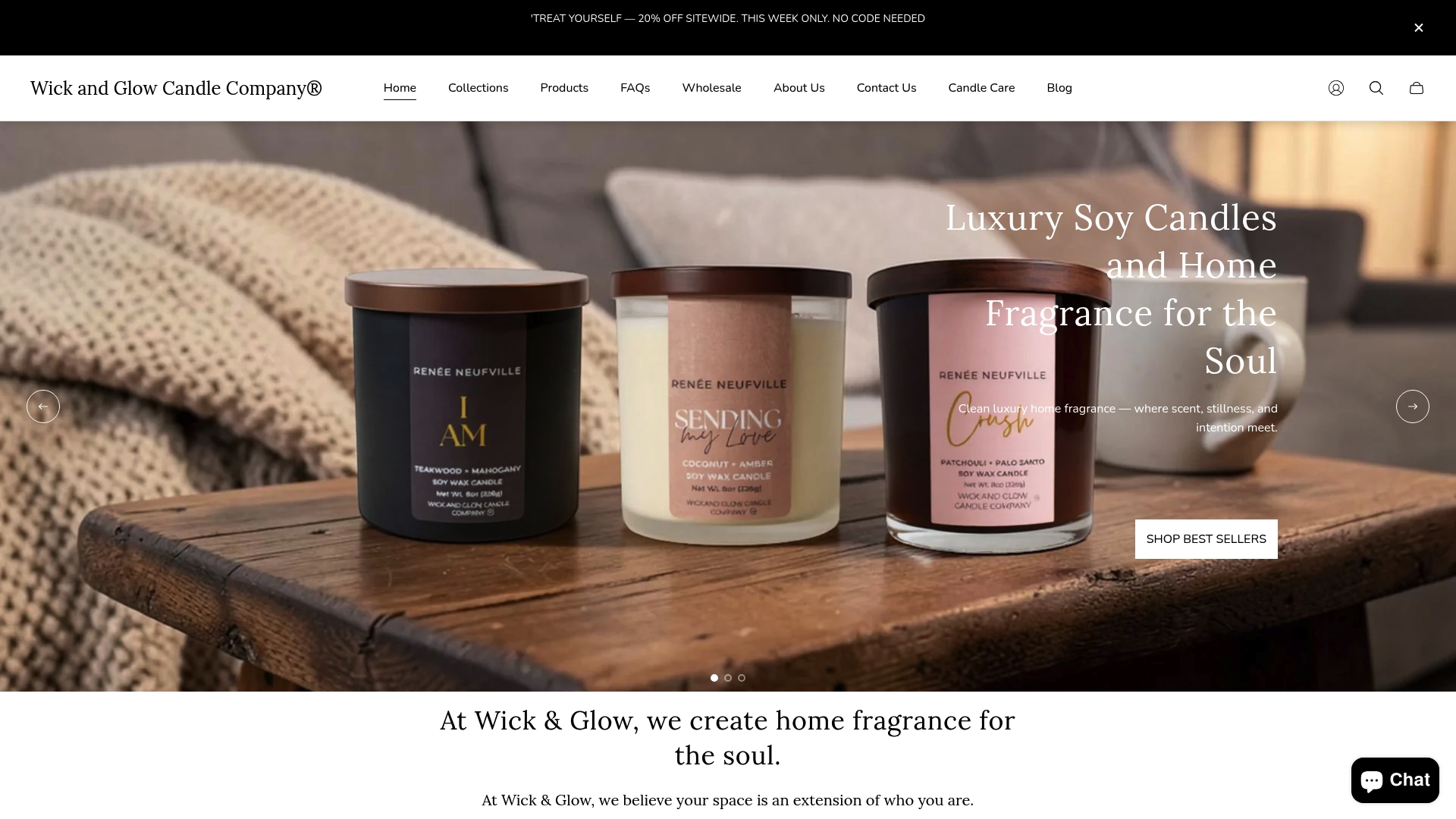
Wickandglow’s hand-poured soy products are built for exactly that kind of intentional use. Every fragrance is phthalate-free and vegan, so the clean-ingredient box is already checked. And because each product comes paired with a curated R&B playlist, you get the scent-and-sound ritual structure without having to build it yourself.
Three formats worth starting with:
-
Reed diffuser for a set-and-forget living room or hallway anchor. Wickandglow’s luxury reed diffuser runs up to several months per bottle with adjustable reed count for intensity control.
-
Candle for ritual moments: meditation, evening wind-down, or a focused work session. The Scenting My Love Trio is a practical starter set if you want to test three scent profiles before committing to a full collection.
-
Room spray for quick resets throughout the day, no flame, no setup, one spritz.
Browse the full collection at Wickandglow and find the scent that fits the ritual you’re building.
Sources
Recommended


