Temperature, humidity, and air movement are the real forces shaping how your home smells at any given time of year. A candle that feels perfectly balanced in january can turn oppressive by july, not because the formula changed, but because heat accelerates how fragrance molecules evaporate and project into a room. Understanding how seasonal fragrances work at home means working with those forces rather than against them.
Here is what shifts across the seasons:
-
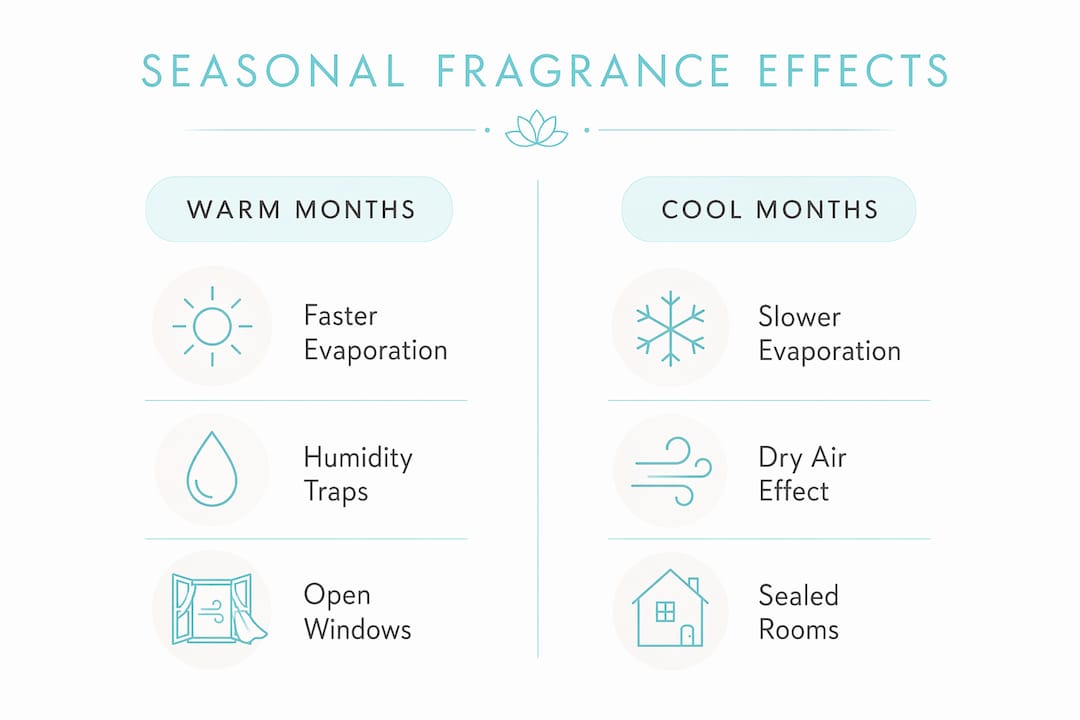
Temperature raises the evaporation rate of fragrance molecules, making scents bloom faster and project more intensely in warm months, while cold air slows that process and keeps scent close to its source.
-
Humidity traps fragrance molecules near surfaces, intensifying scent impact but risking overload with heavy or sweet compositions in summer.
-
Air circulation from open windows or HVAC systems disperses scent faster, shortening longevity but widening reach.
-
Daylight length affects how long windows stay open and how much fresh air moves through a space, both of which influence how a fragrance settles.
-
Signature versus accent scents give you a stable base year-round while seasonal accents, like a spiced candle in october or a citrus spray in june, layer variety on top without disrupting your home’s identity.
How seasonal fragrance behavior actually works in the home
The chemistry is straightforward once you see it. Fragrance molecules evaporate at different rates depending on temperature: warmer air gives molecules more energy to lift off a surface and travel through a room, which is why a diffuser in august fills a space faster than the same diffuser in december. Cold air does the opposite, slowing evaporation so scent stays closer to its source and fades more quickly from the air.
| Environmental Factor |
Warm Months Effect |
Cool Months Effect |
| Temperature |
Faster evaporation, stronger projection |
Slower evaporation, softer throw |
| Humidity |
Molecules trapped near surfaces, intensified scent |
Drier air disperses molecules more freely |
| Air circulation |
Open windows diffuse scent quickly |
Closed rooms concentrate and hold scent longer |
| Daylight length |
Longer days, more ventilation, shorter longevity |
Shorter days, sealed rooms, extended longevity |
Humidity adds another layer. High moisture in the air during summer months traps fragrance molecules close to surfaces and skin, which intensifies perception. That sounds like a bonus until you light a heavy amber candle in august and the sweetness becomes suffocating within twenty minutes. Lighter, ozonic, or aquatic scents handle humid conditions far better because their molecular structure disperses without compounding.
Air circulation is the variable most people overlook. Open windows in spring pull scent out of a room quickly, so a reed diffuser that lasts weeks in a sealed winter bedroom may feel spent in days when the windows are cracked. Closed rooms in winter, on the other hand, hold scent longer, which means you need less product to achieve the same atmospheric effect.
Pro Tip: In winter, reduce the number of diffuser reeds by half. Sealed rooms concentrate fragrance faster than you expect, and fewer reeds give you the same result without overwhelming the space.
Which scent families actually fit each season?
The note families that perform well in each season follow directly from the chemistry above. Light, volatile molecules, the ones found in citrus, green leaves, and aquatic accords, diffuse beautifully in heat. Heavy molecules in resins, vanilla, and warm woods need warmth to bloom but project confidently in cold air without becoming cloying.
Spring and summer call for:
- Citrus notes: bergamot, lemon, grapefruit, yuzu
- Green and herbal notes: violet leaf, basil, mint, galbanum
- Light florals: neroli, transparent jasmine, peony
- Aquatic accords: clean, ozonic, slightly salty compositions
[Lighter notes maintain freshness](https://labelleperfumes.com/en-es/blogs/news/how-to-choose-a-seasonal-perfume-for spring-summer-fall-and-winter) in heat by avoiding the heavy projection that turns sweet scents oppressive. A citrus room spray in june feels energizing; the same spray in december disappears before you notice it.
Autumn and winter reward heavier compositions:
- Warm spices: cinnamon, cardamom, clove, nutmeg
- Woody notes: sandalwood, cedar, vetiver, benzoin
- Gourmand and resinous notes: vanilla, amber, oud, frankincense
- Dried fruits and tobacco accords
Cold air softens scent strength, so heavier notes feel balanced rather than heavy in october and november. A vanilla amber candle that would overwhelm in july becomes exactly right on a cold evening.
| Season |
Primary Note Families |
Avoid |
| Spring |
Fresh florals, green, light citrus |
Dense white florals, heavy gourmands |
| Summer |
Aquatic, citrus, aromatic herbs |
Rich ambers, spiced orientals |
| Autumn |
Soft spices, warm woods, amber |
Sharp citrus, watery aquatics |
| Winter |
Oud, resins, vanilla, leather |
Light musks, thin florals |
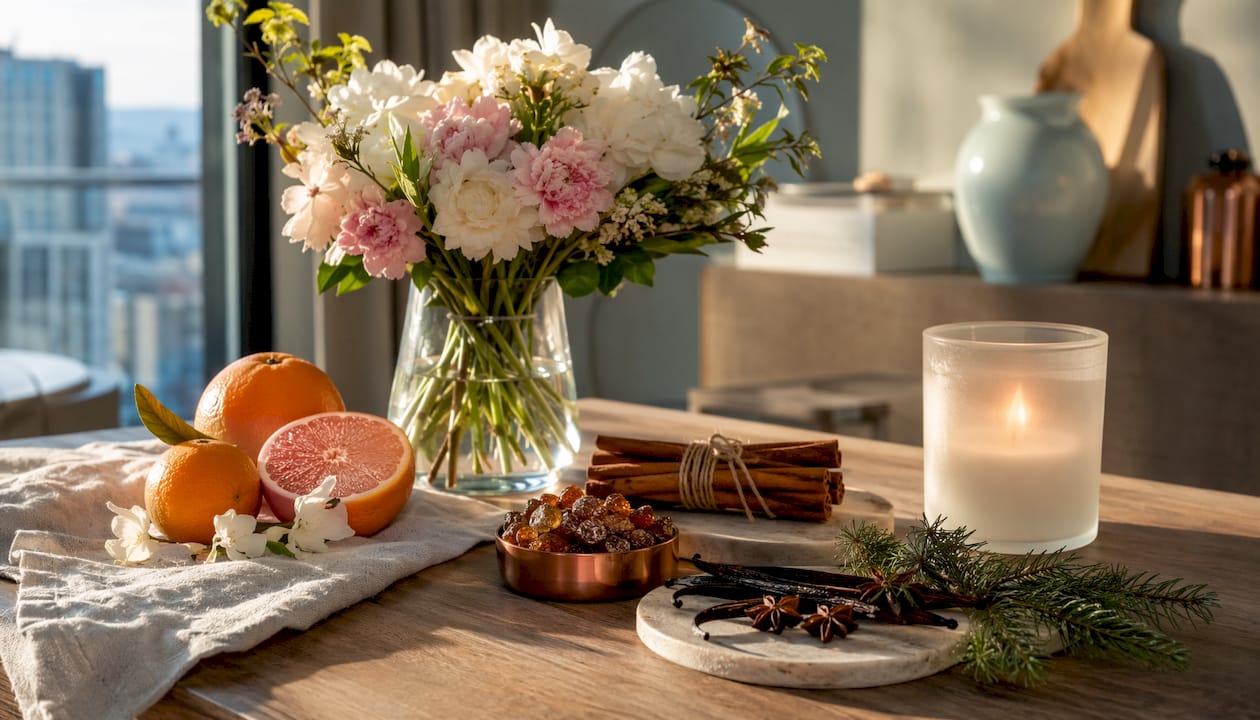
Bridge scents solve the transition problem. Floral-woody musks and light ambers blend warm and fresh elements, making them ideal for march, september, and any week where the weather can’t decide what it wants to be.
Practical tips for rotating home fragrances through the seasons
Rotating scents seasonally is less about buying new products every three months and more about knowing how to layer what you already have through seasonal scent routines. Candles, room sprays, and diffusers each occupy a different role in a layered scent system: diffusers provide continuous background scent, candles anchor a room with warmth and depth, and sprays deliver an immediate top-note burst that refreshes a space in seconds.
-
Layer by product type. Use a reed diffuser for your base note, a candle for mid-room warmth, and a room spray to reset the atmosphere before guests arrive. Each product type releases fragrance at a different rate, which creates dimension rather than a flat single-note wall of scent.
-
Transition with bridge scents. Swap your summer citrus spray for a light amber or floral-woody musk in september before committing to full winter spice in november. Abrupt seasonal jumps are jarring to the nose.
-
Adjust intensity by room size. A small bathroom needs one reed diffuser stick, not six. A large open-plan living room in summer with windows open may need a candle burning plus a spray to maintain presence. Scale product use to the space and the season’s ventilation level.
-
Account for allergies. Seasonal fragrance changes are a common trigger for people with sensitivities, particularly when switching to heavier spiced or resinous compositions in autumn. Introduce new scents gradually and choose non-toxic fragrance options when household members have known sensitivities.
-
Let holidays guide accent choices. Pine, cinnamon, and vanilla carry deep cultural associations with winter holidays, and leaning into those connections makes a home feel intentional rather than generic. Spring cleaning season pairs naturally with green and citrus notes that reinforce a sense of freshness.
-
Store seasonal products correctly. Heat and light degrade fragrance oils. Keep summer products away from windowsills in winter and vice versa. Well-formulated room sprays undergo stability testing across temperature extremes to maintain scent quality, but poor storage still shortens their life.
Pro Tip: Keep your signature scent running year-round as a diffuser in a central room. Rotate seasonal candles and sprays around it as accents. Your home retains a consistent identity while still feeling fresh with each season.
Designing your home fragrance ritual with intention
Interior designers who work with scent professionally share one consistent piece of advice: do not restrict a fragrance you love to a single season. Designers recommend keeping favorite scents as year-round signatures and building seasonal variety through accent products rather than wholesale swaps.
That perspective reframes the whole exercise. Seasonal fragrance rotation is not about following a calendar. It is about reading your environment and your mood, then choosing scents that work with both.
A practical ritual looks like this:
-
Identify your signature. Choose one scent that feels like home to you regardless of season. This becomes your constant, running through a diffuser or as a candle in your most-used room.
-
Select two seasonal accents per year. One for the warm half (spring through summer), one for the cool half (fall through winter). These rotate in as candles or sprays without displacing the signature.
-
Assign scents to rooms by function. Energizing citrus and herbal notes work in kitchens and home offices. Calming lavender, sandalwood, or soft amber suits bedrooms. Entryways benefit from welcoming, neutral scents that set a tone without committing to a mood.
-
Adjust product format by season. In summer, lean on room sprays and lighter diffusers. In winter, candles and reed diffusers with more reeds deliver the warmth and longevity that cold rooms need.
-
Build a home fragrance ritual around moments. Light a candle when you cook on sunday evenings. Spritz a room spray when you open the house after a long day. Scent becomes memory when it is tied to repeated, specific moments rather than used randomly.
Wickandglow approaches this philosophy through fragrances inspired by R&B music, each designed to evoke a specific feeling rather than just smell pleasant. Pairing a scent with a playlist, the way Wickandglow does with collaborations like Renée Neufville, creates a sensory ritual that goes deeper than any single note family. That emotional anchoring is what makes a seasonal fragrance system feel personal rather than decorative.
Key Takeaways
Seasonal home fragrance works because temperature, humidity, and air circulation physically change how scent molecules behave, making lighter notes ideal for warm months and richer, heavier compositions the right choice for cold ones.
| Point |
Details |
| Temperature drives evaporation |
Warm air accelerates scent projection; cold air slows it, requiring richer compositions to achieve the same presence. |
| Humidity intensifies heavy scents |
High moisture traps molecules near surfaces, making light or ozonic notes the safer choice in humid summer conditions. |
| Layer by product type |
Use diffusers for background, candles for warmth, and room sprays for immediate top-note impact across all seasons. |
| Bridge scents ease transitions |
Floral-woody musks and light ambers blend warm and fresh elements, smoothing the shift between seasonal extremes. |
| Keep a year-round signature |
Anchor your home with one consistent scent and rotate seasonal accents around it rather than replacing everything each quarter. |
Ready to build your seasonal scent system? Wickandglow’s Glass Reed Diffuser lets you choose your scent and adjust intensity year-round, and the Scenting My Love Trio gives you three artisanal fragrances designed for layering and rotation. For everything you need to get the most from your candles, the candle care guide covers burn tips, scent maximization, and seasonal storage.

Recommended


