For most people, normal candle use is not proven to be toxic. The Consumer Product Safety Commission, the World Health Organization, and the Research Institute for Fragrance Materials have all studied candle emissions, and the pattern holds: everyday burning stays under recognized safety thresholds. The one thing that actually moves risk is ventilation, so crack a window and don’t burn multiple candles for hours in a sealed room.
TL;DR:
- Burning a single well-trimmed candle in a ventilated room produces minimal soot and chemical emissions, staying well below safety thresholds.
- Scented candles are not inherently riskier than unscented ones unless individuals have fragrance sensitivities or allergies.
- Prolonged, poorly ventilated burning of multiple candles or in drafty, enclosed spaces significantly increases health risks.
- Wax type and wick material influence burning emissions more than the base wax or outdated lead cording; choose high-quality, tested candles.
- Ventilation, wick trimming, and safe burning habits mainly determine household safety, not the use of natural or soy wax candles.
Table of Contents
Myth: unscented candles are always safer than scented ones
Scented candles release fragrance compounds along with the usual combustion byproducts, but that doesn’t automatically make them riskier. Analyses from the National Candle Association found no scientific consensus that standard scented candles pose a health risk when burned under normal conditions, and measured emissions typically sit below WHO benchmarks. The real variable is individual sensitivity, not the scent itself. Someone with fragrance sensitivity or migraine triggers might react to a strongly scented room even at low chemical concentrations, while someone else burns the same candle daily without issue.
Watch for these signals that it’s time to stop using a particular scented candle:
- Headaches or dizziness that start soon after lighting it
- Coughing, throat irritation, or a tight chest in the same room
- Skin or eye irritation that clears up once the candle is out
- Symptoms that repeat with that specific product but not others
Myth: candle soot is a serious health hazard
Soot is fine particulate matter from incomplete combustion, and it looks alarming when it streaks a wall. In a properly ventilated room, though, the particulate output from one well-trimmed candle is modest compared to other everyday indoor sources like cooking or a fireplace. A 2021 laboratory study on ultrafine particles found emissions spike early in a burn, then settle, and that soot output climbs mainly when wicks are too long or airflow is disrupted.
Particulate buildup becomes worth worrying about under specific conditions:
- Several candles burning at once in a small, closed room
- Continuous burning for many hours without a break
- A drafty spot that makes the flame flicker and smoke
Pro Tip: Trim the wick to about a quarter inch before every burn. A long, mushroomed wick is the single biggest cause of visible soot, and it’s a ten-second fix.
Myth: some candle waxes are inherently toxic (or perfectly safe)
Paraffin, soy, and beeswax all burn differently, but wax type alone doesn’t determine safety. Paraffin is petroleum-derived, and some lab comparisons show it producing somewhat higher particulate emissions than plant waxes under certain conditions. Soy and beeswax tend to burn cleaner on average, but “tends to” isn’t the same as “emission-free.”
- Formulation quality, fragrance load, and wick pairing matter more than the base wax alone
- A poorly made soy candle can outperform a well-made paraffin one in the wrong direction, and vice versa
- Soy and beeswax are also more biodegradable and renewable, which matters for sustainability even when health differences are small
- Wickandglow builds its candle collections on hand-poured soy wax specifically because it pairs cleaner combustion with vegan, phthalate-free formulation
This one is outdated. The CPSC banned lead-cored wicks in 2003, and legitimate retail wicks sold since then are cotton, paper, or wood. Check the packaging for wick material, buy from established sellers, and report anything suspect to the CPSC directly. Wick material today mostly affects flame shape and burn rate, not toxicity, when the candle meets current standards.
Do burning candles release VOCs or chemicals that could cause illness?
Burning candles do release volatile organic compounds, including trace amounts of benzene, toluene, formaldehyde, and various terpenes from fragrance oils. Cleveland Clinic notes these compounds show up in measurable amounts, but concentrations in a normal, ventilated home generally stay well under thresholds set in the WHO’s indoor air quality guidelines.

Dose and duration are what actually drive risk in toxicology, not the mere presence of a chemical. A 2025 Frontiers in Public Health study exposed rats to repeated, prolonged candle emissions in poorly ventilated conditions and found inflammatory markers and lung changes. That’s a real finding, but the exposure scenario was extreme by home standards, closer to continuous burning in a sealed enclosure for weeks than to lighting a candle for a dinner party. Risk climbs with poor ventilation, multiple candles burning together, and daily exposure stretched over many hours, not with the occasional evening burn.
Who should be extra cautious, and what alternatives make sense
Certain groups have less margin for error and should be more deliberate about how and where they burn candles.
- People with asthma or COPD, since airway inflammation lowers their tolerance for any particulate or VOC exposure
- Cancer survivors with compromised respiratory function or heightened chemical sensitivity
- Young children and infants, whose airways are smaller and more reactive
- Anyone who notices recurring symptoms tied to a specific fragrance or product
For these readers, flameless LED candles, low-temperature wax melts, or unscented options in a well-ventilated space are reasonable substitutes. A linen and room spray delivers fragrance with zero combustion, which sidesteps the soot and VOC question entirely. If symptoms persist even after switching products, that’s a conversation for a doctor, not a Google search.
How to burn candles safely: a practical checklist
None of this requires giving up candles. It requires a few habits that take seconds.
- Ventilate the room, even a cracked window helps disperse VOCs and particulates
- Trim the wick to a quarter inch before each burn
- Limit continuous burning to under four hours per session
- Keep the candle away from drafts, vents, and fans that disrupt the flame
- Choose well-made candles with tested fragrance loads over cheap, unregulated imports
- Keep candles at least twelve inches from curtains, paper, and anything flammable
- Never leave a burning candle unattended, especially around kids or pets
If you use air purifiers, know their limits: HEPA filters capture particulates like soot, but they don’t remove gaseous VOCs. A combination HEPA and activated carbon filter handles both, while a HEPA-only unit leaves the chemical side untouched.
Pro Tip: Rotate which room you burn in rather than lighting candles in the same small space every day. Spreading exposure across a bigger volume of air does more for VOC dilution than almost any single product change.
Wood wicks and cotton wicks also behave differently in terms of crackle and burn rate, and that comparison from Stars and Cents is worth a read if you’re choosing between the two.
What the research on candle toxicity actually shows
| Source |
What it found |
Caveat |
| National Candle Association |
No consensus that scented candles harm health under normal use |
Industry-affiliated summary of independent studies |
| Frontiers in Public Health (2025) |
Inflammatory markers in rats after prolonged, poorly ventilated exposure |
Extreme, non-representative exposure conditions |
| NCBI reviews |
Mixed results depending on product quality and burn setup |
Findings vary by study design and candle tested |
| Cleveland Clinic |
Trace VOCs detected, but low risk in ventilated homes |
Sensitive individuals may still react |
Lab studies that raise alarms often use repeated, high-duration exposure in sealed test chambers, a setup nothing like a normal living room. Read those results as a description of what happens at the extreme end, not a preview of what your Tuesday-night candle is doing to your lungs. The consistent thread across the NCA, Cleveland Clinic, and peer-reviewed reviews is that typical household exposure sits below concern thresholds, while research on edge cases continues.
Wickandglow’s approach to clean, honest fragrance
We build every candle around ingredient transparency, because that’s what actually lowers emission risk, not marketing language. Our formulas are vegan and phthalate-free, hand-poured in soy wax, and developed alongside artists like Renée Neufville who care as much about how a room feels as how it smells. Clean formulation isn’t a slogan on our labels; it’s the reason we can stand behind what makes a candle non-toxic instead of just claiming it.
If you want a deeper breakdown before you buy, our guide on toxic ingredients to avoid walks through exactly what to check on any label, ours included. And if you’re ready to bring one home, our Scenting My Love Trio pairs a candle with a room spray, so you get fragrance with or without a flame.
Why the “toxic candle” panic gets the details backwards
The loudest claims about candle toxicity tend to skip the dose. A study showing lung inflammation in rats after weeks of sealed-chamber exposure gets repackaged online as “candles cause cancer,” and that jump is where the myth actually lives, not in the original research. The Frontiers study is legitimate science. It’s just answering a different question than “should I light a candle tonight.”
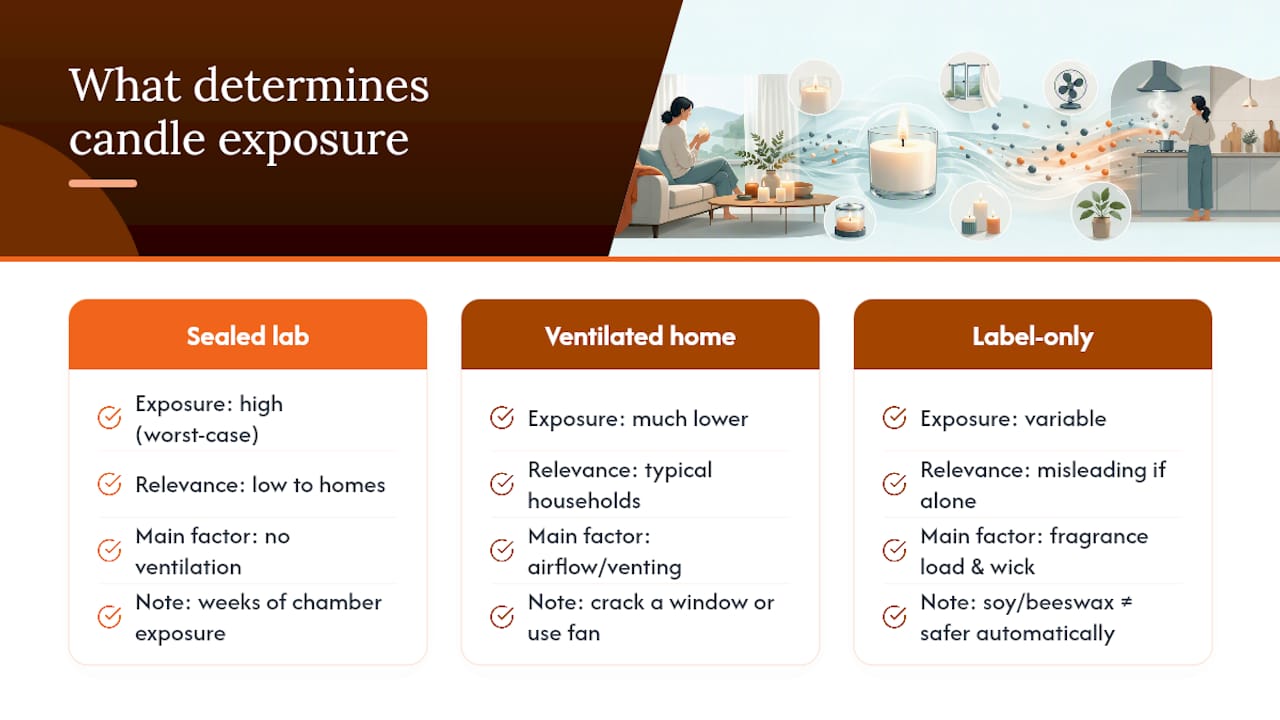
What gets underestimated is how much ventilation alone changes the equation. Most of the fear around candle chemicals assumes a sealed box with no airflow, which describes almost no real household. Crack a window, don’t run six candles in a bathroom with the fan off, and the exposure math looks nothing like the worst-case lab scenarios that circulate on social media.
The flip side matters too: “natural” and “clean” labels get thrown around without much scrutiny, and soy or beeswax alone doesn’t guarantee a safer candle if the fragrance load is heavy or the wick is wrong for the vessel. Formulation and burn habits do more work than the marketing copy on the jar.
— B
This article is general information, not a substitute for advice from a qualified doctor. Consult a qualified healthcare professional about your own circumstances before acting on anything here.
Sources
Recommended


