Transitional home scenting means blending fresh and warm fragrance notes in a deliberate ratio so your home’s scent shifts gradually between seasons rather than flipping abruptly. A simple starting point: combine a warm note like sandalwood with several fresh notes such as citrus, bergamot, light musk, and green tea to ease from summer into fall. That ratio keeps the space feeling airy while the sandalwood base signals something cozier is coming.
Table of Contents
What is transitional home scenting, and why does it matter?
Scentscaping treats fragrance as an intentional design element, the same way you’d choose lighting or furniture. Transitional scenting is the seasonal application of that idea: instead of switching from a bright citrus candle to a heavy pumpkin spice overnight, you layer notes that carry emotional weight from one season into the next. The result feels intentional rather than jarring.
The benefits are practical, not just aesthetic:
-
Smoother mood transitions. Scent is closely tied to memory and emotional state. A blend that bridges summer brightness with fall warmth helps your nervous system ease into the new season rather than resist it.
-
Better scentscaping across open floor plans. A single heavy scent in an open-plan home can overwhelm. A transitional blend with measured projection fills the space without dominating it.
-
Support for zoned behaviors. Scent can define task-based zones — eucalyptus or sandalwood in a home office trains the brain to associate that scent with focus, while a softer blend in the living area signals rest.
-
Flexibility during unpredictable weather. A transitional scent with a citrus or green opening and a warm woody base performs well whether it’s 65°F or 85°F outside.
Common use cases: summer-to-fall evenings when the temperature drops after 7 PM, late-winter-to-spring thaws when you want something lighter but not yet floral, and holiday-prep weeks when you need warmth without going full cinnamon-overload.
Which scent families and notes work for each season?
Every season has a dominant note family. The trick with transitional blending is finding the notes that sit comfortably between two families.
| Season |
Typical Notes |
Bridge Notes |
| Spring |
Peony, lily of the valley, green tea, fresh lemon |
Lavender, light amber, fig |
| Summer |
Grapefruit, bergamot, cucumber, coconut, sea salt |
White musk, soft cedar, vetiver |
| Fall |
Sandalwood, amber, clove, apple, cinnamon |
Soft amber, fig, light vanilla |
| Winter |
Pine, cedarwood, frankincense, cranberry, peppermint |
White musk, vetiver, light woods |
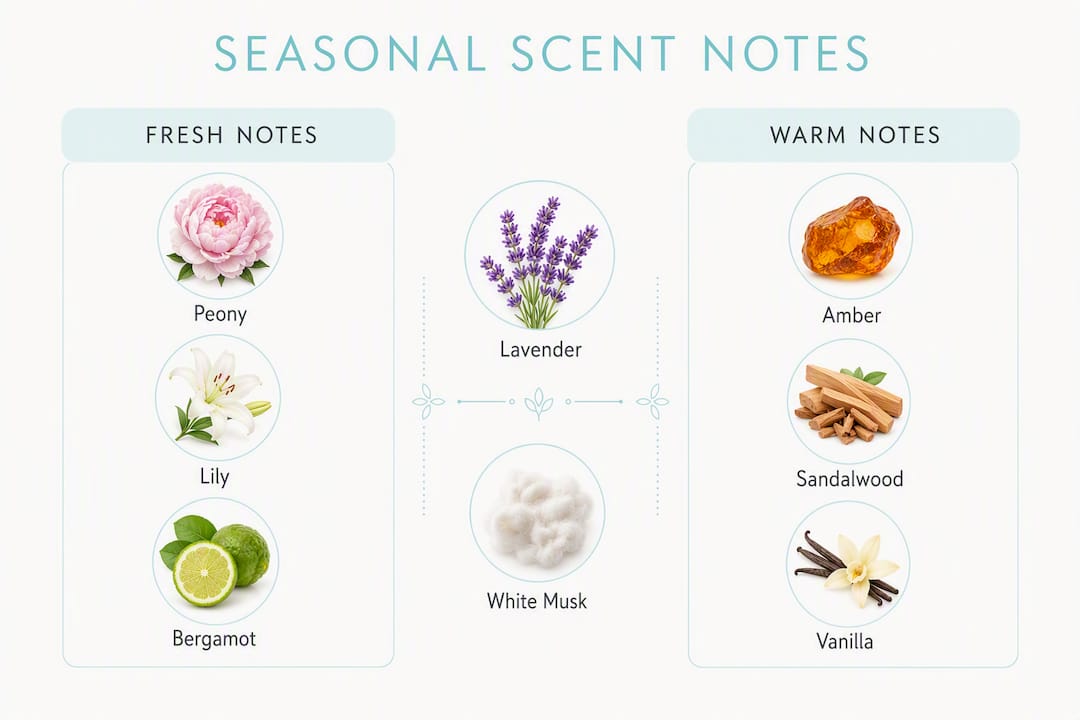
Bridge notes are the real workhorses here. Lavender reads as fresh in summer and calming in fall. White musk sits behind almost any combination without pulling it in one direction. Fig, vetiver, and soft cedar are similarly neutral — they add depth without committing to a single season.

Reliable anchor notes for transitions include white musk, lavender, peony, moderate ambers, and soft woods. A pairing like grapefruit + sandalwood works precisely because the grapefruit reads as summer while the sandalwood reads as fall, and neither cancels the other out.
Current 2026 fragrance trends lean toward botanical, fresh notes — fig, bay and rosemary, cucumber and mint. Including one of these as a middle note keeps a transitional blend feeling current without dating it.
Pro Tip: When choosing a bridge note, smell it alone first. If it reminds you strongly of one specific season, it’s not a bridge — it’s an anchor. True bridge notes feel almost seasonless on their own.
Three ratio patterns cover most situations:
-
1:4 (light lift) — 1 warm note to 4 fresh notes. Best for early-season transitions when the weather is still mostly warm. The warm note is barely perceptible but prevents the blend from feeling flat.
-
1:5 (very fresh with a whisper of warmth) — useful for late summer when you want a hint of fall without committing. Think bergamot, cucumber, green tea, white musk, and a touch of soft amber.
-
3:4 (balanced blend) — 3 warm notes to 4 fresh notes. The go-to for mid-transition, when the season has genuinely shifted but you’re not ready for full winter depth.
Four ready-to-use recipes
Recipe 1 — Summer into Fall (1:4)
Fresh notes: bergamot, grapefruit, green tea, white musk. Warm note: sandalwood. Use in the living room as an evening candle or reed diffuser.
Recipe 2 — Deep Fall (3:4)
Warm notes: amber, soft vanilla, cedarwood. Fresh notes: fig, lavender, bergamot, light musk. Works well as a bedroom candle or electric diffuser blend.
Recipe 3 — Winter into Spring (1:4)
Fresh notes: lemon, peony, green tea, white musk. Warm note: light amber. Ideal as a room spray for hallways and bathrooms.
Recipe 4 — Late Spring into Summer (1:5)
Fresh notes: cucumber, bergamot, grapefruit, coconut, sea salt. Warm note: vetiver. Best as a linen spray or light reed diffuser in a bedroom.
-
Candles: ratios hold as-is; the wax slows diffusion, so warm notes read more prominently over time.
-
Reed diffusers: reduce warm notes by one unit in the ratio — the continuous diffusion amplifies base notes.
-
Room sprays: increase fresh notes slightly; sprays evaporate fast, so the warm base needs less weight to register.
-
Linen sprays: keep ratios light (1:5 or 1:4); fabric holds scent longer, so heavy bases can become overpowering by morning.
Pro Tip: Before committing to a full candle or diffuser, test your blend in a small spray bottle first. Spritz once on a cotton pad, leave it in the room for 30 minutes, and come back with fresh air in your nose. That’s closer to how a candle will read after an hour of burn time.
How to apply transitional scents room by room
The format you choose matters as much as the blend itself. Designers recommend matching format to room size and purpose: diffusers for constant background scent, candles for focal ambiance.
Living room
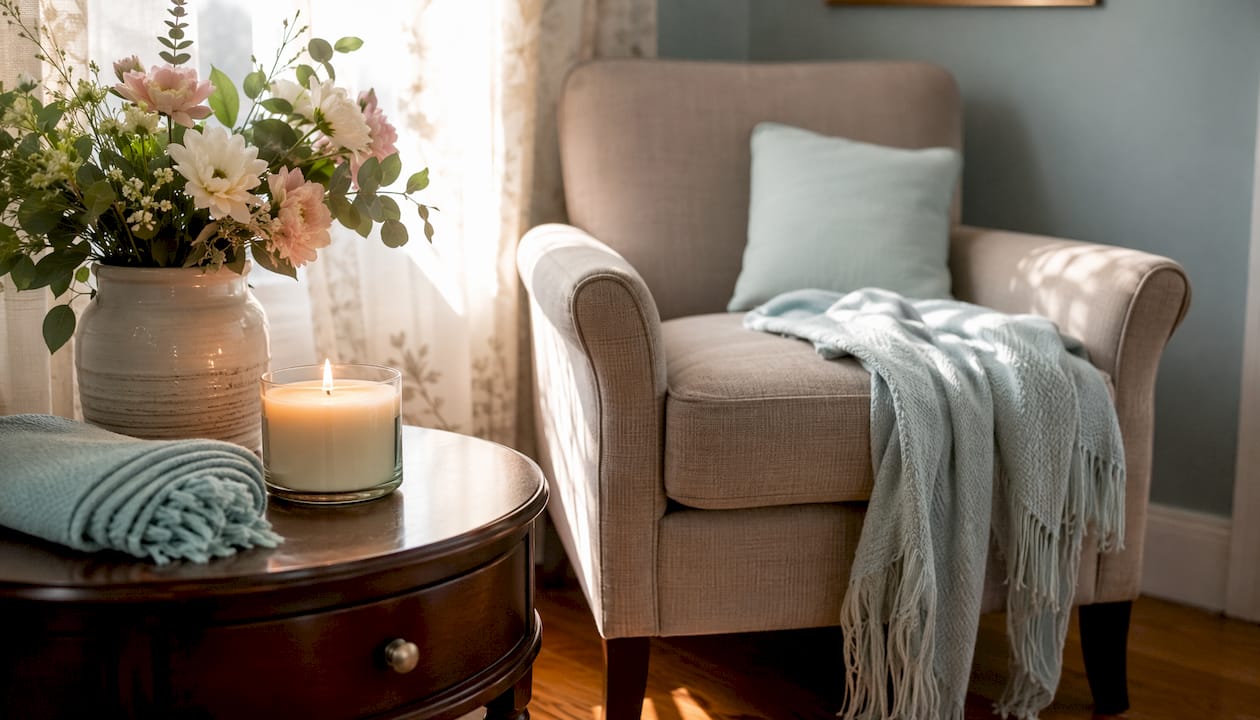
This is your anchor space. A candle works best here because the flickering flame adds visual warmth that reinforces the seasonal shift. Use a 3:4 balanced blend for fall evenings, or a 1:4 light-lift blend for late summer. Intensity: medium. Place the candle on a coffee table or side table, not near an air vent.
Bedroom
Keep it soft. A reed diffuser or linen spray at 1:4 or 1:5 ratio lets the scent stay present without interrupting sleep. Linen sprays are particularly effective here — a light mist on pillowcases before bed creates a consistent scent experience without any flame or plug-in.
Entry and hallway
This is your bridge zone. Professional scent architecture uses neutral bridge notes in hallways to link warmer and lighter room scents. A reed diffuser with white musk or soft cedar works well. Keep intensity low — the hallway scent should feel like a transition, not a destination.
Home office
Scent here should support focus. Eucalyptus, sandalwood, or a light cedar blend signals work mode. A small electric diffuser gives you control over intensity and timing. Avoid heavy food-centric notes (vanilla, cinnamon) in this space — they signal comfort and rest, which works against concentration.
Bathroom
Small space, high humidity. A single-note reed diffuser or a light room spray is enough. Fresh notes (citrus, green tea, cucumber) work best. Avoid heavy ambers or musks — humidity amplifies base notes and they can quickly feel suffocating.
What mistakes do people make with transitional scenting?
The most common error is overloading. Lighting three candles in an open-plan space and running a diffuser simultaneously creates competing scents that cancel each other out rather than layering. One format per zone is the professional standard.
The second mistake is leaning too hard on food-centric notes. Design professionals warn against relying only on predictable seasonal food aromas — pumpkin, cinnamon, apple pie. Pairing citrus with amber or woods creates depth and sophistication that single-season food notes can’t match.
A few more patterns worth avoiding:
-
Skipping temperature testing. A blend that smells balanced at room temperature can read as overwhelming at 80°F. Test your blend on a warm afternoon before committing to a full candle.
-
Ignoring projection. A transitional scent should have measured projection — noticeable when you enter a room, not detectable from the street.
-
Scenting every room. Leaving some rooms intentionally unscented improves perceived luxury and makes scented rooms feel more deliberate.
Pro Tip: Run a “fresh nose” test. Leave your home for 20 minutes, then walk back in through the front door. What you smell in the first 10 seconds is what guests experience. If it’s too strong, reduce by one format (remove the diffuser, keep the candle).
Strategic layering — rotating product types or using a neutral base — outperforms masking. On warmer days, skip the base layer entirely; on cooler days, add it back to maintain balance and longevity.
What you need to know about safety and scent longevity
Basic safety
Trim candle wicks to ¼ inch before each burn to prevent soot and uneven melting. Never burn a candle for more than 4 hours at a stretch. For diffusers, keep them away from direct sunlight and heat sources — both accelerate evaporation and can alter the scent profile. Ventilate rooms with pets or allergy sufferers; even clean fragrances can irritate sensitive respiratory systems.
What to look for on labels
Clean formulations avoid phthalates, parabens, and synthetic dyes. Vegan formulas skip beeswax and animal-derived musks. Wickandglow’s entire line is made with clean, vegan, phthalate-free ingredients — a straightforward signal that the formulations meet these standards without requiring you to decode a chemistry label.
| Format |
Typical Lifespan |
Tips to Extend |
| Soy candle (8 oz) |
— |
Trim wick, burn 2–3 hours at a time |
| Reed diffuser (7 oz) |
3–4 months |
Flip reeds weekly, keep away from AC vents |
| Electric diffuser |
Continuous (refill-based) |
Use intermittent cycles (30 min on, 30 off) |
| Room spray |
— |
Cap tightly, store away from heat and light |
Store unused fragrance products in a cool, dark place. Heat and UV exposure degrade both the scent compounds and the carrier oils, shortening effective life significantly.
Key Takeaways
Transitional home scenting works best when you anchor each room with one format, use a neutral bridge note in hallways, and test your blend at actual room temperature before committing to a full product.
| Point |
Details |
| Start with a 1:4 ratio |
One warm note to four fresh notes gives a light, season-bridging blend for early transitions. |
| Use bridge notes in hallways |
White musk, soft cedar, or vetiver in the entry zone links warmer and lighter room scents naturally. |
| Match format to room size |
Candles for living rooms, reed diffusers for bedrooms and hallways, sprays for bathrooms. |
| Test before committing |
Spray a small decant on a cotton pad and evaluate after 30 minutes before buying a full candle. |
| Wickandglow for clean testing |
The Scenting My Love Trio lets you sample multiple transitional profiles with clean, phthalate-free formulas. |
The part most guides skip
Most seasonal scenting advice treats the transition as a problem to solve — get rid of the summer scent, bring in the fall one. That framing misses what makes a home feel genuinely alive. The overlap is the point.
The best-smelling homes I’ve encountered don’t smell like a season. They smell like a moment — the specific feeling of a late-August evening when the air is still warm but something in it has already shifted. That’s what a well-built transitional blend captures, and it’s not accidental. It requires choosing notes that hold tension between two emotional states rather than resolving into one.
The conventional advice to “go heavier in fall, lighter in summer” is technically correct but creatively limiting. A grapefruit and sandalwood blend in October is more interesting than straight amber, and it will read as sophisticated rather than predictable. Pairing unconventional notes — citrus with amber or woods — creates depth that single-season food notes simply can’t match.
The other thing guides consistently undervalue: silence. An unscented room next to a beautifully scented one makes both feel more intentional. You don’t need to fill every cubic foot of your home with fragrance. You need to place it where it earns its keep.
Wickandglow makes transitional scenting easy to test
Knowing the ratios is one thing. Having the right products to test them is another. Wickandglow’s hand-poured soy candles, reed diffusers, and room sprays are all made with clean, vegan, phthalate-free ingredients — so you’re not introducing harsh synthetic compounds while experimenting with new blends.

Each product pairs with a curated R&B playlist, which means the sensory experience extends beyond scent. The Scenting My Love Trio is the practical starting point for anyone building a transitional fragrance wardrobe: three distinct profiles in one set, sized for testing before you commit to a full candle. If you already know you want a signature transitional candle for your living room, the Exhale Luxury Candle is a strong first choice. Browse the full collection at wickandglow.com and find the blend that fits your season.
Useful sources
These sources informed the blending formulas, scentscaping guidance, and safety notes throughout this guide:
-
Scentscaping | Vogue — The foundational piece on treating fragrance as intentional interior design, including zone-based scenting and anchor-note strategy.
-
LAFCO Scentscape Guidance — Professional scent architecture advice, specifically the hallway bridge-note concept for linking room scents.
-
How to Make Your Home Smell Like Fall | Architectural Digest — Designer recommendations for unconventional note pairings (citrus with amber, woods) that create depth beyond food-centric fall scents.
-
Natural Home Fragrance Trends 2026 | Parkminster — Current demand trends toward botanical and fresh notes (fig, bay and rosemary, cucumber and mint) useful for modern bridge note selection.
-
5 Tips for Rotating Fragrances by Season | Scento — Practical layering advice and the dual-personality structure of transitional scents (fresh top notes, warm bases).
-
Scentscaping 101 | AOL — Format-to-room matching guidance and the case for leaving some rooms intentionally unscented.
-
Transitional Scents: Winter to Spring | No Blind Buys — Anchor note lists and the layering-by-temperature method for adjusting blend intensity seasonally.
-
One Scent, One Season | Sunflowers and Stories — Accessible seasonal ritual framework (candle + diffuser + greenery) for readers who want a manageable starting setup.
Recommended


